

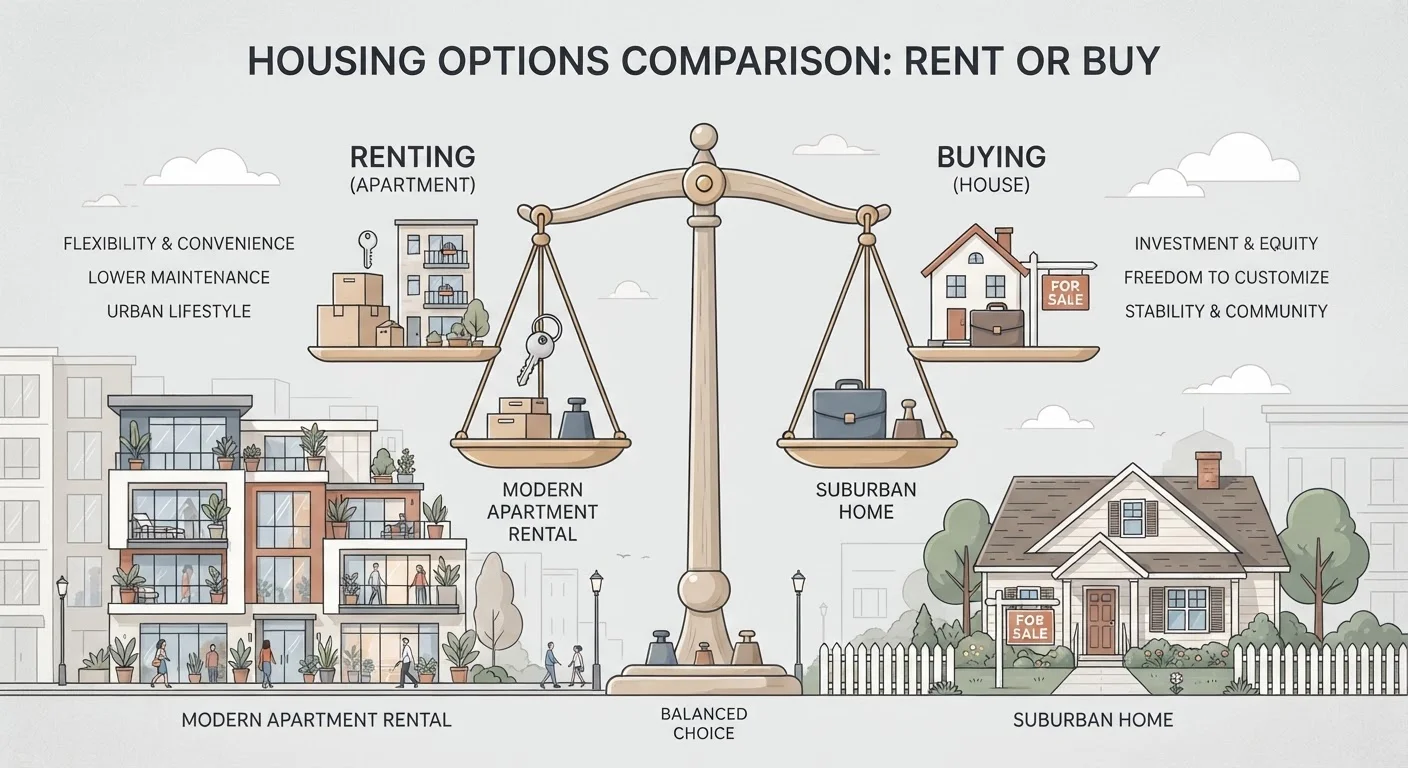
Key Takeaways
Our Verdict
Buying a home makes financial sense when you plan to stay in one place for several years, have stable income, and can manage upfront and ongoing costs. Renting is often the smarter move for those who value flexibility, are early in their careers, or live in high-cost markets where purchase prices far outpace rents. Neither path guarantees a better outcome - individual circumstances are the deciding factor.
| Best for | Recommended |
|---|---|
| Those with stable income who plan to stay long-term | Buying |
| Those prioritizing mobility or in high-cost markets | Renting |
| First-time decision-makers with limited savings | Renting (while saving) |
| Those ready to build long-term wealth through real estate | Buying |
The Core Trade-Off: Flexibility vs. Equity
At its simplest, renting gives you the right to occupy a home without owning it; buying transfers legal ownership along with all its financial implications. But the real comparison is more layered than that framing suggests.
Renters typically pay a fixed monthly amount with fewer surprise expenses - appliance breakdowns, roof repairs, and structural issues are generally the landlord's responsibility. That predictability has genuine value, particularly for those with tighter budgets or unpredictable income. For a broader look at the renting experience from start to finish, see The Full Lifecycle of a Rental.
Homeowners build equity - the portion of the home's value they actually own outright - as they pay down their mortgage. Over time, that equity can become a meaningful financial asset. However, it comes alongside property taxes, homeowners insurance, and maintenance costs that can add 1-3% of a home's value annually, according to commonly cited estimates from housing research organizations.
| Renting | Buying | |
|---|---|---|
| Upfront costs | Low (deposit + first month) | High (down payment + closing costs) |
| Monthly cost predictability | Generally stable; rent may increase | Variable (taxes, maintenance, repairs) |
| Equity building | None | Yes, over time |
| Flexibility to relocate | High (lease-term dependent) | Low (selling takes time and money) |
| Maintenance responsibility | Typically landlord's responsibility | Entirely owner's responsibility |
| Customization freedom | Limited by landlord rules | Full control |
| Tax considerations | No direct deductions | Potential mortgage interest deductions |
The Financial Arithmetic: Upfront Costs and the Break-Even Point
Buying requires substantial upfront capital. A conventional mortgage typically requires a down payment of 5-20% of the purchase price, plus closing costs that generally run 2-5% of the loan amount. On a $400,000 home, that could mean $20,000-$80,000 needed before you turn the key.
Renting demands far less to start - typically a security deposit and first month's rent. That lower barrier means saved capital can potentially be invested elsewhere, though whether investment returns would outpace home price appreciation depends heavily on market conditions and individual choices. For context on how to think about long-term financial trade-offs, asset allocation principles can help frame the comparison.
The break-even point - the number of years you'd need to own a home before buying becomes cheaper than renting - varies significantly by market. In some cities, it may be as few as three years; in high-cost coastal markets, it can stretch beyond a decade. If there's any chance you'll relocate sooner, buying carries real financial risk. For more on how market timing affects this calculation, see Renting vs. Buying During a Shifting Market.
~5 years
Typical break-even timeline for buying
Housing economists commonly estimate that homeowners need roughly five or more years to recoup transaction costs, though this varies widely by local market.
1-3%
Annual maintenance cost as share of home value
Housing research organizations frequently cite this range as a planning benchmark for ongoing homeowner maintenance and repair expenses.
Lifestyle Factors That Often Tip the Decision
Financial modeling alone rarely settles this question. Life circumstances matter just as much - sometimes more.
Job stability and mobility: If your career might require relocation within the next few years, or you're in an industry with variable income, the transaction costs of buying and selling a home quickly can easily wipe out any equity gained.
Family and space needs: Growing families often value the stability, school district continuity, and physical space that ownership typically provides. Renters may face lease non-renewals that force moves at inconvenient times.
Control over the space: Owners can renovate, repaint, and customize freely. Renters are generally subject to landlord approval for modifications. For those exploring what homeownership customization actually involves, open-concept renovation trade-offs illustrate the complexity involved.
If you want a deeper framework for thinking through all of these personal dimensions together, Renting vs. Buying: How to Think Through the Decision for Your Own Life offers a structured approach.
Run the Numbers for Your Local Market
National averages rarely capture what's true in your specific city or neighborhood. Before deciding, compare local rent prices to equivalent purchase prices and estimate how long you'd realistically stay. Many nonprofit housing counselors and HUD-approved agencies offer free or low-cost guidance to help you work through this calculation with your actual numbers.
Taking the Next Step in Either Direction
If buying is on your horizon, understanding the full process reduces anxiety and helps you prepare financially. The Homebuying Process, Start to Finish breaks down each stage - from saving for a down payment through closing day. When you're ready to explore mortgage options, Fixed-Rate vs. Adjustable-Rate Mortgages explains the structural differences between loan types.
If renting remains the right fit, it helps to separate fact from fiction. Many common assumptions about renting - that it's "throwing money away" or that landlords have unlimited access rights - don't hold up. The Mythology Around Renting addresses those misconceptions directly. And if you're evaluating a specific rental, Furnished vs. Unfurnished Rentals covers trade-offs that go well beyond monthly price.
This article provides general educational information about housing decisions and is not financial, legal, or real estate advice. Individual circumstances vary significantly. Consult a licensed real estate professional, financial adviser, or attorney before making major housing decisions.