

Key Takeaways
Our Verdict
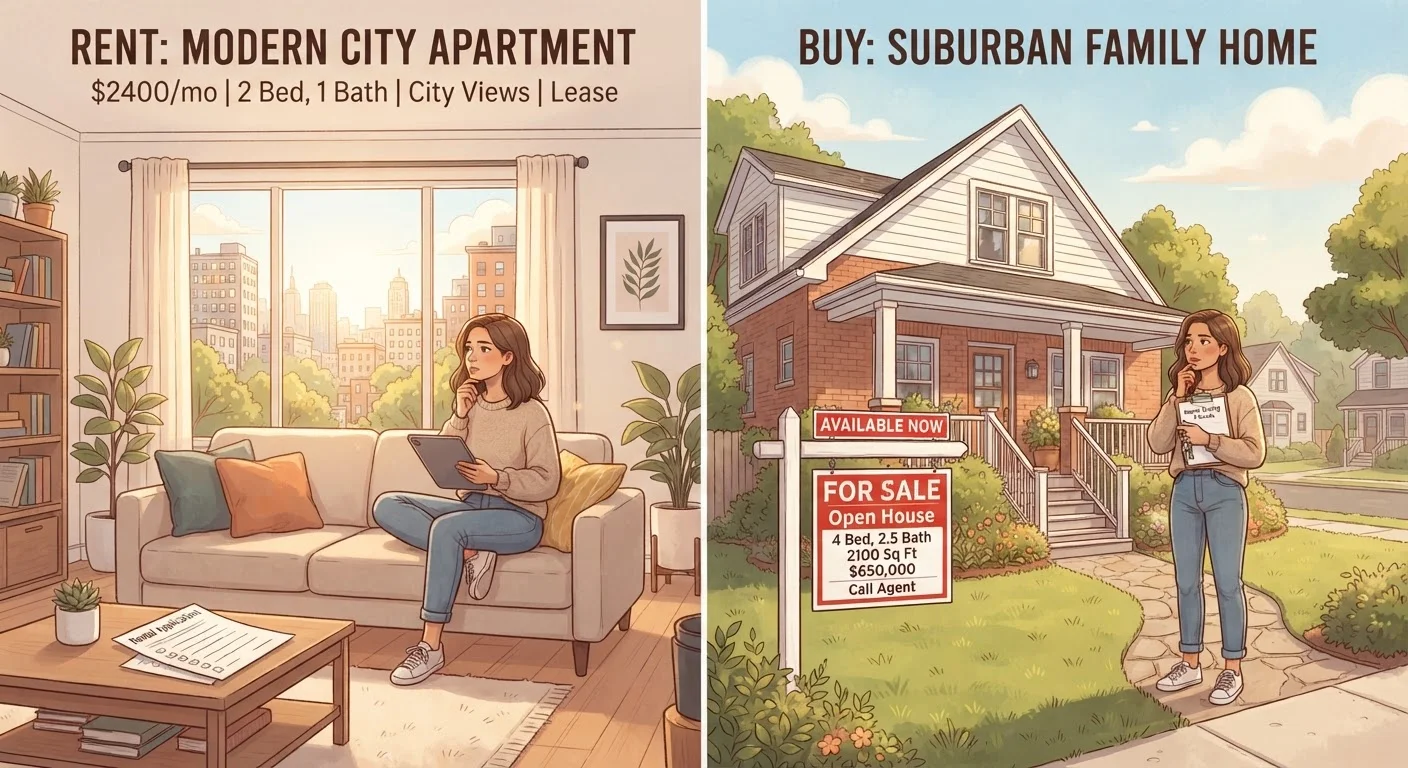
Renting and buying serve genuinely different needs, and both can be financially sound choices depending on your circumstances. Buying tends to make more sense for those with stable long-term plans, sufficient savings, and a local market where purchase prices are reasonable relative to rents. Renting is the smarter move when flexibility matters, when upfront capital is limited, or when the math in your market simply doesn't favor ownership.
| Best for | Recommended |
|---|---|
| Those with stable income, long-term local ties, and sufficient savings for a down payment and reserves | Buying |
| Those who prioritize mobility, are early in their career, or are in a high-cost market with elevated price-to-rent ratios | Renting |
| Those navigating uncertain income, variable job location, or major life transitions | Renting |
| Those ready to put down roots and build long-term wealth through forced savings and equity accumulation | Buying |
Why This Decision Is More Personal Than Financial
The renting vs. buying question gets framed as a financial calculation more often than it should. While numbers matter, the decision also turns on factors that can't be plugged into a spreadsheet: how certain you are about where you'll live in five years, whether you want the responsibilities of homeownership, and what stability actually means to you.
Neither path is inherently superior. Renting is not "throwing money away" - it buys you housing, flexibility, and freedom from maintenance costs. Buying is not always wealth-building - it carries significant costs and risks that depend heavily on how long you stay and what happens to local property values. For a deeper look at how market conditions shape this choice, see how shifting market conditions affect the rent-or-buy decision.
Starting with an honest assessment of your life stage and priorities - before running any numbers - will make the financial analysis far more meaningful.
The Real Costs on Each Side
Comparing a monthly rent payment to a mortgage payment is an incomplete analysis. Each path carries costs that are easy to undercount.
True costs of renting
- Monthly rent (which may increase at lease renewal)
- Renter's insurance - generally modest, but required by most landlords
- Moving costs if you relocate between leases
True costs of buying
- Down payment - typically 3-20% of the purchase price
- Closing costs - generally 2-5% of the loan amount, due upfront
- Mortgage principal and interest
- Property taxes - vary widely by location, often 1-2% of assessed value annually
- Homeowner's insurance and, if applicable, PMI (private mortgage insurance, required when the down payment is below 20%)
- Maintenance and repairs - a commonly cited rule of thumb is budgeting 1% of the home's value per year, though actual costs vary considerably
- HOA fees, if applicable
When you add these together, owning is frequently more expensive on a monthly cash-flow basis than renting a comparable home - at least in the early years.
| Renting | Buying | |
|---|---|---|
| Upfront costs | Security deposit + first month | Down payment + closing costs (5-25% of price) |
| Monthly cash flow | Often lower, predictable | Often higher when all costs included |
| Equity building | None directly | Yes, gradually over time |
| Flexibility to relocate | High - lease-bound, not asset-bound | Low - selling takes time and money |
| Maintenance responsibility | Landlord handles most repairs | Owner bears all costs |
| Exposure to market risk | Rent increases at renewal | Property value fluctuations |
| Customization freedom | Limited by lease terms | Full control of property |
| Best holding period | Short to medium term | Typically 5+ years to break even |
The Price-to-Rent Ratio: A Local Market Lens
One useful tool for evaluating whether buying makes financial sense in your area is the price-to-rent ratio. It's calculated by dividing the median home purchase price by the annual median rent for a comparable property.
A ratio below 15 generally suggests buying may offer better value. A ratio above 20 tends to favor renting, since purchase prices are high relative to what you'd pay to rent. Many high-cost metro areas carry ratios well above 25, meaning renters can often invest the difference in costs and potentially come out ahead - though this depends on investment returns and individual circumstances.
How to Run a Quick Price-to-Rent Check
Find the median sale price of homes comparable to what you'd rent in your target neighborhood. Divide that by 12 months of rent for a similar unit. For example, a $400,000 home with comparable rent of $1,800/month yields a ratio of about 22 - generally favoring renting in that market. Use this as a directional signal, not a final answer, and factor in your personal timeline and finances.
This ratio is a starting point, not a verdict. Your personal holding period - how long you plan to stay - is equally important. Transaction costs mean buyers typically need several years just to break even versus renting.
Flexibility vs. Stability: The Lifestyle Calculus
Financial analysis aside, renting and buying deliver fundamentally different lifestyles. Renting generally offers:
- The ability to relocate without the friction of selling a home
- No exposure to unexpected repair costs
- Predictable short-term housing costs
Buying typically provides:
- Long-term housing stability and protection from landlord decisions
- Freedom to customize your space
- Equity accumulation over time as the mortgage is paid down
- A hedge against future rent increases in your local market
If your career, family situation, or personal goals are in flux, the flexibility of renting has real financial value - even if it doesn't show up neatly in a comparison chart. If you're planning to stay in a community long-term and value the autonomy that comes with ownership, buying can offer both financial and emotional returns.
For those currently renting and weighing their options, understanding the full rental lifecycle can help you make the most of your lease regardless of your long-term plans.
Questions to Ask Before You Decide
Before treating this as purely a math problem, work through these questions honestly:
- How long do I plan to stay? Buying typically requires a minimum of five to seven years to recoup transaction costs and begin building meaningful equity.
- How stable is my income? A mortgage is a long-term obligation. Variable income, job uncertainty, or potential career changes all affect how much risk you can responsibly take on.
- Do I have adequate savings? Beyond the down payment, buyers need reserves for closing costs, moving, and the inevitable early repairs.
- What does my local market look like? Home prices, rent levels, property tax rates, and inventory all vary dramatically by city and neighborhood.
- Am I ready for the responsibilities of ownership? Maintenance, repairs, and managing a property are time and energy commitments, not just financial ones.
There's no universally correct answer to this decision. For readers thinking about what comes next if they do decide to buy, the homebuying process overview covers the key steps and concepts worth understanding before you start. For those staying in rentals for now, furnished vs. unfurnished rental trade-offs is worth a read when evaluating your next unit.
This article is for general informational and educational purposes only and does not constitute financial, legal, or investment advice. Real estate decisions involve complex variables specific to your situation, local market, and financial circumstances. Consult a licensed real estate professional, financial adviser, or attorney before making any housing decision.