

Key Takeaways
Why Coverage Maps Are Built for Marketing, Not Navigation
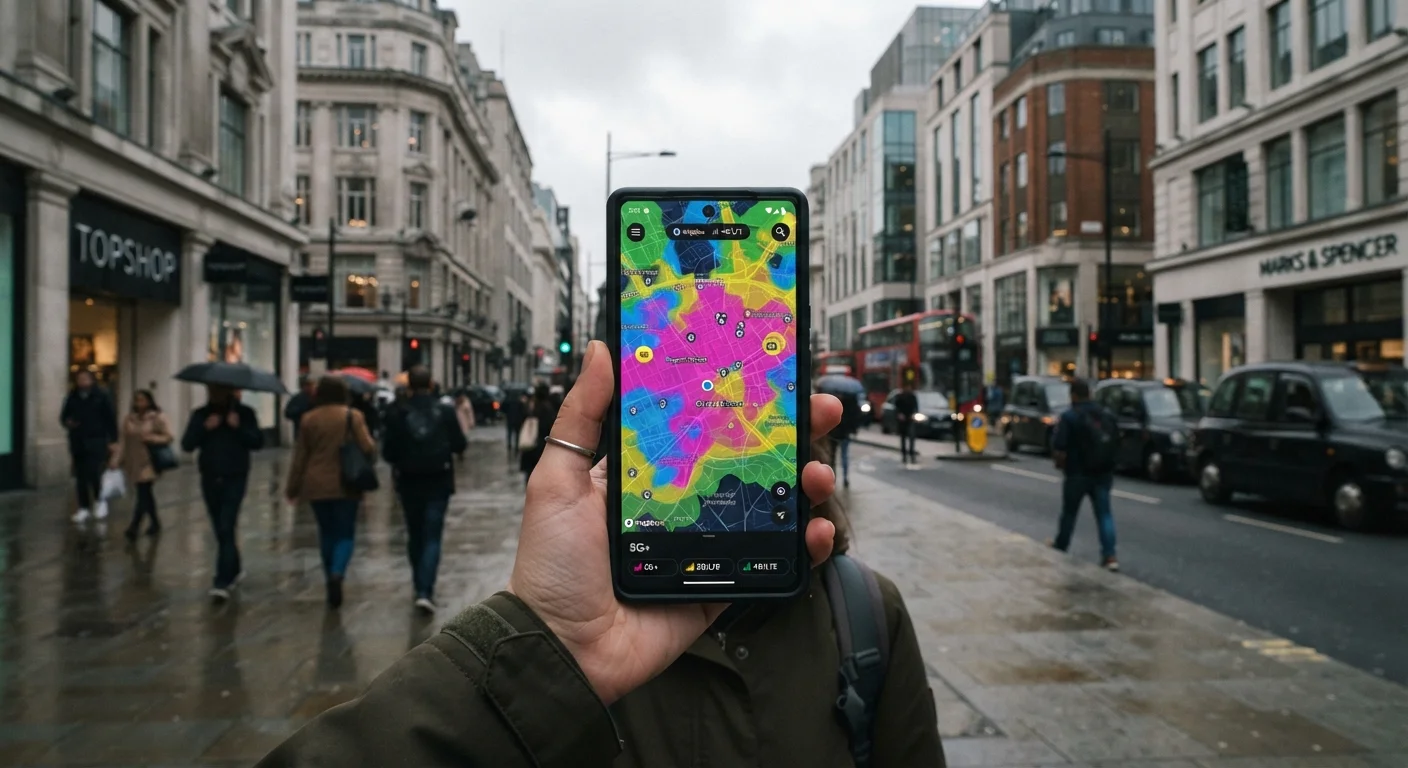
Every major carrier publishes a coverage map showing vast swaths of the country blanketed in 5G. Zoom out far enough and the country looks nearly fully covered. Zoom in on your neighborhood, and the picture gets complicated fast.
Maps are generated using signal propagation models - software that predicts where a tower's signal should theoretically reach given terrain, tower height, and transmit power. What those models don't account for: dense foliage, building materials like concrete and low-e glass, underground spaces, or the difference between standing on a rooftop versus being inside a basement apartment. Carriers are also not required to define a uniform signal threshold for what counts as "covered," which means a location labeled 5G on one map might show no usable data connection in practice.
Independent testing firms regularly find significant gaps between mapped coverage and measured performance. The FCC has acknowledged shortcomings in carrier-reported coverage data and has pushed for more verified, on-the-ground measurements in recent years. For a broader look at how connection type affects real-world performance, see this guide to connection types by location.
Myth
If the map shows 5G at my address, I'll get 5G speeds.
Fact
Map coverage indicates theoretical signal reach, not guaranteed throughput. Indoor environments, congestion, and device capability all affect what you actually receive.
Coverage maps use predictive modeling. A tower's modeled signal footprint may technically reach your address, but building materials - especially concrete, brick, and energy-efficient glass - can reduce signal strength enough that your phone falls back to LTE. Even when a 5G connection is maintained, heavy network congestion during peak hours can reduce real-world speeds to LTE-equivalent levels or lower.
Myth
Seeing '5G' in your phone's status bar means you're on a fast 5G network.
Fact
The 5G icon reflects the network type your phone has connected to, not the speed you're receiving at that moment.
Some carriers have displayed a "5GE" or similar indicator for enhanced LTE, not true 5G. Even on genuine 5G, the icon doesn't distinguish between low-band 5G (speeds close to good LTE) and mid-band 5G (noticeably faster). Network congestion, your distance from the tower, and whether you're indoors all shape actual throughput regardless of what the status bar shows.
Myth
5G coverage maps from different carriers can be directly compared.
Fact
Carriers use different signal thresholds, frequency bands, and modeling assumptions, making their maps effectively incomparable on a like-for-like basis.
There is no industry-wide standard requiring a consistent minimum signal strength to call an area "covered." One carrier might label a zone 5G based on a strong mid-band signal; another might include fringe low-band coverage that barely exceeds LTE performance. The FCC's ongoing work to improve coverage data reporting reflects how problematic self-reported maps have been for both regulators and consumers.
Myth
5G mmWave will soon blanket cities, replacing the need for Wi-Fi indoors.
Fact
mmWave's severe range and penetration limits make city-wide indoor coverage physically impractical with current technology.
mmWave frequencies above 24 GHz attenuate rapidly - they can be blocked by a single pane of glass or a human body. Providing continuous indoor mmWave coverage would require deploying hardware at extremely short intervals (every few meters in some environments), which is economically and logistically infeasible at city scale. Sub-6GHz 5G extends indoor coverage, but it doesn't match the multi-gigabit promise of mmWave. For most households, a solid home Wi-Fi setup remains essential - see tips on optimizing your home Wi-Fi.
Myth
A newer phone automatically gets better 5G coverage.
Fact
5G performance depends on which spectrum bands your device supports, not just whether it's labeled '5G capable.'
5G-capable phones vary in which frequency bands they support. A device that only handles low-band 5G will never connect to a carrier's mid-band or mmWave network, even in areas where those signals exist. Before assuming an upgrade will improve your experience, checking the device's documented band support against your carrier's deployed spectrum is more informative than relying on marketing language. Common myths about internet speed covers related misconceptions about performance expectations.
Sub-6GHz vs. mmWave: The Spectrum Gap That Changes Everything
Not all 5G signals are the same, and that distinction matters more than the "5G" label on your screen.
Sub-6GHz 5G (also called "mid-band" or "low-band" 5G, depending on exact frequency) travels farther and passes through walls reasonably well. It delivers meaningful speed improvements over 4G LTE - often 100-300 Mbps in real-world conditions - and covers most areas where carriers claim broad 5G deployment.
mmWave 5G (millimeter wave, above 24 GHz) is a different beast. It can theoretically deliver multi-gigabit speeds, but its signal degrades sharply with distance and is blocked by almost anything solid - a window, a hand, a tree. Practical mmWave coverage is limited to small outdoor hot spots in dense urban areas, stadiums, and transit hubs. Walk half a block or step indoors and you drop back to sub-6GHz or LTE.
~300m
Typical outdoor mmWave effective range
Industry technical analyses generally place practical mmWave 5G coverage at under 300 meters from a node in ideal outdoor conditions, with rapid degradation through obstacles.
sub-6GHz
Spectrum behind most U.S. 5G connections
The majority of 5G connections in the U.S. run on sub-6GHz spectrum, which trades peak speed for broader geographic reach and building penetration.
When a carrier advertises peak 5G speeds, those figures usually reflect mmWave lab or ideal outdoor conditions - not what most subscribers experience daily. If you want to understand why your actual connection rarely matches advertised numbers, this breakdown of real vs. advertised speeds explains the gap.
Common Myths - and What's Actually True
Carrier messaging and tech press coverage have created a set of durable misconceptions about 5G. Here's what independent analysis and documented network behavior actually show.
Don't Rely on Carrier Maps Alone
Before choosing or switching a plan based on 5G coverage, consult independent speed-test aggregators and crowd-sourced coverage tools that reflect actual measured performance rather than modeled predictions. Carrier maps are a starting point, not a guarantee. If reliable data service at a specific location - your home, workplace, or regular commute - is important to you, on-the-ground testing with a trial SIM or a return-window purchase is more informative than any map.
If you're evaluating a plan partly on 5G access, checking crowd-sourced speed-test databases for your specific address or commute route gives a far more reliable signal than any carrier map. What wireless carriers don't say in their ads covers related fine-print issues worth reading before you sign up.