

Key Takeaways
Asset Allocation
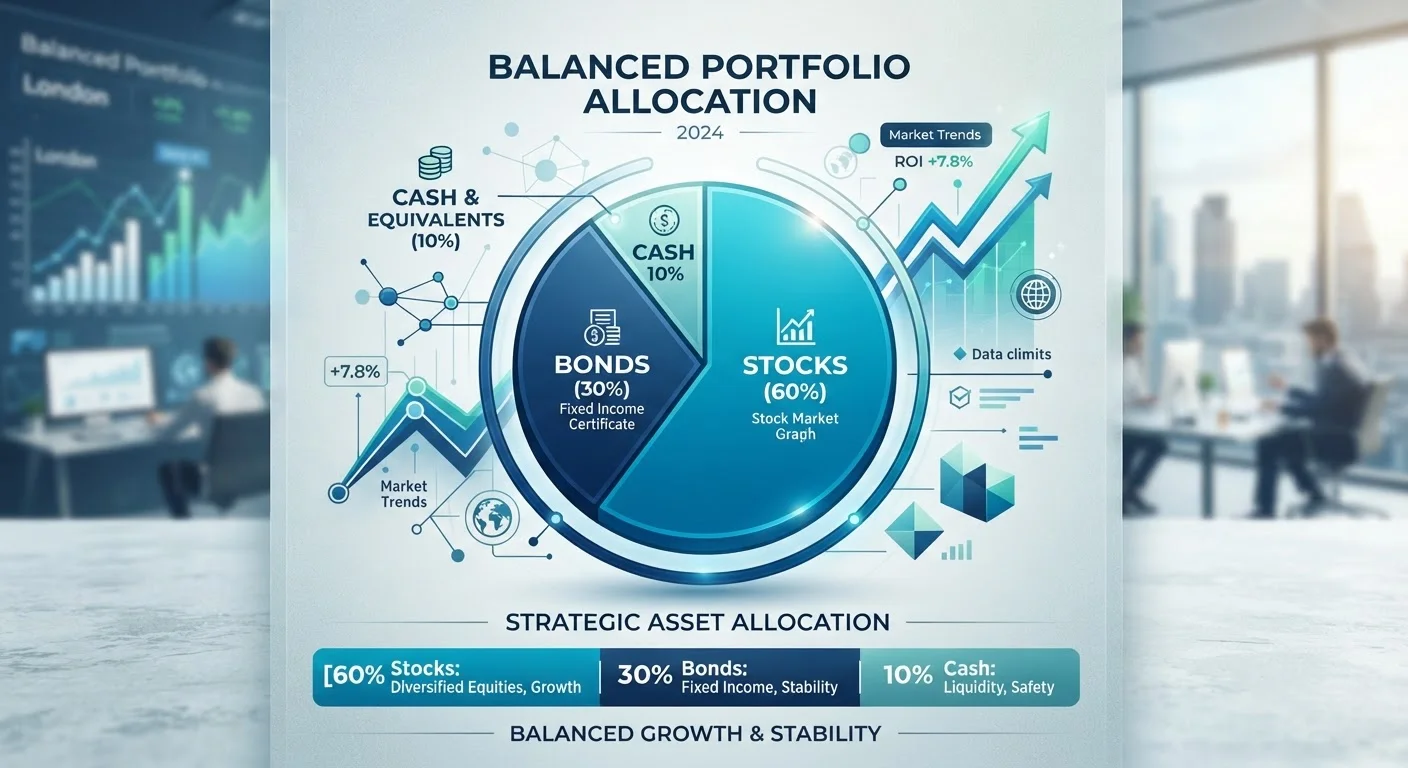
Asset allocation is how you divide your investment portfolio among different asset classes - most commonly stocks, bonds, and cash equivalents. The mix you choose determines how much risk you take on and how much growth potential your portfolio carries. Getting the balance right for your situation is one of the most consequential decisions in long-term investing.
Research from Brinson, Hood, and Beebower (1986, updated 1991) suggested that asset allocation policy - not individual security selection or market timing - accounts for the majority of a portfolio's long-term return variability.
The Three Core Asset Classes
Every portfolio starts with a choice about what to own. The three foundational asset classes are:
- Stocks (equities): Ownership shares in companies. Stocks historically offer the highest long-term growth potential but also carry the most short-term volatility. A 30% single-year decline is possible - and has happened repeatedly - even in broadly diversified stock indexes.
- Bonds (fixed income): Loans made to governments or corporations in exchange for regular interest payments. Bonds are generally less volatile than stocks but offer lower expected returns over long horizons. They serve as a stabilizing counterweight during stock market downturns.
- Cash and cash equivalents: Savings accounts, money market funds, and short-term Treasury bills. These preserve capital and provide liquidity but rarely keep pace with inflation over long periods.
Understanding how these classes behave - and how they tend to move differently from one another - is the foundation of allocation strategy. For a broader look at how investment decisions fit into your overall financial picture, see Long-Term Financial Planning: Principles That Hold Up Across Decades.
~90%
Of return variability explained by allocation policy
A widely cited 1991 study by Brinson, Hood, and Beebower found that asset allocation policy explained approximately 91% of the variation in portfolio returns over time - more than security selection or market timing.
50%+
Peak-to-trough S&P 500 decline in 2008-09
According to Standard & Poor's historical data, the S&P 500 index fell approximately 57% from its October 2007 peak to its March 2009 trough, illustrating the magnitude of equity volatility that allocation decisions must account for.
3-4%
Average annual U.S. inflation over the past century
Federal Reserve historical data suggests long-run U.S. inflation has averaged roughly 3-4% annually, underscoring why overly conservative allocations - holding mostly cash - risk eroding purchasing power over decades.
Why the Mix Matters More Than the Picks
It's tempting to focus on which specific stocks or funds to buy. But financial research consistently shows that the proportion of your money in each asset class drives more of your long-term experience than any individual security selection does.
Consider two hypothetical investors of the same age. One holds 90% stocks and 10% bonds; the other holds 50% in each. During a significant market downturn, the first investor's portfolio might drop 40% while the second's drops 20%. Both portfolios recover - but the first investor may have panicked and sold, locking in losses. The second investor's smoother ride made it easier to stay the course.
This is why asset allocation isn't just a math exercise. It's also a behavioral tool. A portfolio that matches your actual risk tolerance is one you're more likely to hold through volatility rather than abandon at exactly the wrong moment.
“The most important decision in portfolio management is the asset allocation decision - how to divide the portfolio between stocks, bonds, and other asset classes. This decision has more impact on long-term performance than any other.”
— David Swensen, Former Chief Investment Officer, Yale University Endowment; author of 'Pioneering Portfolio Management'
How Allocation Shifts Across Life Stages
A 25-year-old saving for retirement 40 years away can afford to hold a stock-heavy portfolio. Short-term crashes are painful but recoverable with decades of compounding ahead. A 62-year-old planning to retire in three years cannot afford the same bet - a severe market drop just before retirement can permanently damage withdrawable wealth, a dynamic known as sequence of returns risk.
As a general pattern - not a universal prescription - allocations tend to evolve like this:
- Early career (20s-30s): Higher equity allocation, lower bond exposure. Time horizon absorbs volatility.
- Mid-career (40s-50s): Gradual shift toward more bonds and stable assets as retirement approaches.
- Pre-retirement and retirement (60s+): Capital preservation becomes more important; income-generating assets and lower-volatility holdings take priority.
Your life stage is just one factor. Income stability, existing assets, debt levels, and personal risk tolerance all play a role. For a full picture of how financial priorities evolve, see The Life Stages of a Financial Plan.
Rebalancing: Keeping Your Allocation on Track
Markets move constantly, and a portfolio that starts at 70% stocks and 30% bonds can drift significantly over time. After a strong stock rally, that same portfolio might be sitting at 85% stocks - carrying more risk than you originally intended.
Rebalancing means periodically selling assets that have grown beyond their target weight and buying those that have fallen below it. This enforces a disciplined "buy low, sell high" behavior that many investors struggle to execute emotionally.
Common rebalancing approaches include:
- Calendar-based: Review and adjust once or twice per year.
- Threshold-based: Rebalance whenever an asset class drifts a set percentage (e.g., 5%) from its target.
- Event-based: Reassess after major life changes - marriage, job loss, inheritance, or approaching retirement.
Before implementing any rebalancing strategy, be aware of potential tax implications - selling assets in a taxable account may trigger capital gains. A licensed financial adviser or tax professional can help you navigate this for your specific situation.
It's also worth ensuring you have a solid emergency fund before focusing heavily on portfolio construction. Emergency Fund vs. Investing: Where Does Your Next Dollar Go? explores how financial planners generally think about sequencing these priorities.
This article is for general informational and educational purposes only and does not constitute personalized financial, investment, or tax advice. All investments carry risk, including possible loss of principal. Consult a qualified, licensed financial adviser before making decisions based on your individual circumstances.