

Key Takeaways
Our Verdict
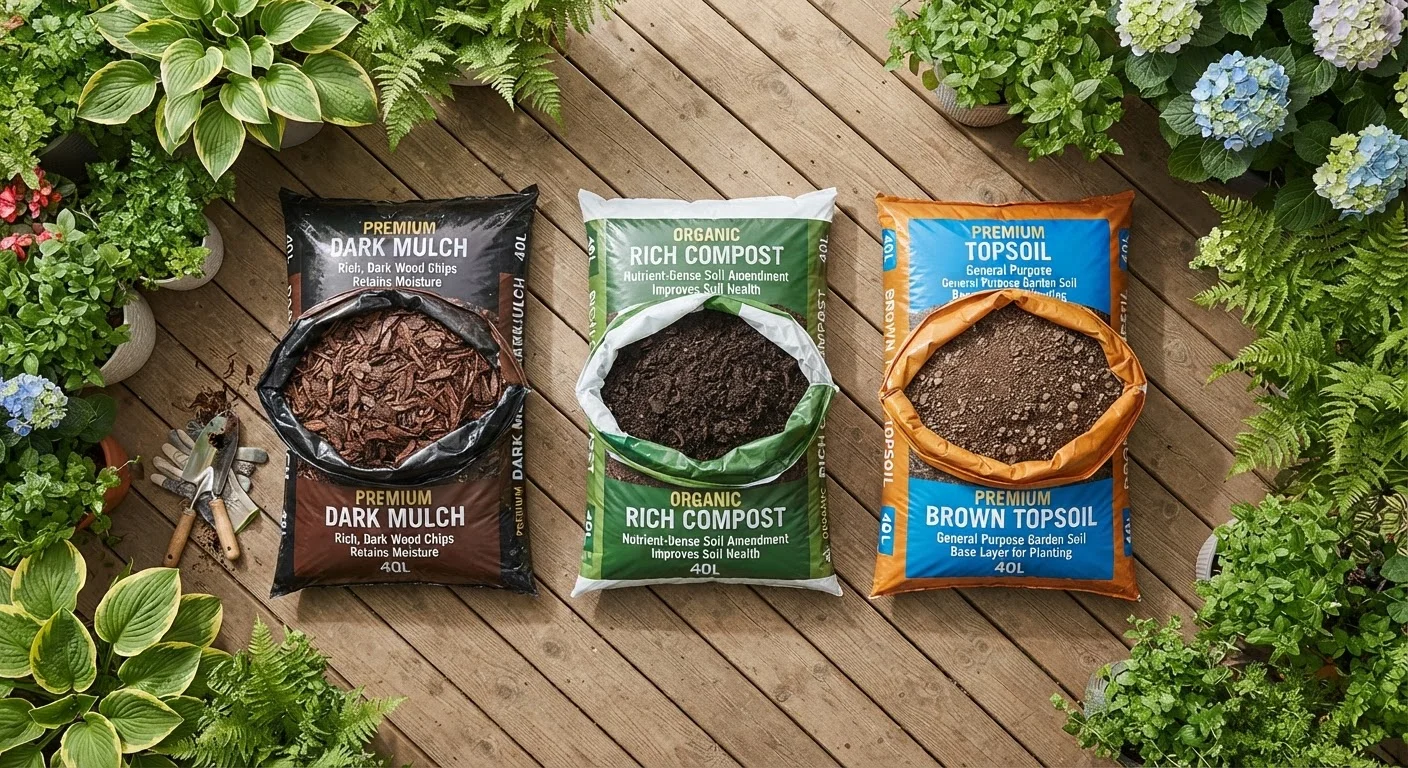
Mulch, compost, and topsoil are not interchangeable. Each addresses a different problem: mulch protects the soil surface, compost enriches what's already there, and topsoil provides a base for new growing areas. Using the right one - or the right combination - saves time, money, and frustration.
| Best for | Recommended |
|---|---|
| Established beds needing weed control and moisture retention | Mulch |
| Gardens with poor, depleted, or compacted soil | Compost |
| New planting areas, raised beds, or uneven lawns needing fill | Topsoil |
| Complete garden overhaul or new lawn establishment | Topsoil base + compost amendment + mulch finish |
Why These Three Get Confused
Walk into any garden center and you'll find bags of mulch, compost, and topsoil lined up next to each other, often looking nearly identical - all dark brown, all earthy-smelling. But using one when you need another is like putting oil where your coolant goes: similar in appearance, completely different in function.
The confusion is understandable. All three are soil-adjacent products made largely from organic matter, and marketing labels sometimes blur the lines further. This guide cuts through the noise with a plain-language breakdown of what each one actually does, where it goes, and when to reach for it.
For a look at how soil quality affects other lawn decisions, see our guide to grass seed vs. sod, which covers how soil conditions shape your options for establishing a new lawn.
Mulch: The Protective Surface Layer
Mulch is applied to the surface of your soil - it stays on top and is never tilled in. Its primary jobs are:
- Suppressing weeds by blocking light at the soil surface
- Retaining soil moisture so plants need watering less frequently
- Moderating soil temperature, keeping roots cooler in summer and warmer in early spring or fall
- Reducing erosion from rain and foot traffic
Organic mulches - shredded bark, wood chips, straw, and shredded leaves - slowly break down over time, adding modest organic matter to the soil below. Inorganic mulches like gravel or rubber don't decompose at all.
A standard application is 2-3 inches deep around plants and trees, kept a few inches away from stems and trunks to prevent rot. More than 4 inches can actually suffocate roots and create a habitat for pests.
Keep Mulch Away From Plant Stems
A common mistake called 'volcano mulching' piles mulch directly against tree trunks or shrub stems. This traps moisture against the bark, invites disease, and can slowly kill the plant. Always leave a 2-4 inch gap between mulch and any stem or trunk, and keep the layer no deeper than 3-4 inches.
Compost: The Soil Amendment That Feeds and Improves
Compost is decomposed organic matter - kitchen scraps, yard waste, and other plant-based materials broken down by microorganisms into a dark, crumbly material. Unlike mulch, compost is worked into existing soil, typically 2-4 inches tilled down 6-8 inches.
Its benefits are soil-deep:
- Adds nutrients that plants can absorb over time (though compost is not a replacement for a complete fertilizer - see our N-P-K fertilizer guide for how those nutrients differ)
- Improves drainage in clay-heavy soil and improves water retention in sandy soil
- Feeds beneficial soil microbes that support long-term plant health
- Gradually raises organic matter content, a key indicator of overall soil health
Compost can also be used as a thin top-dressing on lawns - a process called topdressing - where a light layer is raked across grass to improve the soil below without tilling. If you want to make your own, our home composting guide walks through the process from start to finish.
| Mulch | Compost | Topsoil | |
|---|---|---|---|
| Primary purpose | Protect soil surface | Enrich and improve soil | Provide a growing medium |
| Where it goes | On top of soil | Mixed into soil | Laid as a base layer |
| Typical depth | 2-3 inches | 2-4 inches tilled in | 2-6+ inches as needed |
| Feeds plants? | Minimally, over time | Yes, gradually | Little to none on its own |
| Weed suppression | Yes - primary benefit | No | No |
| Best used for | Established beds and trees | Improving existing soil | New beds, fill, grading |
| Typical application timing | Spring or fall refresh | Before planting season | When establishing areas |
Topsoil: The Growing Medium for New Areas
Topsoil is exactly what it sounds like: the top layer of earth, typically the first 2-8 inches, where most plant roots grow. Purchased topsoil is used when you need to add volume - filling in low spots, building up a raised bed, grading a new planting area, or establishing a lawn where there's currently little or no workable soil.
Quality varies widely. Bagged topsoil sold at garden centers is often blended with compost or other amendments and screened to remove rocks and debris. Bulk topsoil ordered by the truckload may be raw fill dirt with minimal organic content - always ask about the source and composition before ordering in large quantities.
Topsoil alone is not a cure for poor soil - it's a foundation. A thin layer of topsoil spread over compacted clay, for example, won't automatically give you a thriving garden bed. For the best results, amend new topsoil with compost before planting, and finish with a layer of mulch on top. This layered approach addresses structure, nutrition, and surface protection all at once.
Unsure whether to seed or sod over your freshly prepared topsoil? Our grass seed vs. sod comparison breaks down the trade-offs by timeline and budget.
Using All Three Together
The most effective garden beds typically use all three in a logical sequence:
- Start with topsoil if you're building a new bed or filling a low area. This establishes volume and a root zone.
- Amend with compost by tilling it into the top 6-8 inches of soil before planting. This enriches the growing environment and improves texture.
- Apply mulch on top after planting. This protects the soil surface and locks in the work you've already done below.
For existing, established beds that already have decent soil, you can often skip the topsoil and focus on annual compost amendments in spring or fall, followed by refreshing your mulch layer each season.
Seasonal fertilization pairs well with this cycle - compost improves soil biology while targeted fertilizers supply specific nutrients at the right growth stages.