

Key Takeaways
Why Southeast Asia Is Actually Perfect for Carry-On Travel
Southeast Asia has a quiet secret that experienced travelers already know: it might be the single best region in the world to visit with only a carry-on. The climate eliminates bulky layers, markets and pharmacies are stocked with almost everything you'd need to replace, and guesthouses across Thailand, Vietnam, Indonesia, and beyond offer laundry service for a few dollars a bag. The region rewards light packers and penalizes the overprepared.
That said, the approach requires intention. If you've ever wrestled with what to leave behind, it helps to recognize that overpacking is a planning problem, not a packing problem. The decisions you make before you open your bag determine how much you carry.
One critical logistical factor: low-cost regional carriers like AirAsia and Vietjet enforce carry-on weight limits of 7 kg (roughly 15 lbs) far more strictly than US airlines. Before you commit to carry-on-only travel in Southeast Asia, understand the trade-offs between carry-on and checked luggage for the specific routes you're flying.
The Clothing Core That Actually Works
The temptation is to pack for every scenario. Resist it. In Southeast Asia, a functional travel wardrobe orbits around breathability, versatility, and fast drying. Synthetic or merino wool fabrics outperform cotton in humidity - cotton stays wet and heavy, which is miserable in 90°F heat.
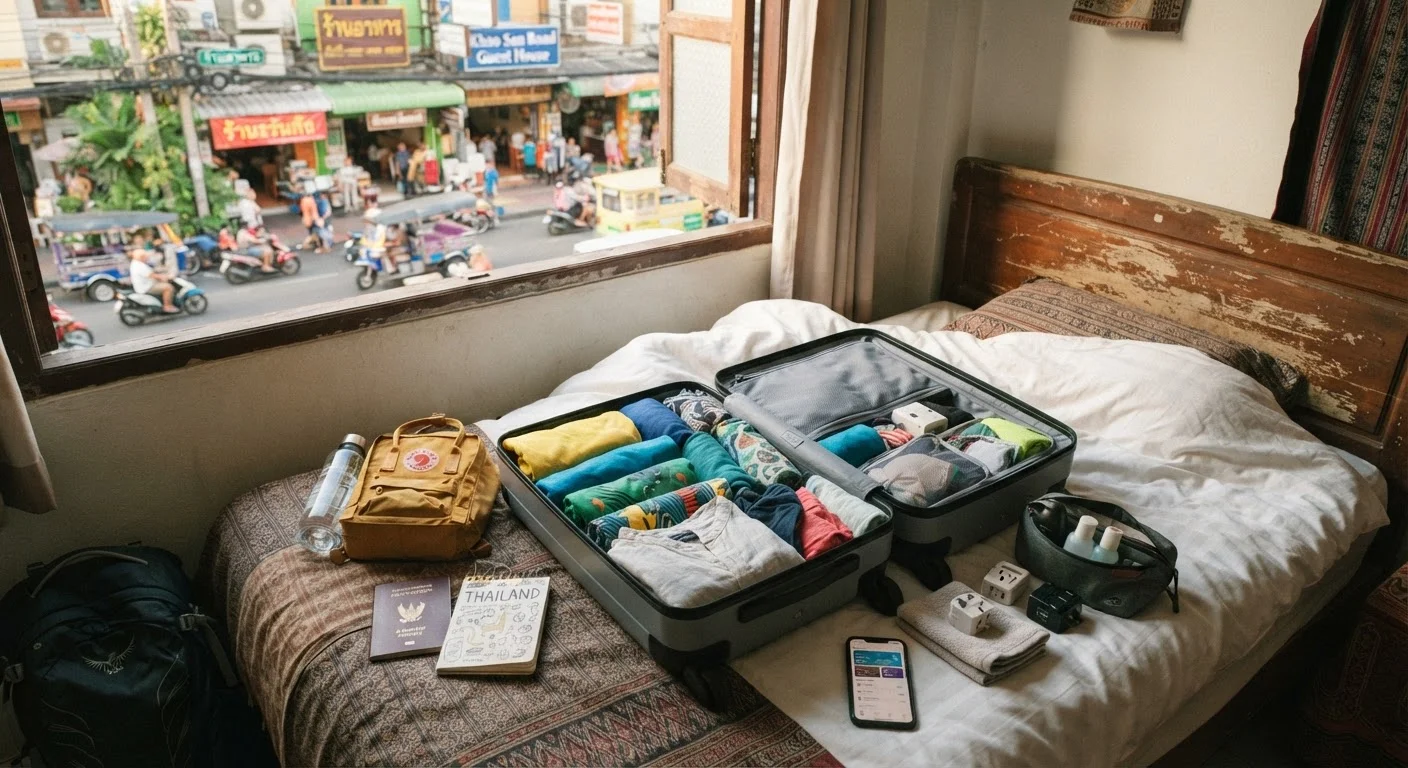
For a two-week trip, most experienced travelers settle on roughly: three tops, two bottoms, one lightweight layer for overly air-conditioned buses and temples, and a versatile dress or linen pants that can serve both casual and modest-dress purposes. Pack swimwear since you'll want it constantly. Layering, folding, and selection strategies help you verify this all fits before you leave home.
Toiletries, Medications, and What to Leave Behind
Toiletries are where bags bloat. The practical reality of Southeast Asia: 7-Eleven stores operate on nearly every urban block in Thailand; Vietnamese pharmacies carry sunscreen, antihistamines, and stomach remedies; Indonesian minimarkets stock shampoo, razors, and basic skincare. You do not need to bring a six-week supply of shampoo for a two-week trip.
Verify Entry Rules for Medications
Some prescription and over-the-counter medications common in the US are controlled or restricted in certain Southeast Asian countries. Before traveling, check the official entry requirements of each country on your itinerary for any medications you plan to carry. Carrying a copy of your prescription and keeping medications in their original packaging is generally advisable - but verify specific rules with official government and embassy sources before you depart.
What does deserve real thought is a small, curated medicine kit. Travelers' diarrhea, motion sickness on winding mountain roads, and stomach bugs are common enough that carrying oral rehydration salts, an antidiarrheal, and antacids is genuinely worthwhile. Check with your healthcare provider about appropriate medications before your trip, and verify any entry requirements for medications with the destination country's official sources.
Sunscreen is worth bringing from home - quality and SPF options vary, and prices at tourist areas can run high. Beyond that, buy locally. A few small items experienced travelers swear by are worth reviewing before you finalize your kit.
Making Laundry Your Secret Weapon
In Southeast Asia, laundry services are cheap, fast, and everywhere. Hostels, guesthouses, and dedicated laundry shops in every major destination will wash, dry, and fold a bag of clothes for the equivalent of $1-$3 USD. Planning a laundry day every four to five days eliminates the math problem of packing enough clothes entirely.
Embrace this system and you stop thinking of your clothing as finite - you're working with a rotating inventory. It also unlocks another advantage: you can buy something at a market, wear it for a week, and either pack it home or donate it. That flexibility costs nothing and adds real joy to the trip.
If budget is part of the equation, keeping your bag light also saves money at airports and keeps you mobile between destinations - a real advantage when hopping between cities on short notice. For more on spending smartly without sacrificing the experience, see our guide on traveling on a budget without ending up miserable.