

Key Takeaways
Why One Carry-On Is a Realistic Goal - Not a Sacrifice
The idea of surviving two weeks on a single carry-on sounds extreme until you've done it once. At that point, it becomes the only way to travel. No baggage fees, no 30-minute wait at the carousel, no risk of an airline losing your checked bag three days into your trip. The freedom of walking straight off the plane and onto a train is genuinely life-changing for frequent travelers.
The key insight is that most travelers overpack because they think in terms of days, not activities. Fourteen days doesn't require fourteen outfits - it requires a flexible wardrobe system and a willingness to do laundry once or twice. If you're heading abroad for the first time, our guide to planning an international trip covers the full pre-departure process, including how to think about packing relative to your destination.
Check Airline Size Rules Before You Pack
Carry-on size limits vary by airline and can differ even on codeshare flights. Some budget carriers allow bags as small as 20" x 14" x 9", while major US carriers are more generous. Always verify the most restrictive rule across every airline on your itinerary - not just your primary carrier - before finalizing your bag choice.
Once you've mastered the fundamentals here, check out these overlooked travel bag essentials - small items that experienced travelers swear by but most first-timers only discover after wishing they had them.
What to Bring, What to Leave, and How to Pack It
Successful carry-on packing comes down to three decisions made in the right order: what bag, what clothes, and how to fit it all. Skipping straight to packing without making those first two decisions is where most travelers go wrong.
What you will need
Carry-on bag
Your primary container - must meet the size restrictions of every airline on your itinerary.
Packing cubes
Compress and organize clothing by category, making it easy to locate items without unpacking everything.
Quart-sized clear zip bag
Required by TSA for carrying liquids through airport security.
Solid toiletry bars
Replace liquid shampoo, conditioner, and soap to sidestep the TSA 3-1-1 liquid limit entirely.
Packing list (printed or digital)
Keeps you accountable during packing and prevents duplicate or forgotten items.
Audit your itinerary before touching your closet
Pull up your full two-week schedule and note every type of activity: flights, transit days, outdoor sightseeing, nice dinners, beach days, business meetings. Count the distinct dress codes, not the days. Most two-week trips involve only two or three distinct contexts - casual exploration, one or two nicer evenings, and perhaps one active day. That number, not 14, determines how many outfit types you actually need.
Build a capsule wardrobe in neutral, mix-and-match colors
Limit your palette to two or three colors that all work together - navy, white, and olive, for example. Choose five tops, three bottoms, one dress or smart layer, and one versatile jacket. Every item should pair with at least three others in your bag. Avoid novelty prints and single-use statement pieces; they force you into outfit lockstep instead of giving you flexibility.
Pare down toiletries ruthlessly
Decant everything possible into travel-sized containers and switch to solid alternatives wherever you can. A shampoo bar, solid conditioner bar, and concentrated soap tablet eliminate nearly all liquids from your kit. Keep your TSA quart bag for the items that truly must remain liquid: contact solution, liquid medication, or a specific skincare product. Remember that most hotel rooms supply shampoo and body wash, so those don't need to travel with you at all.
Pack electronics thoughtfully and only what you'll use daily
Phone charger, one universal adapter, earbuds, and perhaps a small portable battery - that's a solid baseline. A laptop is often the heaviest single item travelers carry; if your trip is leisure-focused, consider whether a tablet or even just your phone can cover your needs. Every cable and device you add costs weight and takes up space in your personal item, which is better used for a layer you'll want on the plane.
Roll clothes and load your bag with a system
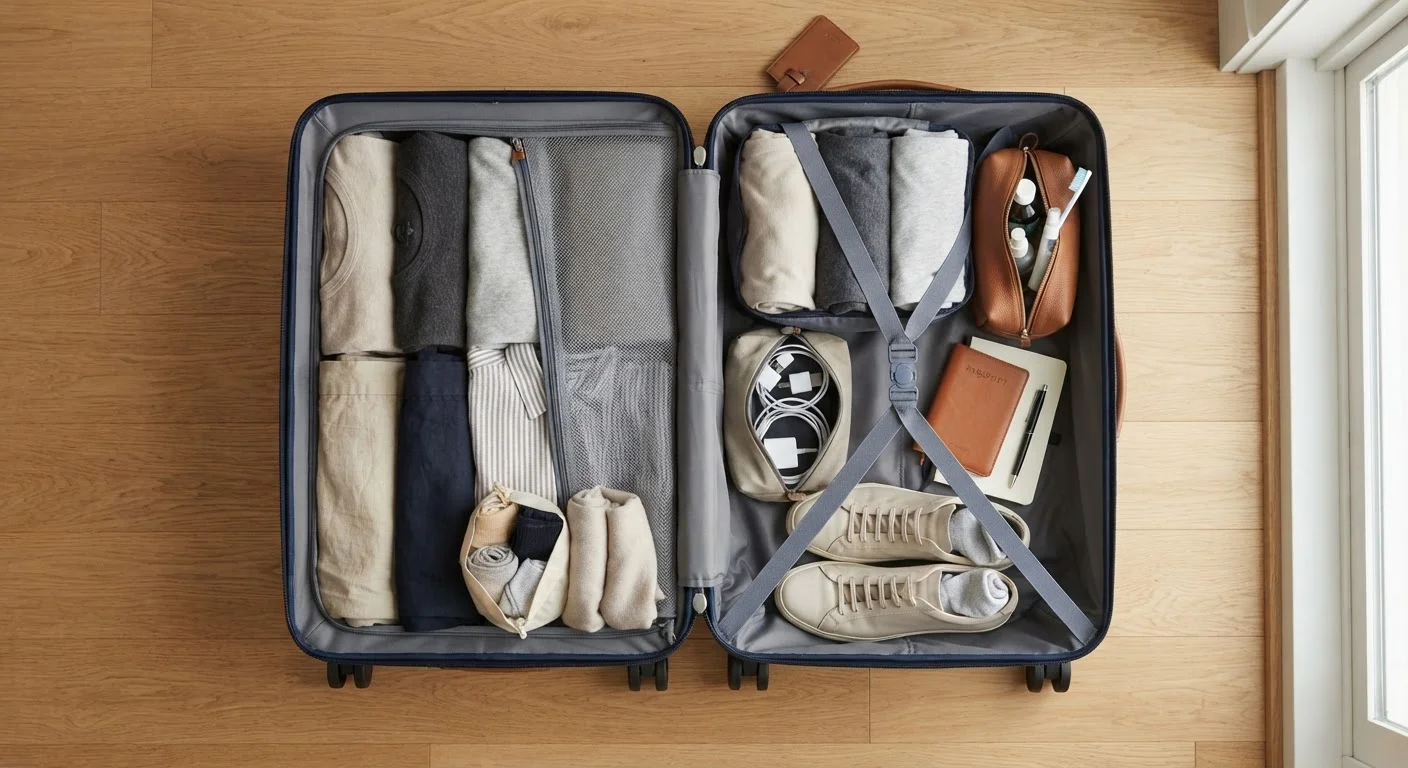
Roll every garment tightly - ranger rolls (military-style), which tuck the ends in on themselves, hold their shape best. Place heavier items like jeans or your jacket flat against the back panel (the side closest to your back when wearing the bag). Fill packing cubes with rolled clothing, compress them closed, then stack the cubes inside the bag. Stuff socks inside shoes. Shoes go sole-against-the-frame, usually one on each side. Small items like belts coil inside a rolled shirt.
Use your personal item strategically
Most airlines allow a personal item in addition to your carry-on - a backpack or tote that fits under the seat. Use this for your electronics, a change of clothes in case your bag is ever delayed, your travel documents, snacks, and anything you'll want during the flight. A well-organized personal item means you won't need to dig into your overhead bag mid-flight, and it serves as overflow for items that don't fit in the carry-on.
Use Laundry as a Packing Strategy
Plan for two laundry sessions - roughly at the end of day five and day ten - and you only need to pack for about five days of clothing at a time. Most hotels offer laundry service, and laundromats are easy to find in most cities worldwide. If you're nervous about the process, this guide to carry-on travel through Southeast Asia shows how experienced light-packers handle laundry on the road.
Liquids Rules Apply Everywhere in Your Bag
TSA's 3-1-1 rule limits liquids to containers of 3.4 oz (100ml) or less, all fitting in one quart-sized clear bag. Oversized toiletries are the single most common reason carry-ons get flagged at security. Switch to solid toiletries - shampoo bars, solid sunscreen, and concentrated soap tablets - to eliminate the problem entirely and free up space.
For trips with a specific regional flavor - like warm, humid climates with easy access to markets and guesthouses - some of these rules shift. Our piece on carry-on travel through Southeast Asia explores how the local laundry culture and climate make ultra-light packing even more achievable than in other destinations. And if baggage fees are part of your calculation, the Trip Planning hub has practical guidance on keeping overall travel costs in check.