

Key Takeaways
Why Foundation Drainage Deserves Serious Attention
Water is patient. It finds the path of least resistance, and if that path leads toward your foundation, the consequences compound quietly over months and years. Hydrostatic pressure - the force water exerts against a buried wall when saturated soil can't drain - is one of the leading causes of foundation cracking, bowing walls, and basement moisture intrusion in American homes.
This isn't a problem limited to older construction or flood-prone regions. A single grading mistake, a clogged downspout, or a flower bed with a raised edge can redirect enough water to begin softening soil, leaching mortar, or introducing moisture that fuels mold. Understanding how water behaves around your home is one of the highest-value maintenance skills a homeowner can develop - and most of the warning signs are visible to an untrained eye if you know where to look.
For a fuller picture of how water-related oversights compound into major repair bills, see our article on how small roof problems escalate.
Best Practices for Grading and Surface Drainage
Grading - the slope of the ground around your home - is the first line of defense against foundation water intrusion. The widely recommended standard is a drop of at least 6 inches over the first 10 feet measured from the foundation wall. That grade ensures surface runoff flows away from the house rather than pooling against it.
Inspect and correct the grade along your entire foundation perimeter, not just problem areas.
Water follows the path of least resistance, and a single low spot can funnel runoff from a wide area directly against the house. Spot-fixing one section while neglecting others only redirects the problem. A complete perimeter review ensures water consistently flows away from the structure.
Use dense, compactable fill soil - not mulch or organic material - against the foundation for the first 6 inches.
Mulch and wood chips absorb and retain moisture, essentially keeping water against the wall rather than shedding it. Dense fill soil, when properly graded, sheds surface water more effectively and doesn't decompose and sink over time the way organic material does.
Check that window wells for below-grade windows have proper gravel drainage at the base and covers when not in use.
Window wells concentrate roof runoff and ground-level water in a small enclosure directly adjacent to a foundation opening. Without gravel drainage, they fill quickly and allow water to seep around window frames into the basement.
Raise planting beds adjacent to the foundation so they slope away rather than holding water against the wall.
Raised planting beds with interior edges higher than the exterior create a bowl that directs water toward the foundation. Beds should be built so the soil surface nearest the wall is lower than the outer edge, allowing water to drain outward.
Verify that any hardscaping - patios, driveways, and walkways - does not direct water toward the foundation.
Concrete and paver surfaces settle over time, and their slope can reverse without obvious visual cues. A patio that originally drained toward the yard may now slope inward and send hundreds of gallons of roof and surface water toward the foundation with every rain event.
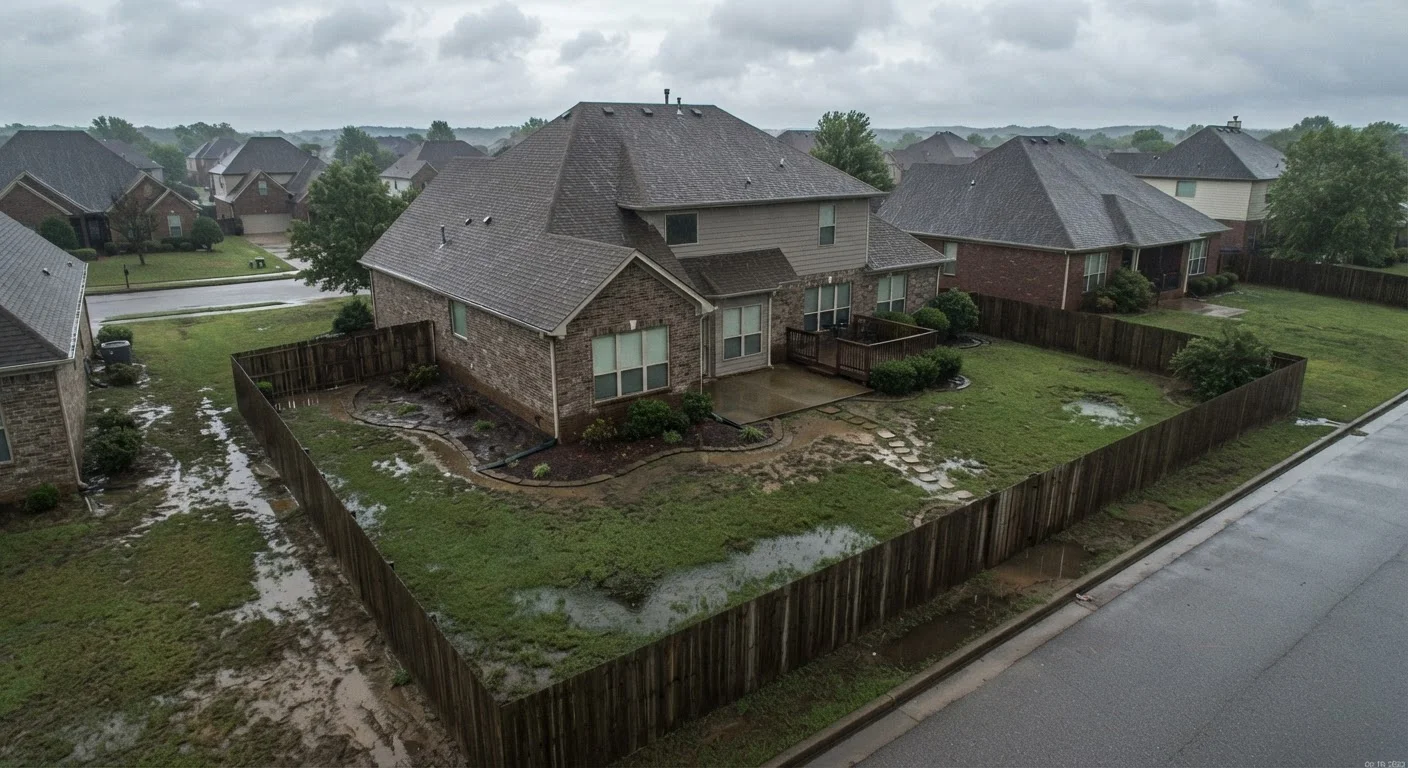
Before assuming a grading problem requires heavy equipment, walk your property after a significant rainfall. Puddles that persist more than 30 minutes within 3 feet of the foundation, soil that feels consistently wet or soft in a narrow band along the house, and efflorescence (white mineral deposits) on basement walls are all signs that drainage is not performing as it should.
Overwatering your lawn can make existing drainage problems significantly worse. See our guide on lawn watering habits that do more harm than good for smarter irrigation practices.
Gutters, Downspouts, and the Last Mile of Water Management
A properly graded lot can still develop foundation moisture problems if the gutter system is delivering large volumes of water right next to the house. Gutters collect runoff from the entire roof surface - which can be thousands of square feet - and funnel it through downspouts. If those downspouts terminate at the foundation wall, you've essentially concentrated your roof drainage into the most vulnerable zone around your home.
Downspout extensions should discharge water at least 4-6 feet from the foundation. Splash blocks - the concrete or plastic pads placed at the base of downspouts - are only effective when the grade beyond them continues to slope away. If the splash block sits in a low area or the soil has settled, the block itself becomes a water trap. Our detailed guide on gutter maintenance mistakes covers both cleaning frequency and proper slope alignment.
When to Call a Professional
Some drainage problems are DIY-friendly: regrading a small area with topsoil, adding a downspout extension, or repositioning a splash block. Others require a licensed contractor or civil engineer - particularly when the issue involves installing French drains (perforated pipe buried in gravel to redirect subsurface water), a sump pump system, or correcting significant soil settlement near the foundation.
If you notice horizontal cracks in a block or concrete foundation wall, inward bowing, or doors and windows that stick without an obvious cause, do not delay contacting a structural engineer. These symptoms may indicate hydrostatic pressure has already caused movement. Costs for professional drainage correction vary widely by region and scope, but they are consistently less than foundation repair or mold remediation after the fact.
Interior waterproofing products - paints or sealants applied to basement walls - are a common response to moisture, but they address the symptom rather than the source. Water blocked on the interior side still saturates the wall assembly and can accelerate deterioration from the outside in. Exterior drainage correction is the more durable solution. For a broader view of which common home maintenance beliefs lead homeowners astray, see our article on home maintenance myths that cost money.