

Key Takeaways
Sequence of Returns Risk
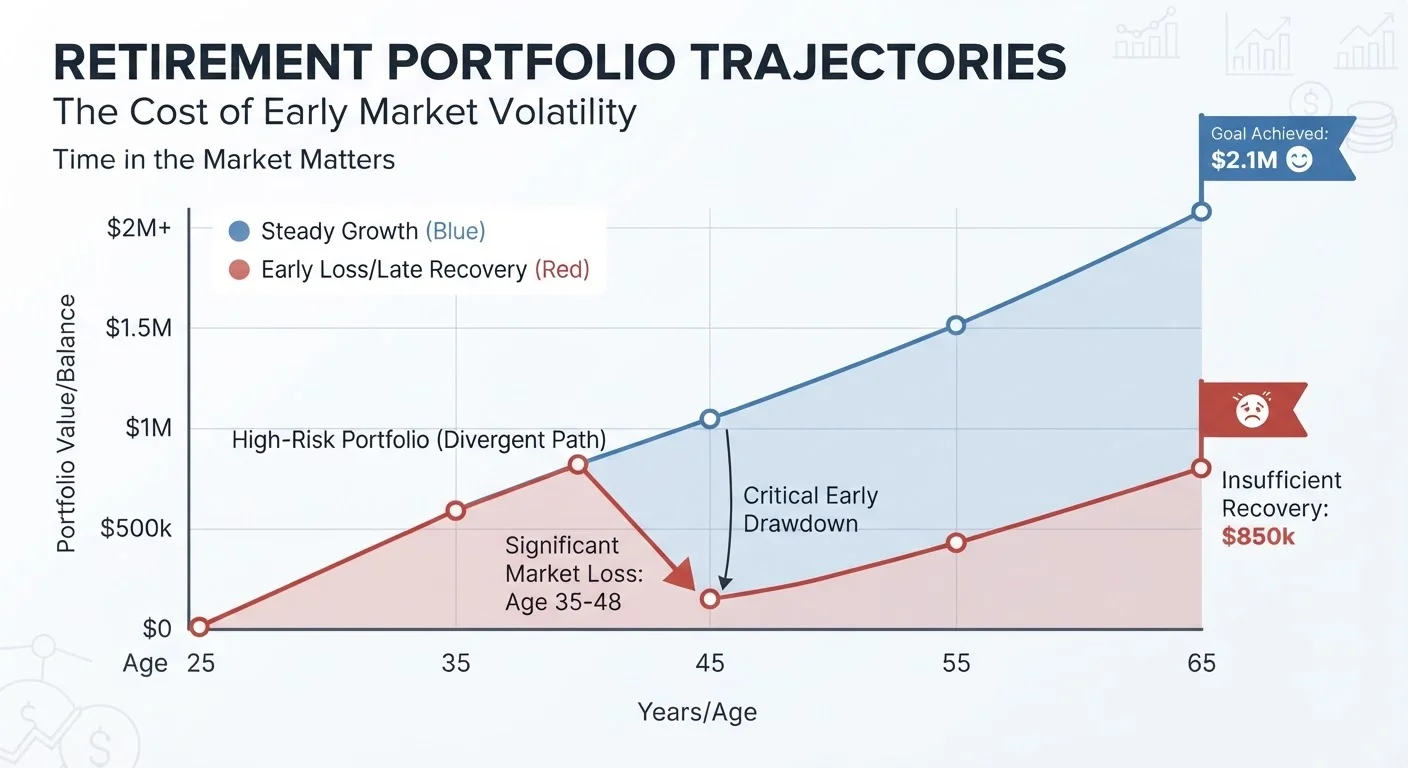
Sequence of returns risk is the danger that the timing of market losses - not just their size - can permanently damage a retirement portfolio. Two retirees with identical average investment returns over the same period can end up with drastically different balances depending on whether the bad years come early or late in retirement. When losses happen in the first few years of withdrawal, retirees are forced to sell more shares at depressed prices to cover living expenses, leaving fewer shares to recover when markets rebound.
This risk is most acute during the 'fragile decade' - roughly the five years before and five years after retirement - when the portfolio is at its largest and withdrawals begin. It is mathematically distinct from average-return risk and cannot be eliminated by simply achieving a higher average annual return.
Why Average Returns Can Mislead Retirees
Most retirement projections are built around an average annual return assumption - say, 6% or 7% per year over decades. That figure feels reassuring. But it hides a critical detail: the order in which those returns arrive matters enormously once you start withdrawing money.
Consider two hypothetical retirees who both average 5% annually over a 20-year retirement. Retiree A experiences strong gains early and losses later. Retiree B faces the same losses and gains in reverse order - a market slump in years one through three, followed by recovery. Both average the same return, but Retiree B may exhaust their savings years before Retiree A does.
The reason is mechanical. When you withdraw a fixed amount each year and markets are down, you must sell more shares to cover that withdrawal. Those sold shares are gone - they cannot participate in the eventual rebound. Over time, this "forced selling at a loss" erodes the portfolio's base faster than any return calculation predicts.
This is why tools like retirement calculators should be used carefully. As explained in our guide to reading retirement calculators, the assumptions you feed in - including return smoothing - can paint an overly optimistic picture.
~30%
Portfolio loss that can halve retirement duration
Research in retirement income planning suggests a 30% loss in the first two years of retirement, combined with fixed withdrawals, can reduce portfolio longevity by roughly half compared to the same loss occurring in years 15-20.
10 years
The fragile decade surrounding retirement
Financial planners generally identify the five years before and five years after the retirement date as the highest-risk window for sequence of returns damage.
1-3 years
Liquid reserve often suggested by planners
Many retirement planning frameworks recommend holding the equivalent of one to three years of withdrawals in low-volatility assets as a buffer against early-retirement market downturns.
The Fragile Decade: When Risk Is Highest
Financial planners sometimes refer to the "fragile decade" - the five years immediately before retirement and the five years immediately after - as the window when sequence of returns risk is most dangerous. This is when portfolios are typically at their largest dollar value, meaning a percentage loss translates into a larger absolute dollar hit than at any earlier point in life.
During accumulation years, a downturn is inconvenient but recoverable. You keep contributing, and lower prices mean you buy more shares cheaply. But the moment regular withdrawals begin, the dynamic reverses. Each withdrawal in a down market locks in losses that compounding can no longer fully repair.
“It's not just about how much you earn on your investments - it's about when you earn it. The sequence in which returns arrive can be more consequential than the average return itself, particularly for someone who has just started drawing down their portfolio.”
— Wade Pfau, Professor of Retirement Income, The American College of Financial Services
This reality connects to a broader truth about financial life stages: the strategies that serve you well during wealth-building years need to evolve as you approach and enter retirement. Our article on the life stages of a financial plan explains how priorities shift at each major transition point.
Practical Strategies to Reduce Exposure
No strategy eliminates sequence of returns risk entirely, but several approaches can reduce its impact. These are general concepts - how they apply to your situation depends on your specific financial picture, and a licensed financial adviser can help you think through the tradeoffs.
- Cash or bond buffer: Holding one to three years of anticipated withdrawals in low-volatility assets means you can draw on that reserve during a market downturn rather than selling equities at depressed prices. This buys time for markets to recover.
- Flexible withdrawal rate: Rather than withdrawing a fixed dollar amount each year, some retirees reduce withdrawals modestly during down markets and increase them when portfolios grow. Even small adjustments can significantly extend portfolio longevity.
- Equity glide path: A glide path gradually reduces equity exposure as you approach and enter retirement, limiting the damage a market shock can inflict during the highest-risk years. Some target-date funds use this approach automatically.
- Part-time income or delayed large expenses: Maintaining even modest earned income in early retirement years reduces how much the portfolio must distribute, which directly reduces sequence risk exposure.
It's also worth noting what does not help: simply achieving a higher average return does not offset poor sequencing. A portfolio with a higher average return but front-loaded losses can still underperform a more modest portfolio with favorable early returns. Understanding this distinction separates informed retirement planning from guesswork - and helps explain why common retirement myths about returns can be genuinely harmful.
This article is for general informational and educational purposes only. It does not constitute personalized financial, investment, tax, or legal advice. Please consult a qualified financial adviser before making decisions about your retirement strategy.