

Key Takeaways
Life-Stage Financial Planning
Life-stage financial planning is the practice of aligning your money decisions with where you are in life. Rather than applying a one-size-fits-all approach, it recognizes that the financial priorities of a 25-year-old - building an emergency fund and paying off student loans - are fundamentally different from those of a 55-year-old maximizing retirement contributions. The goal is to match your strategy to your current circumstances while keeping future milestones in view.
Financial planners sometimes refer to this as 'lifecycle investing' or 'goal-based planning,' where asset allocation, insurance coverage, and savings rates are calibrated to age, income stability, and time horizon.
Why Life Stage Changes Everything
A financial plan is not a static document you create once and file away. It is a living framework that should evolve as your income, obligations, goals, and time horizon change. Understanding why priorities shift across life stages is the foundation of effective long-term planning.
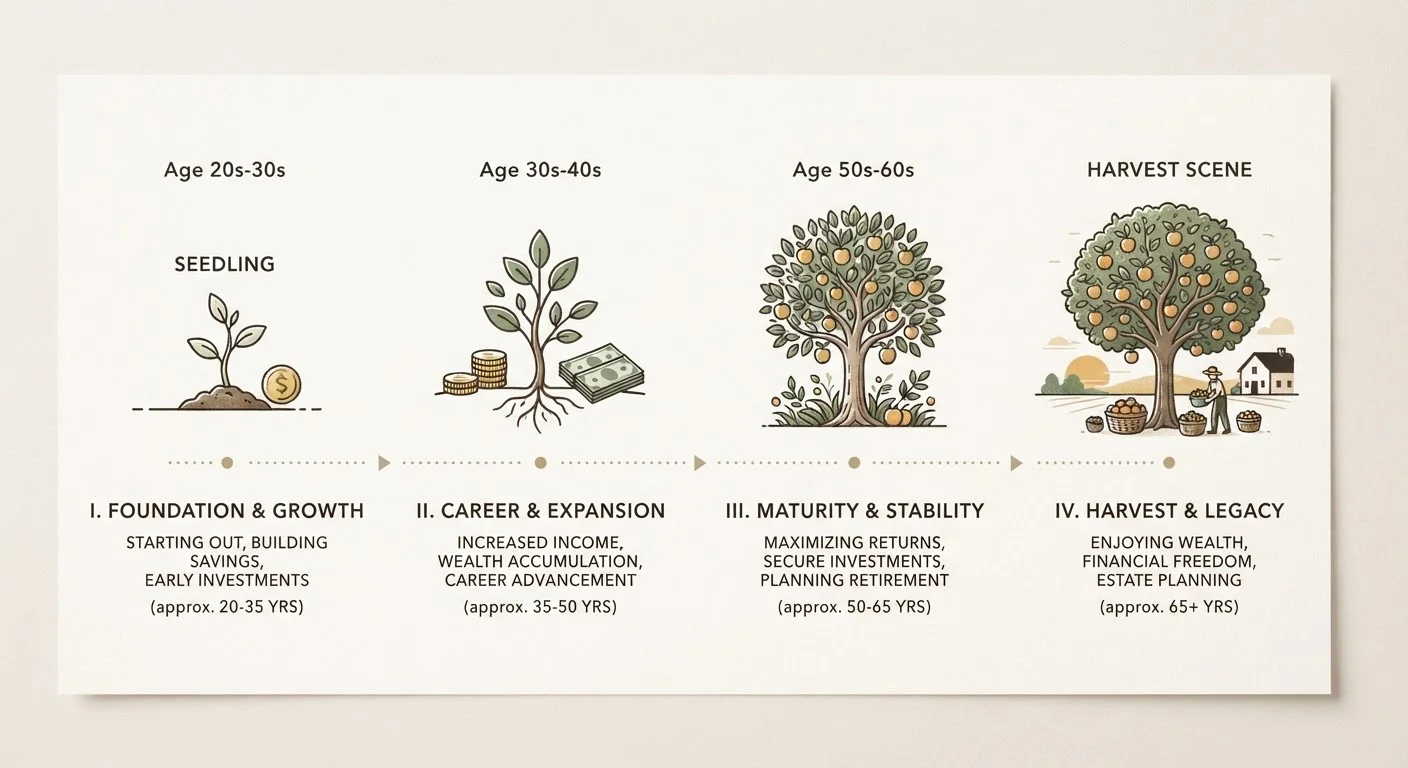
The four broad stages - early adulthood, mid-life, pre-retirement, and retirement - each carry distinct financial demands. Treating them as interchangeable is one of the most common reasons people fall behind. Our guide on long-term financial planning principles explores the overarching framework in detail.
Start Simple, Then Adjust
You do not need a complex plan to start. A basic budget, a small emergency fund, and even a minimal retirement contribution put you ahead of where most people begin. The key is establishing the habit and the account structures early - you can optimize later as your income and knowledge grow. See our budgeting basics hub for straightforward strategies.
Early Adulthood (roughly ages 22-35): Foundations First
In early adulthood, income is often inconsistent or modest, and financial habits are just forming. The most consequential decisions here are rarely about large sums - they are about structures and behaviors.
- Emergency fund: Building three to six months of essential expenses in a liquid, accessible account provides a buffer that prevents one setback from unraveling everything else.
- Debt prioritization: High-interest consumer debt costs more than almost any investment can reliably earn. Addressing it aggressively is mathematically sound.
- Retirement contributions: Even small contributions to an employer-sponsored plan or an IRA in your 20s benefit from decades of compound growth. The IRS sets annual contribution limits that adjust periodically - check IRS.gov for current figures.
- Basic insurance coverage: Health, renter's, and auto insurance protect against losses that can be financially catastrophic at this stage.
If you are just getting started, our beginner's guide to building a financial plan walks through these components step by step.
~$0
Retirement savings for many Americans under 35
Federal Reserve Survey of Consumer Finances data consistently shows that a large share of younger households have no retirement account savings at all, underscoring the importance of starting early.
8%/year
Social Security benefit increase per year of delayed claiming
According to the Social Security Administration, benefits grow by approximately 8% for each year claiming is delayed past full retirement age, up to age 70.
Age 73
Required Minimum Distribution start age (current IRS rules)
Under the SECURE 2.0 Act, the IRS requires distributions from most tax-deferred retirement accounts beginning at age 73, a key planning trigger for retirees.
Mid-Life (roughly ages 36-54): Managing Complexity
Mid-life is typically the period of peak earning - and peak financial complexity. Mortgages, children's education costs, aging parents, career transitions, and accelerating retirement savings all compete for the same dollars.
The most important shift in this stage is intentionality. Higher income can mask poor planning habits if spending expands in lockstep. The decisions made in this decade often determine retirement readiness more than any other period. For a focused look at these trade-offs, see our article on financial planning in your 30s.
- Increasing retirement contributions: If earlier years were lean, this is the time to close the gap - especially if your income now supports higher savings rates.
- Life and disability insurance: As financial dependents increase, so does the cost of being uninsured against income loss.
- Investment rebalancing: A portfolio appropriate at 30 may carry more risk than is prudent at 48. Regular rebalancing aligns allocation with evolving goals.
Understanding why financial goals stall can help you identify and correct behavioral patterns before they compound.
Pre-Retirement (roughly ages 55-65): Protecting What You've Built
The decade before retirement is less about growth and more about preservation and transition planning. Decisions made here - when to claim Social Security, how to sequence withdrawals, what to do with concentrated assets - have lasting consequences.
- Catch-up contributions: The IRS allows workers aged 50 and older to make additional contributions to retirement accounts beyond standard limits. Verify current thresholds at IRS.gov.
- Healthcare planning: Medicare eligibility begins at 65, but the gap between early retirement and that age requires careful bridging. Costs are frequently underestimated.
- Debt elimination: Entering retirement without high-interest debt reduces the income required to maintain your lifestyle.
- Social Security strategy: Claiming timing significantly affects lifetime benefit totals. The Social Security Administration provides tools to model different scenarios.
Use a retirement calculator responsibly to stress-test your projections - and understand the assumptions behind the numbers.
Retirement: Spending Down Strategically
Retirement shifts the financial objective from accumulation to distribution. The core challenge is making assets last through an uncertain - and potentially long - lifespan while maintaining purchasing power against inflation.
Common considerations include withdrawal sequencing (which accounts to draw from first), Required Minimum Distributions (RMDs) from tax-deferred accounts beginning at age 73 under current IRS rules, and legacy or estate planning goals. Tracking financial milestones at every age remains useful even in retirement, where spending discipline and healthcare costs become central variables.
Your Plan Should Be Reviewed Annually
Life changes - and so should your financial plan. Major events like a job change, marriage, divorce, a new child, or an inheritance each signal a need to reassess your priorities, coverage levels, and savings rates. Even without a major event, an annual check-in helps ensure your plan stays aligned with your current goals and circumstances.
This article is for general informational and educational purposes only and does not constitute personalized financial, investment, tax, or legal advice. Consult a qualified, licensed financial professional before making decisions about your own financial situation.