

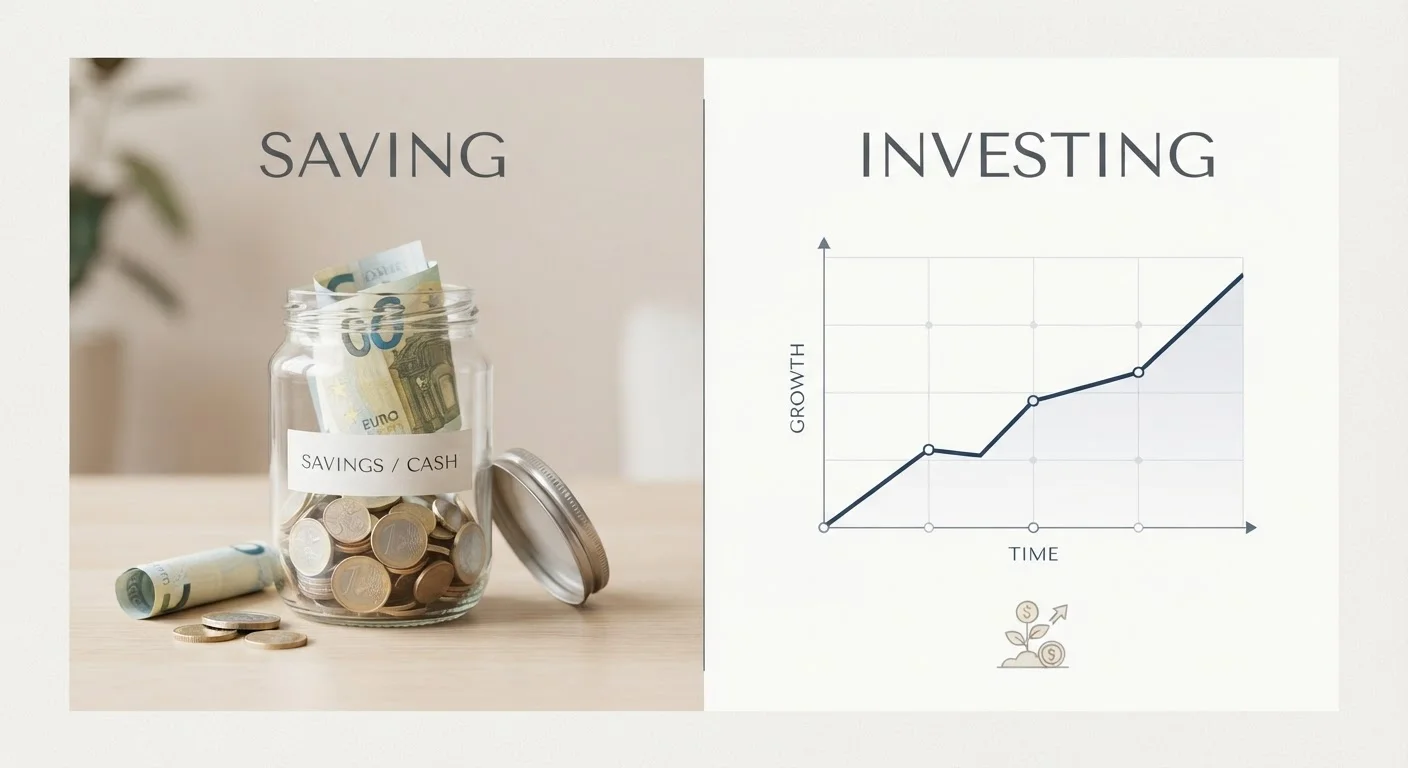
Key Takeaways
Option A
Emergency Fund
The financial safety net that protects everything else.
Best for: Anyone who lacks stable cash reserves to cover unexpected expenses without going into debt.
Option B
Investing
The long-term wealth-building engine that compounds over time.
Best for: Those with a stable income, manageable debt, and a cash cushion already in place who are ready to grow wealth.
If you have no cash cushion and live paycheck to paycheck
Emergency Fund
Without liquid reserves, any unexpected expense - a car repair, medical bill, or job loss - can force high-interest debt or derail your investment accounts. Build at least one month of expenses before anything else.
If your employer offers a 401(k) match you aren't capturing
Investing
An employer match is effectively an immediate 50-100% return on contributed dollars. Most financial planners consider capturing the full match worth prioritizing even alongside early emergency saving.
If you have a starter fund but want to grow long-term wealth
Investing
Once you have a functional safety net, directing surplus dollars toward tax-advantaged accounts can meaningfully compound over years and decades.
If your income is irregular or your job is unstable
Emergency Fund
Variable-income earners typically benefit from larger reserves - potentially six months or more of expenses - before committing heavily to market investments.
If you have a stable job, solid savings, and no high-interest debt
Investing
With financial fundamentals in place, prioritizing investment contributions - especially in tax-advantaged accounts - is the logical next step for building long-term security.
Why the Sequence Matters More Than the Choice
The question isn't really whether an emergency fund or investing is more valuable - both serve essential roles in a sound financial plan. The real question is sequencing: which comes first given your current situation, and how do you decide when to shift gears?
Financial planners generally treat these two goals as complementary rather than competing. But they're not interchangeable. An emergency fund is a defensive tool - it absorbs financial shocks without requiring you to take on debt or liquidate investments at a bad time. Investing, by contrast, is an offensive strategy designed to grow wealth over years or decades through compounding returns.
When the sequence gets reversed - when someone invests aggressively without a cash buffer - a single setback can force them to sell holdings at a loss, wipe out hard-won gains, or take on high-interest debt. That's the real cost of skipping the foundation. See our beginner's guide to building a financial plan for how these priorities fit into a broader framework.
| Criterion | Emergency Fund | Investing |
|---|---|---|
| Primary purpose | Financial protection and liquidity | Long-term wealth growth |
| Typical account type | High-yield savings or money market | 401(k), IRA, or brokerage account |
| Risk level | Very low - principal is stable | Variable - depends on asset mix |
| Time horizon | Immediate access required | Years to decades |
| Return potential | Low (savings rate) | Higher, but not guaranteed |
| When to prioritize | Before or alongside investing | After starter fund; always capture employer match |
| Target amount | 3-6+ months of essential expenses | As much as budget allows after safety net |
The Case for Funding Your Emergency Reserve First
An emergency fund is liquid cash - typically held in a high-yield savings account or money market account - set aside exclusively for genuine financial emergencies: job loss, medical expenses, essential home or car repairs. It is not an investment vehicle, and it's not meant to grow aggressively. Its job is availability and stability.
The conventional guidance, echoed by the Consumer Financial Protection Bureau (CFPB), is to target three to six months of essential living expenses. However, that benchmark isn't universal. Freelancers, contract workers, single-income households, or anyone in a volatile industry may need considerably more. Our companion piece explains why the three-month rule doesn't fit every household.
Building this reserve first gives you something that investing can't: the ability to leave your portfolio untouched during a downturn or personal crisis. When markets fall and your income also dips - a scenario that happens more often than people expect - having cash on hand means you aren't a forced seller at the worst possible time.
37%
Americans who couldn't cover a $400 emergency
According to the Federal Reserve's Report on the Economic Well-Being of U.S. Households, a significant share of adults would struggle to cover an unexpected $400 expense without borrowing or selling something.
3-6 months
Recommended emergency fund target
The Consumer Financial Protection Bureau (CFPB) generally recommends keeping three to six months of essential expenses in liquid savings as a baseline emergency reserve.
~50%
Workers not maximizing employer 401(k) match
Research from Vanguard's annual How America Saves report has consistently shown that a meaningful portion of eligible employees do not contribute enough to capture their full employer match.
The One Investing Exception: Capturing the Employer Match
There is one widely recognized exception to the "emergency fund first" sequence: the employer 401(k) match. If your employer matches a portion of your retirement contributions - say, 50 cents per dollar up to 6% of salary - declining that match to prioritize cash savings means leaving a portion of your compensation on the table.
Most financial planners treat capturing the full employer match as a near-universal priority, even before a cash reserve is fully funded. The reason is simple: the immediate return on matched dollars is unmatched by any other low-risk financial move. It's worth noting, though, that this logic applies specifically to matched contributions - not to maxing out a 401(k) or contributing to taxable brokerage accounts before you have a safety net.
To understand the broader trade-offs between debt, savings, and investing priorities, the case for and against paying off debt before investing offers a useful companion framework.
How to Think About Splitting Contributions Over Time
For many people, this doesn't need to be an either/or decision. Once you've captured any employer match, a practical approach is to split surplus dollars between building your emergency fund and making modest investment contributions - then shift the balance as the reserve grows.
For example: if you have $300 per month to allocate beyond your employer-match contribution, directing $200 toward emergency savings and $100 toward a Roth IRA until the fund is fully funded can accomplish both goals simultaneously. Once the reserve reaches your target, the full $300 can move into investing.
This sequencing logic also connects to how financial priorities evolve through life. A 25-year-old with minimal obligations and a stable job faces a different calculus than a 45-year-old with a mortgage, dependents, and less time to rebuild savings after a setback. Our article on how financial priorities shift across life stages explores this progression in depth.
If you're also navigating debt alongside these decisions, the framework for saving while in debt can help you manage multiple financial priorities without stalling on any one of them. And if you want to build a budget that makes room for both goals, our complete guide to personal budgeting is a practical starting point.
This article is for general informational and educational purposes only and does not constitute personalized financial, investment, or tax advice. Readers should consult a licensed financial adviser or planner before making decisions specific to their circumstances.