

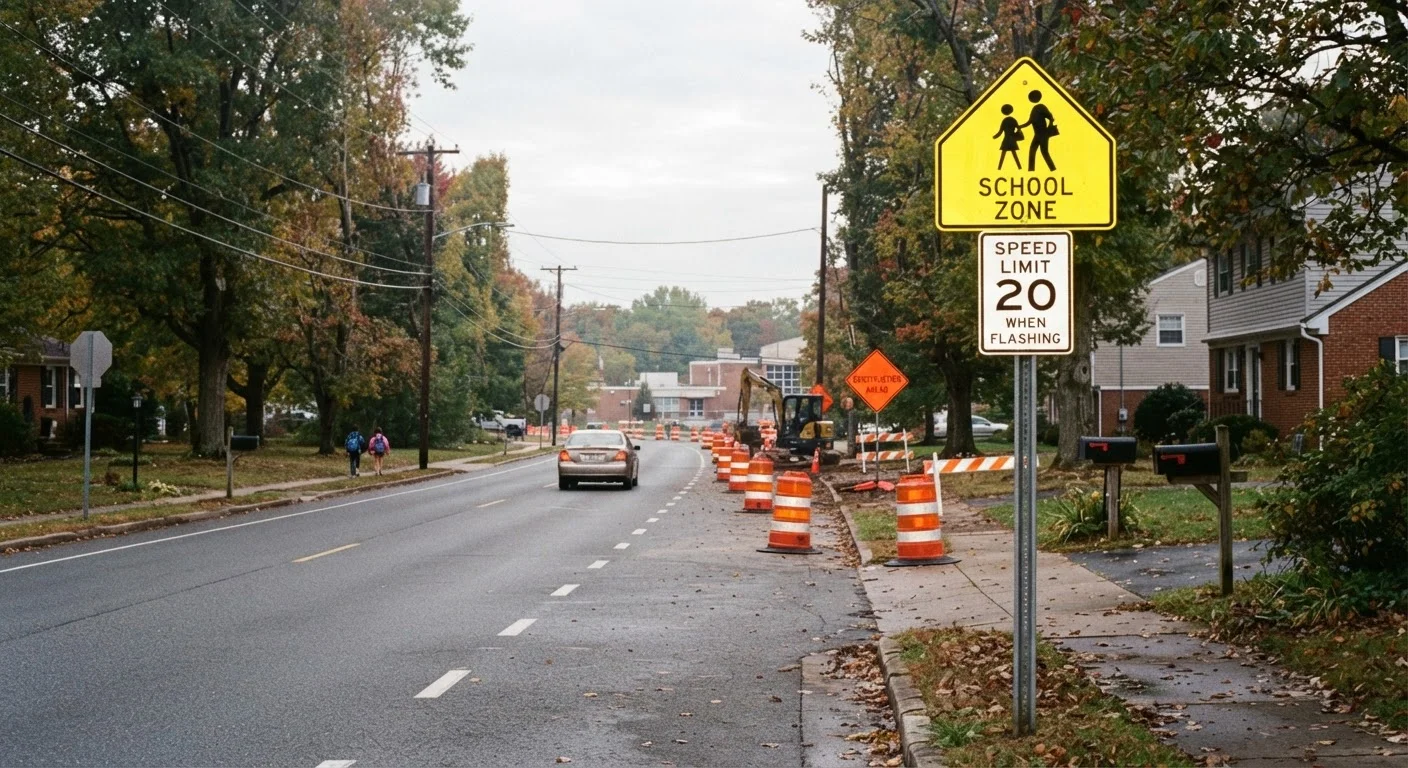
Why These Zones Carry Heavier Legal Weight
School zones and work zones are among the most legally consequential stretches of road a driver encounters. Both are designated areas where the risk of serious injury to vulnerable people - children, crossing guards, construction workers - is significantly elevated. In response, state and federal law imposes stricter speed limits, amplified fines, and sometimes mandatory license penalties that go well beyond standard traffic violations.
Understanding these rules isn't just about avoiding tickets. Workers struck in highway work zones account for hundreds of fatalities every year in the United States, according to the Federal Highway Administration. Children on foot near schools represent another distinct vulnerability. The laws in these zones reflect that reality, and enforcement tends to be aggressive.
For a broader look at how traffic law protects pedestrians and other road users, see our guide to sharing the road legally.
School Zone Laws: What Drivers Must Know
School zones are typically marked by pentagonal (five-sided) yellow warning signs, flashing amber beacons, and posted speed limit signs - often 15 to 25 mph, depending on the state and jurisdiction. The reduced speed limit generally applies during designated hours, such as when children are arriving or leaving school, though some states enforce the lower limit whenever the beacon is flashing regardless of school hours.
Key rules that apply in most states:
- Reduced speed limits - typically 15-25 mph during active school hours; always obey posted signs.
- Doubled fines - most states double, and some triple, the fine for any moving violation committed in a school zone.
- Stopping for school buses - when a school bus displays flashing red lights and a stop arm, traffic in both directions must stop on undivided roads. On divided highways, rules vary by state.
- No passing zones - passing other vehicles in a school zone is prohibited in virtually every state.
- Pedestrian right-of-way - children in crosswalks must be given the full right of way before proceeding.
Cameras are increasingly used to enforce school zone speed limits. A citation from a camera-based system is typically a civil fine rather than a moving violation, but it still carries a monetary penalty. Check your state's specific statutes - rules governing when a school zone is legally active differ, and ignorance of those hours is not a defense.
For a refresher on how US traffic signs are designed and what their shapes and colors legally mean, see our traffic sign field guide.
School Zone
A designated section of road near a school where reduced speed limits and enhanced traffic rules apply during specified hours. Marked by distinctive pentagonal signs and often flashing amber beacons.
Work Zone
A temporary traffic control area established for road construction, maintenance, or utility work. Governed by federal MUTCD standards and enforced by state transportation departments.
MUTCD
The Manual on Uniform Traffic Control Devices, the federal document that sets national standards for traffic signs, signals, and pavement markings, including those used in work zones.
Move Over Law
A law - enacted in all 50 US states - requiring drivers approaching stopped emergency or maintenance vehicles to move one lane away or reduce speed to a safe level if a lane change isn't possible.
Flagger
A trained worker who uses hand signals, flags, or paddles to direct traffic through a work zone. A flagger's directions carry the same legal authority as a traffic signal.
Stop Arm (School Bus)
A mechanical arm that extends from the left side of a school bus and, combined with flashing red lights, legally requires approaching traffic to stop until the arm retracts.
Work Zone Laws: Rules for Active Construction Areas
Work zones are temporary traffic control areas established whenever road construction, maintenance, or utility work is underway. They are governed at the federal level by the Manual on Uniform Traffic Control Devices (MUTCD), which sets national standards for signage, lane markings, and traffic control. State Departments of Transportation implement and enforce these standards on their road networks.
Core legal obligations in work zones:
- Reduced speed limits - posted work zone speed limits must be obeyed; fines are typically doubled and in some states tripled, especially when workers are present.
- Move over requirements - all 50 states have Move Over laws. When passing a work zone with stopped or slow emergency or maintenance vehicles, drivers must move one lane away or, if unable to, slow to a safe speed.
- No mobile phone use - many states impose stricter distracted driving rules inside work zones. See what hands-free laws actually cover by state for state-by-state detail.
- Following temporary traffic control - flaggers have the same legal authority as traffic signals. Ignoring a flagger's direction is a moving violation.
- Lane merge compliance - zipper merging near lane closures is the legally endorsed technique in most states; cutting across marked lanes can draw citations.
1 in 4
Work zone crashes involve rear-end collisions
According to the Federal Highway Administration, rear-end crashes are the most common crash type in highway work zones.
85%
Of work zone fatalities are drivers or passengers
Federal Highway Administration data consistently show that most work zone crash deaths involve vehicle occupants, not workers.
All 50
States with enhanced work zone penalties
Every US state imposes elevated fines or penalties for traffic violations committed within a designated work zone.
Penalties for work zone violations can include points on a license, license suspension for repeat offenses, and in some states, mandatory court appearance rather than a simple fine payment. If a crash occurs in a work zone, elevated penalties typically apply even if workers weren't physically present at the moment of impact.
Understanding right-of-way rules in complex traffic situations can also help drivers navigate the unfamiliar lane configurations common in active work zones.