

| Governing standard | Manual on Uniform Traffic Control Devices (MUTCD) (Federal Highway Administration) |
| Number of sign categories | 3 primary: Regulatory, Warning, Guide (MUTCD, current edition) |
| Standard warning sign shape | Diamond (square rotated 45°) (MUTCD) |
| Stop sign color standard | Red background, white border and lettering (MUTCD) |
| Work zone sign color | Orange background, black text or symbols (MUTCD) |
| School zone sign color | Fluorescent yellow-green background (MUTCD) |
How the System Is Structured
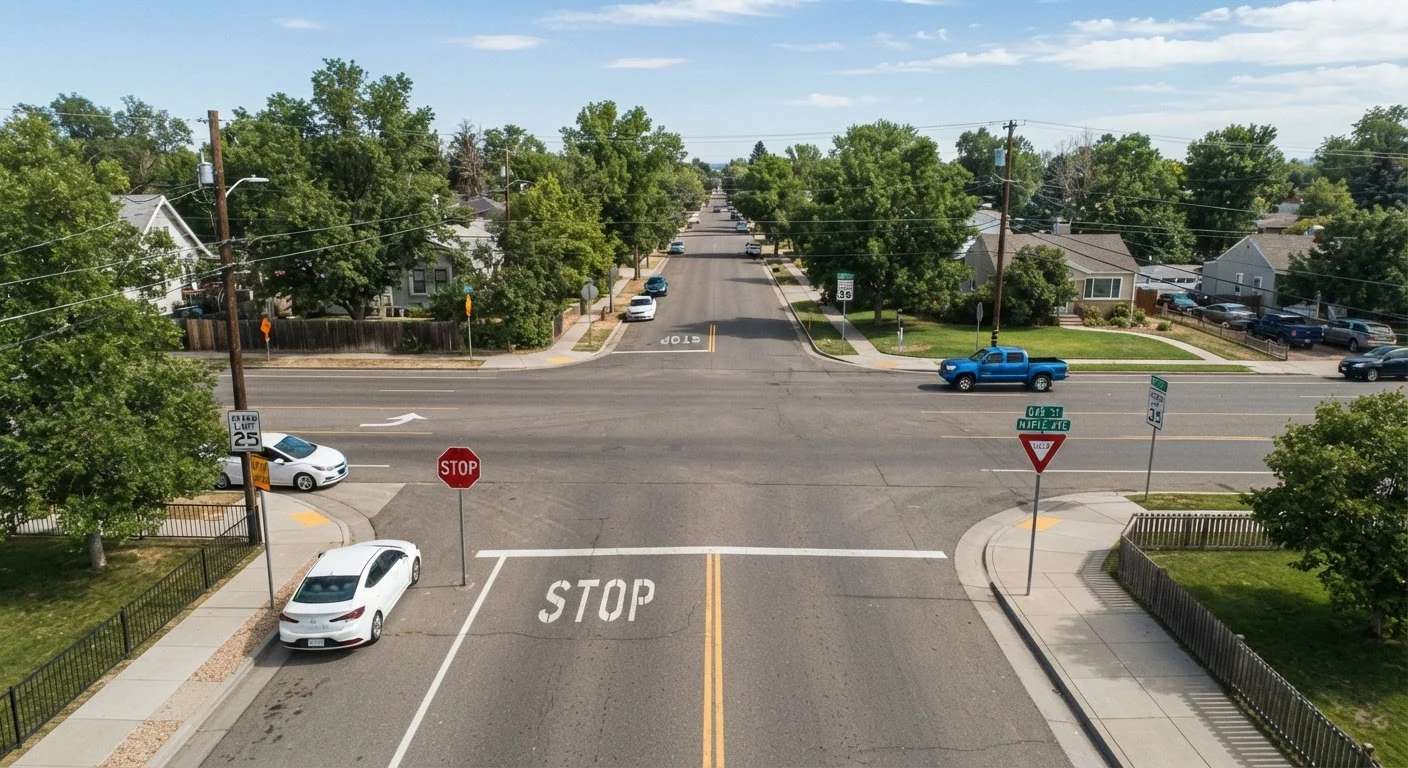
Every traffic sign on a US public road must conform to the MUTCD, the Federal Highway Administration's national design standard. The MUTCD assigns meaning at three levels simultaneously: shape, color, and symbol or text. A driver who recognizes shape and color can grasp a sign's intent before reading a single word - a deliberate design choice that improves reaction time and aids non-English readers.
| Governing standard | Manual on Uniform Traffic Control Devices (MUTCD) (Federal Highway Administration) |
| Number of sign categories | 3 primary: Regulatory, Warning, Guide (MUTCD, current edition) |
| Standard warning sign shape | Diamond (square rotated 45°) (MUTCD) |
| Stop sign color standard | Red background, white border and lettering (MUTCD) |
| Work zone sign color | Orange background, black text or symbols (MUTCD) |
| School zone sign color | Fluorescent yellow-green background (MUTCD) |
Signs fall into three primary categories. Regulatory signs state the law - you are legally required to comply with them. Warning signs alert you to conditions ahead that require extra care. Guide signs give navigation information. Understanding which category a sign belongs to tells you immediately whether compliance is mandatory or advisory.
For a deeper look at how sign rules intersect with legal obligations at intersections, see right-of-way rules that confuse even experienced drivers.
Shape as a First Signal
Shape is the fastest-decoded element of any sign, readable even in poor visibility or at the edge of your peripheral vision. The MUTCD assigns each shape a fixed role:
- Octagon - Stop only. No other sign uses this shape.
- Triangle (inverted) - Yield only. The downward point signals you must give way.
- Diamond - Warning. Curved roads, animal crossings, merges, and similar hazards.
- Rectangle (vertical) - Regulatory. Speed limits, turn restrictions, lane controls.
- Rectangle (horizontal) - Guide and informational content.
- Pentagon (pointing up) - School advance warning signs.
- Crossbuck (X shape) - Railroad crossing. Always treat it as a warning to look and listen.
- Circle - Railroad advance warning or no-passing zone marker.
Memorizing this list means you can begin responding to a sign a fraction of a second before you've read it - which at highway speeds can translate to meaningful stopping distance.
MUTCD
The Manual on Uniform Traffic Control Devices, published by the Federal Highway Administration. It is the national standard governing the design, placement, and meaning of all traffic signs, signals, and pavement markings on public roads in the United States.
Regulatory sign
A sign that communicates a legal requirement drivers must obey, such as speed limits, turn restrictions, or stop commands. Violating a regulatory sign is a traffic offense.
Warning sign
A sign that alerts drivers to a hazard or change in road conditions ahead. Warning signs advise caution but do not themselves impose a legal obligation.
Guide sign
A sign that provides directional, distance, or destination information to help drivers navigate. Highway route markers and exit signs are common examples.
Retroreflectivity
The property of a sign's sheeting material that reflects headlight beams back toward the driver, making the sign legible at night. Federal standards require all traffic signs to maintain minimum retroreflectivity levels.
Prima facie speed limit
A statutory speed limit that applies by law in specific contexts - such as school zones or residential streets - even when no posted sign is visible.
Color Codes and What They Mean
Color in the MUTCD system is not decorative - each hue carries a defined category of meaning:
| Color | Meaning | Common examples |
|---|---|---|
| Red | Stop, prohibition, or do not enter | Stop, Yield, Wrong Way, Do Not Enter |
| Yellow | General warning | Curve ahead, pedestrian crossing, signal ahead |
| Orange | Temporary - work zones and detours | Construction zone speed limits, lane shift warnings |
| Green | Permitted movements, guide information | Highway exits, distance markers, bike route signs |
| Blue | Motorist services | Rest area, hospital, gas, food |
| Brown | Recreation and cultural sites | National parks, campgrounds, historic sites |
| Fluorescent yellow-green | Pedestrian, bicycle, and school zones | School crossing, shared-use path warnings |
| White | Regulatory information | Speed limit, lane use, turn restriction |
Work zone and school zone signs deserve special attention because the rules - and the fines - change in these areas. See school zone and work zone laws every driver should know for a full breakdown.
State Variations Are Limited
While states can supplement MUTCD standards, they cannot contradict them on any federally funded road. You may encounter slight regional differences in wording or supplemental plaques, but the core shape, color, and symbol system is consistent nationwide. When in doubt, the shape and color of a sign give you the most reliable quick read.
Signs You're Most Likely to Misread
Even licensed drivers sometimes misinterpret specific signs. A few that generate consistent confusion:
Yield vs. Stop
A Yield sign does not mean stop if traffic is clear - it means slow, assess, and proceed only when safe. Coming to a complete stop at a yield is technically legal but can create rear-end risk. Blowing through one without slowing is a traffic violation.
Speed limit signs in unmarked zones
Not every road posts a speed limit. Many states rely on prima facie limits - statutory defaults for specific road types - when no sign is present. Speed limits aren't always posted explains how to determine the legal limit when you don't see a number.
Regulatory vs. warning at railroad crossings
The round advance warning sign (yellow, with an X and RR) is advisory - it tells you a crossing is ahead. The crossbuck at the crossing itself is regulatory: you must yield to any approaching train. The distinction matters legally.
Shared road signs and vulnerable users
Bicycle lane signs and pedestrian crossing signs are regulatory in many jurisdictions - meaning drivers have defined legal obligations when present. For a full summary, see sharing the road with cyclists, pedestrians, and motorcyclists.