

| What 'unlimited' legally means | No hard data cutoff - but speeds can still be slowed (FTC guidance on data plan disclosures) |
| Typical premium data threshold | 25 GB - 100 GB depending on plan tier (Common range across major U.S. carrier plans) |
| Minimum throttle speed (common) | 600 Kbps - 1.5 Mbps after cap (Documented in carrier terms of service) |
| 5G network types in the U.S. | Sub-6 GHz (wide coverage) and mmWave (dense urban) (FCC 5G spectrum classifications) |
| Number porting right | Federally protected under FCC rules (FCC Local Number Portability rules) |
| Device unlock requirement | Carriers must unlock devices meeting eligibility criteria (FCC Unlocking Consumer Choice and Wireless Competition Act) |
Why Carrier Language Needs a Decoder Ring
Phone plan marketing is fluent in a language designed to sound generous while obscuring trade-offs. Terms like "unlimited," "premium data," and "nationwide 5G" carry specific technical meanings that rarely match their plain-English implication. Whether you're picking a first plan or switching carriers, understanding this vocabulary is the difference between choosing a plan that fits your life and one that surprises you on your first bill.
This glossary covers 30 terms you'll encounter while shopping for wireless service, organized by category. For a broader look at tech jargon beyond phone plans, see our general tech term reference.
Unlimited Data
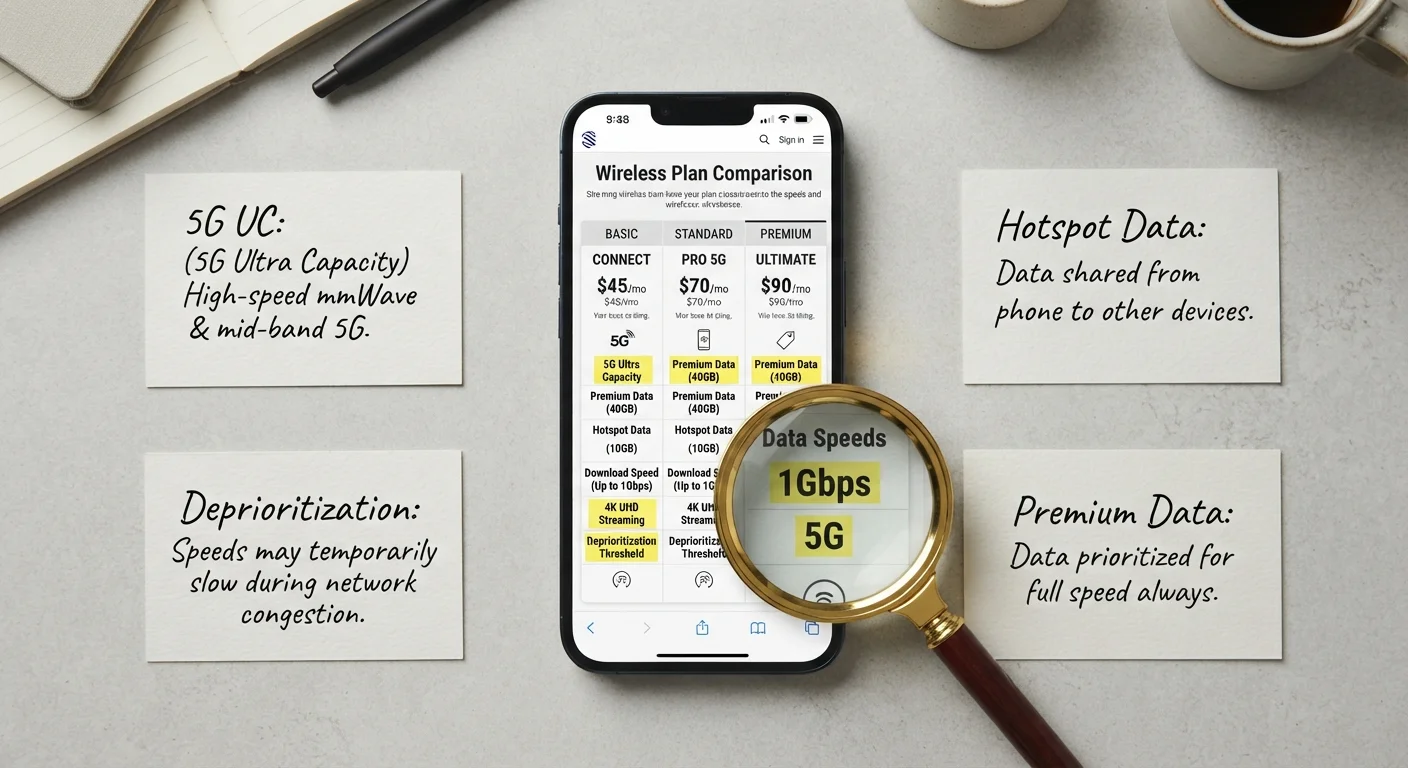
A plan that doesn't cut off your data access after a set amount of usage. However, most unlimited plans include a threshold after which speeds are throttled or traffic is deprioritized during network congestion - the data doesn't stop, but it may become significantly slower.
Premium Data
A defined amount of high-speed data within an unlimited plan that is protected from deprioritization. Once the premium allotment is used, remaining data may be slowed during busy periods. The exact amount varies by plan tier.
Hotspot Data
Data allocated specifically for tethering - sharing your phone's cellular connection with other devices like a laptop or tablet. Hotspot allotments are often lower than your overall data allowance and may be throttled to slower speeds after a separate cap is reached.
Carrier Aggregation
A technique that combines multiple frequency bands to increase data speeds. When you see speed claims like "up to X Gbps," carrier aggregation is often what makes those peak figures possible under ideal conditions.
Number Porting
The process of transferring your existing phone number from one carrier to another. U.S. law requires carriers to honor port requests; you do not lose your number by switching providers, provided you initiate the port before canceling your old plan.
Device Lock
Software restriction that prevents a phone from being used on a different carrier's network. Carriers are generally required to unlock devices once certain conditions are met, such as completing a payment plan or satisfying a service period.
International Day Pass
An add-on that lets you use your domestic plan's minutes, texts, and data abroad for a flat daily fee. It's a convenient option for short trips but can be costlier than local SIM cards for extended travel.
Network Congestion
A slowdown in data speeds that occurs when a cell tower has more active users than its available bandwidth can efficiently serve. Congestion is most common in dense urban areas, stadiums, or during high-demand events.
APN (Access Point Name)
A configuration setting that tells your phone how to connect to the carrier's data network. Most phones set this automatically, but manual APN configuration is sometimes required when using an MVNO SIM or a phone purchased abroad.
Taxes and Regulatory Fees
Government-mandated charges - such as the Universal Service Fund surcharge and state/local taxes - that appear as separate line items on your bill. These are not carrier fees; they are required by law and vary by jurisdiction, meaning advertised plan prices rarely reflect the final monthly total.
Mobile Hotspot
The feature on a smartphone that broadcasts a Wi-Fi signal other devices can connect to, using the phone's cellular data connection. Also called tethering. The amount of data usable this way is typically separate from and smaller than your total plan data.
Soft Credit Check vs. Hard Credit Check
Postpaid plans often require a credit check before approval. A soft check doesn't affect your credit score; a hard inquiry does. Carriers vary in which type they perform, and some offer prepaid alternatives that require no credit check at all.
Data, Speed, and Network Terms
These are the terms that appear most prominently in plan advertising and have the greatest practical impact on what you can do with your phone day-to-day.
| What 'unlimited' legally means | No hard data cutoff - but speeds can still be slowed (FTC guidance on data plan disclosures) |
| Typical premium data threshold | 25 GB - 100 GB depending on plan tier (Common range across major U.S. carrier plans) |
| Minimum throttle speed (common) | 600 Kbps - 1.5 Mbps after cap (Documented in carrier terms of service) |
| 5G network types in the U.S. | Sub-6 GHz (wide coverage) and mmWave (dense urban) (FCC 5G spectrum classifications) |
| Number porting right | Federally protected under FCC rules (FCC Local Number Portability rules) |
| Device unlock requirement | Carriers must unlock devices meeting eligibility criteria (FCC Unlocking Consumer Choice and Wireless Competition Act) |
Throttling and Deprioritization
Two terms that often appear together but mean different things. Throttling is a carrier-imposed speed reduction that applies automatically once you hit a defined data threshold - for example, speeds dropping to 600 Kbps after 50 GB. Deprioritization is conditional: your data is slowed only when the network tower you're connected to is congested. If you're in a low-traffic area, deprioritized data often feels identical to full speed. Carriers sometimes use these terms interchangeably in marketing copy, which they are not.
5G Sub-6 vs. mmWave
Not all 5G connections are equal. Sub-6 GHz 5G travels far and penetrates buildings well, offering speeds modestly faster than LTE across wide coverage areas. Millimeter wave (mmWave) 5G delivers multi-gigabit speeds but has very short range and struggles with walls, meaning it's mainly available in dense urban outdoor environments. A plan advertised as "nationwide 5G" typically refers to Sub-6 coverage. See how internet speed concepts translate to home broadband in our Home Internet hub.
LTE vs. 4G
For practical purposes, LTE and 4G refer to the same network generation. LTE (Long-Term Evolution) is the technical standard; 4G is the marketing label. You may also see "LTE Advanced" or "4G LTE," which indicate incremental improvements to the same underlying technology.
Network Slicing
A 5G capability that allows carriers to partition their network into virtual "slices" optimized for different use cases - one slice prioritized for low-latency gaming, another for high-bandwidth video. Most consumer plans don't yet expose network slicing as a user-facing feature, but it underpins how carriers plan to differentiate tiers of 5G service.
Plan Structure and Contract Terms
These terms govern how your plan is structured, what you actually own, and what it costs to leave. Reviewing them carefully before signing is essential - for a full pre-signup checklist, see what to verify before committing to a wireless plan.
BYOD (Bring Your Own Device)
Allows you to use a phone you already own rather than purchasing through the carrier. BYOD plans are often priced lower, but the phone must be unlocked and compatible with the carrier's network bands. A locked device is software-restricted to work only on the original carrier's network.
Device Installment Plan vs. Lease
An installment plan means you're financing the phone's purchase price over 24-36 months; at the end, you own the device outright. A lease means you're renting it - monthly payments are lower, but you return the phone at the end of the term and own nothing. Carriers don't always make this distinction obvious in advertising.
ETF (Early Termination Fee)
A charge for canceling a contract before its term ends, common on older postpaid agreements. Many carriers have shifted to installment plans, which don't carry an ETF - but you remain responsible for any unpaid device balance if you leave early.
Autopay Discount
Many plans advertise a monthly rate that's only achievable if you enroll in automatic payment. The "regular" price - what you pay without autopay - is often $5-$10 higher per line. Always confirm which rate you're being quoted. Decoding your phone bill can help you understand how these discounts actually appear in billing.
Postpaid vs. Prepaid
Postpaid plans bill you after each month of service, typically require a credit check, and often include device financing options. Prepaid plans require payment upfront and carry no credit check or long-term commitment. Prepaid has historically been associated with limited features, though many prepaid options now run on the same networks as postpaid tiers.
MVNOs (Mobile Virtual Network Operators)
Companies that sell wireless service by leasing network capacity from major carriers rather than owning towers. MVNO customers use the same physical infrastructure but are typically deprioritized behind the host carrier's own subscribers during congestion. If you're new to navigating these distinctions, our plain-English plan walkthrough explains how carrier tiers work in practice.
SIM, eSIM, and Roaming Terms
These terms come up frequently when switching phones, traveling internationally, or managing multiple numbers on one device.
SIM Card
A small physical card that stores your carrier credentials and identifies your device on the network. Removing and replacing a SIM is how most people have traditionally switched carriers or added temporary service while traveling abroad.
eSIM (Embedded SIM)
A SIM built directly into the phone's hardware and activated digitally. Rather than swapping a card, you scan a QR code or use a carrier app to activate a new line. eSIMs make it easier to switch carriers or add a second line without physically handling hardware, and most current flagship phones support them.
Dual SIM
The ability to use two SIMs simultaneously - either two physical cards, or one physical SIM plus one eSIM. This lets you maintain separate personal and work lines on a single device, or keep a local SIM active while adding a travel SIM abroad.
Roaming
Using your phone on a network other than your home carrier's - typically when traveling internationally, but sometimes domestically in areas your carrier doesn't cover. Roaming charges vary significantly by carrier and destination. Some plans include roaming in specific regions at no extra cost; others charge per-minute or per-megabyte rates that add up quickly. Always verify the terms for your destination before traveling.
Wi-Fi Calling
Places calls and sends texts over a Wi-Fi connection rather than the cellular network. Useful in areas with weak cellular signal but a strong broadband connection. Calls typically count against your plan's minutes in the same way as cellular calls.
VoLTE (Voice over LTE)
The technology that carries phone calls over 4G LTE data connections rather than older 2G/3G voice channels. VoLTE enables HD-quality voice calls and simultaneous voice and data use. As carriers retire 2G and 3G networks, VoLTE compatibility is increasingly required for a phone to make calls at all on many U.S. networks.
This article provides general educational information about wireless industry terminology. It is not personalized telecommunications or financial advice. Plan features, pricing, and availability vary by carrier and region; always verify current terms directly with the carrier before signing up.