

| Typical additional fees above advertised price | 15%-25% depending on state and local taxes (Tax Foundation, Wireless Taxes and Fees Report) |
| Federal USF contribution factor | Set quarterly by the FCC; billed as a percentage of interstate charges (Federal Communications Commission) |
| E911 fee structure | Per-line, per-month; amount varies by state and county (National Emergency Number Association (NENA)) |
| Third-party cramming block | Available free of charge; request from carrier directly (FCC Consumer Guide on Mobile Cramming) |
| EIP vs. service charge | Treated as separate contracts; canceling service may not cancel device balance (Consumer Financial Protection Bureau guidance) |
The Base Plan Charge: What You're Actually Paying For
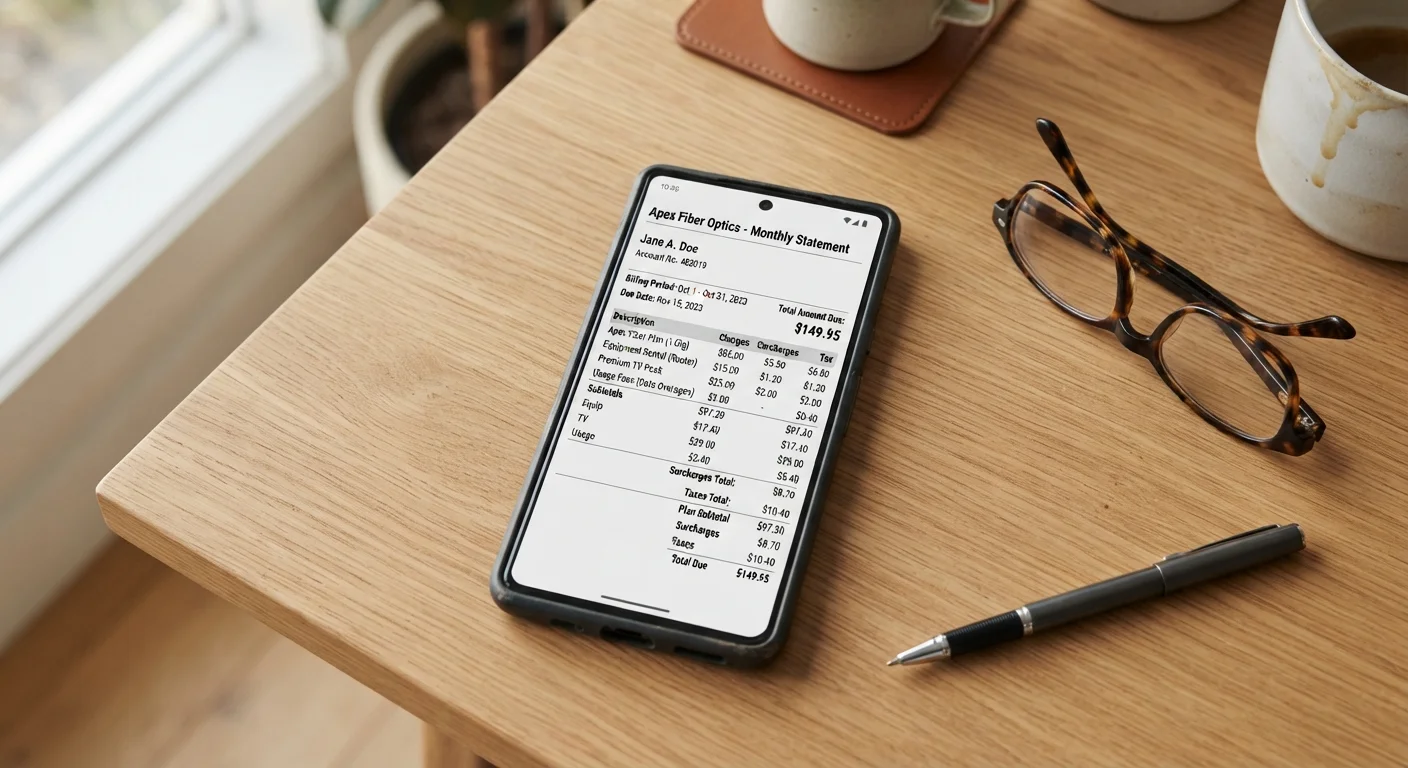
The most prominent number on your bill is the monthly plan rate - what the carrier advertised when you signed up. This covers voice minutes, text messaging, and a defined allotment of data. However, this figure rarely reflects what you'll actually pay. Carriers typically advertise per-line pricing based on multi-line accounts with autopay discounts applied, so a solo plan or a paper-billing preference can push that number higher before any taxes are added.
If you're financing a device through your carrier, a separate Equipment Installment Plan (EIP) charge appears alongside the service fee. These are legally distinct: the service portion covers your plan, while the EIP is effectively a loan for the hardware. See the full breakdown of carrier phone financing to understand how total cost of ownership compares to buying outright.
Watch for plan-level add-ons billed here too: device protection insurance, international calling bundles, or premium streaming perks that were included free during a promotional window but converted to paid line items after the trial ended.
| Typical additional fees above advertised price | 15%-25% depending on state and local taxes (Tax Foundation, Wireless Taxes and Fees Report) |
| Federal USF contribution factor | Set quarterly by the FCC; billed as a percentage of interstate charges (Federal Communications Commission) |
| E911 fee structure | Per-line, per-month; amount varies by state and county (National Emergency Number Association (NENA)) |
| Third-party cramming block | Available free of charge; request from carrier directly (FCC Consumer Guide on Mobile Cramming) |
| EIP vs. service charge | Treated as separate contracts; canceling service may not cancel device balance (Consumer Financial Protection Bureau guidance) |
Taxes, Fees, and Surcharges: A Field Guide
This section of the bill is where most confusion lives. Charges fall into two broad categories: government-mandated taxes and carrier-imposed surcharges. Both look official, but they behave differently.
Government Taxes and Fees
- Federal Universal Service Fund (USF): Funds the FCC program that subsidizes phone and broadband access for rural areas, schools, libraries, and low-income households. Carriers pass this through to customers as a percentage of eligible charges.
- State and local sales tax: Applied to wireless service in most states, rates vary by jurisdiction - sometimes dramatically.
- E911 fee: A per-line charge that funds the infrastructure behind emergency 911 services. Set at the state or local level; typically a few dollars per line.
- Telecommunications relay service (TRS) fee: Supports services like video relay for people who are deaf or hard of hearing. Usually a very small per-line charge.
Carrier Surcharges (Not Taxes)
These are fees carriers add themselves and label with government-sounding names. They are legal, but they are not mandated by any specific regulation. Common examples include Administrative Charge, Regulatory Charge, and Federal Programs Cost Recovery Fee. Carriers set these amounts and can change them with notice. They aren't negotiable, but understanding that they're carrier revenue - not a government pass-through - is important context. For a deeper look at the terminology carriers use, the Phone Plan Glossary defines these and similar terms in plain language.
Carrier Fees vs. Government Taxes: A Key Distinction
Not every official-sounding charge on your bill is a government tax. Carriers are permitted to add their own surcharges and label them with regulatory-sounding names. While these fees are disclosed in service agreements, they are set by the carrier - not legislated. If a fee increases, it's because the carrier chose to raise it, not because a tax rate changed. Reviewing the fine print on your service agreement clarifies which charges fall into each category.
Credits, Adjustments, and One-Time Charges
The bottom portion of most bills includes any credits applied that month and one-time charges. Promotional credits - such as a trade-in credit or a plan switch incentive - appear here as negative amounts. These are typically applied for a fixed number of months; when they expire, your bill increases automatically.
One-time charges cover things like activation or upgrade fees, which some carriers still assess per line or per device swap. International roaming overages, premium SMS charges, or third-party content subscriptions billed through your carrier also appear as one-time or variable items.
If a charge looks unfamiliar, it's worth checking whether a third-party service was authorized to bill through your carrier - a practice called cramming. The FCC has rules requiring carriers to make it easy to block third-party charges, and you can request a block at no cost. Before committing to any plan structure that makes these charges harder to spot, review what to verify before signing a carrier agreement.
Finally, compare your total against what you expected when you enrolled. Common assumptions that cost people money on their phone plans documents how gaps between advertised and actual costs develop over time - and how to close them.
Universal Service Fund (USF)
A federally administered program that subsidizes telecommunications access for underserved communities, schools, and libraries. Carriers collect a portion of eligible revenue and pass costs to consumers as a line-item surcharge.
Equipment Installment Plan (EIP)
A financing arrangement in which the cost of a device is spread across monthly payments - typically 24 to 36 months - billed separately from the wireless service charge.
Cramming
The practice of placing unauthorized or misleading third-party charges on a phone bill. The FCC requires carriers to provide free blocking of third-party billing upon request.
Administrative Charge
A carrier-set surcharge, not a government tax, intended to recover internal costs such as billing system maintenance or regulatory compliance expenses. The carrier determines the amount.
E911 Fee
A per-line charge mandated at the state or local level to fund emergency 911 infrastructure, including call-routing systems and dispatcher networks.
Regulatory Recovery Fee
A carrier-imposed fee that sounds like a government pass-through but is actually set and retained by the carrier to offset compliance costs. The amount and label vary by carrier.