

Key Takeaways
Option A
Month-to-Month Lease
The flexible, no long-term commitment option.
Best for: Renters who need the freedom to relocate with short notice or whose living situation may change in the near term.
Option B
Fixed-Term Lease
The stable, predictable long-term rental agreement.
Best for: Renters who want locked-in rent, a secure place to stay for a defined period, and greater landlord accountability.
If you're relocating for work or expecting a major life change soon
Month-to-Month Lease
Short notice periods let you exit without penalty, which is critical when your timeline is uncertain.
If you've found a neighborhood and unit you love and want to stay put
Fixed-Term Lease
A fixed-term agreement locks in your rent and prevents the landlord from asking you to leave mid-year.
If you're on a tight, predictable budget and need consistent monthly costs
Fixed-Term Lease
Your rent rate is guaranteed for the lease period, protecting you from mid-year increases.
If you're new to a city and still exploring which neighborhood fits
Month-to-Month Lease
Going month-to-month lets you learn the area and move when you find a better long-term fit.
If you're trying to save money and qualify for the lowest possible rent
Fixed-Term Lease
Landlords often offer lower rates on fixed-term agreements in exchange for the guaranteed occupancy period.
What Each Lease Type Actually Means
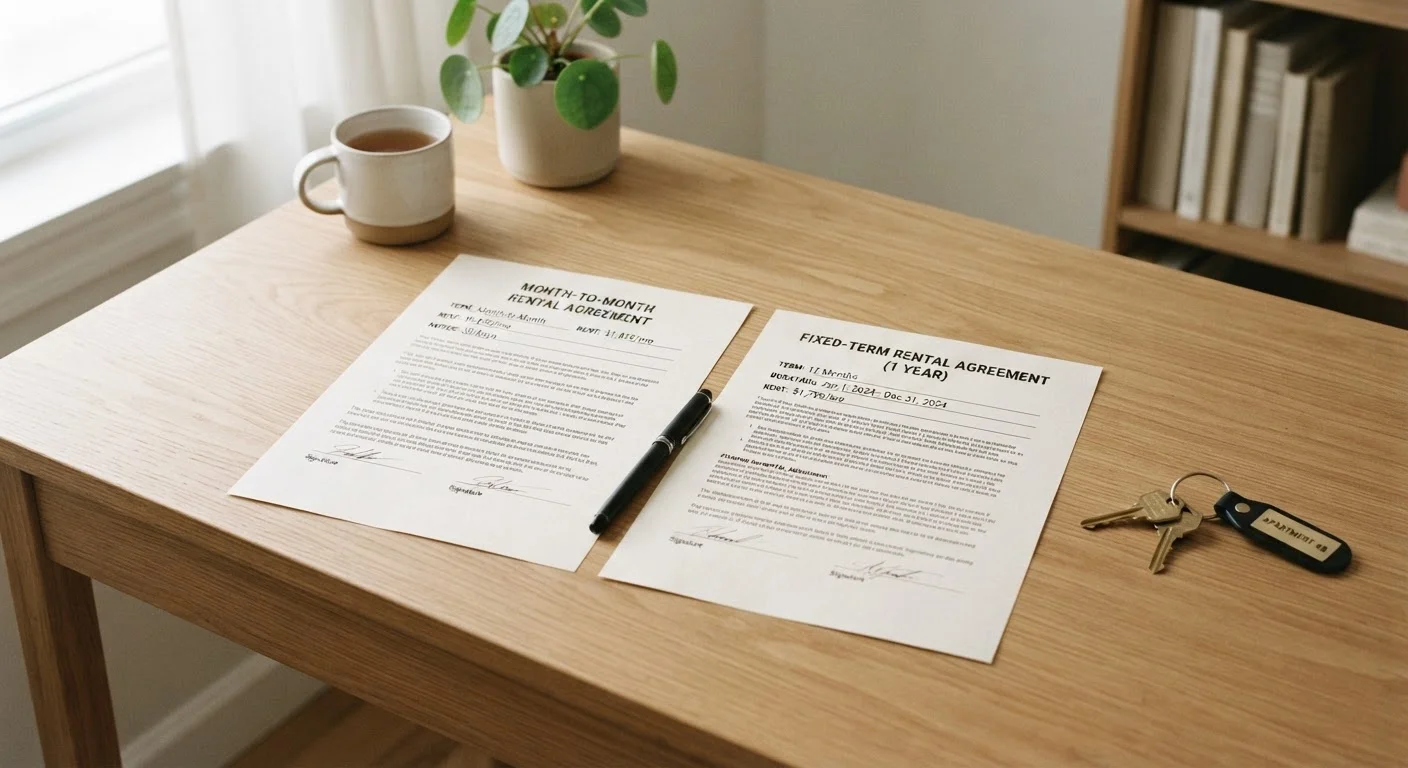
A month-to-month lease (also called a periodic tenancy) renews automatically each month unless either the tenant or landlord gives written notice to end it - typically 30 days, though this varies by state. There is no defined end date baked into the agreement.
A fixed-term lease runs for a set period - most commonly 12 months - and spells out a clear start and end date. Both parties are bound to those terms unless specific exit clauses apply. At the end of the term, you typically have the option to renew, sign a new lease, or transition to a month-to-month arrangement.
Understanding how each works at a structural level is the starting point. For a deeper look at what every clause in either type of agreement actually obligates you to, see this plain-English lease guide before you sign anything.
| Criterion | Month-to-Month | Fixed-Term (12 months) |
|---|---|---|
| Lease length | Renews monthly, no set end | Set period, typically 12 months |
| Typical rent cost | Often 10-20% higher | Usually lower, locked-in rate |
| Flexibility to move | High - 30-day notice typical | Low - early exit incurs penalties |
| Rent increase risk | Higher - can change each month | Protected for lease term |
| Landlord termination notice | 30 days in most states | Cannot terminate without legal cause |
| Best for | Transitional or uncertain timelines | Stable, long-term housing needs |
The Real Trade-Offs: Flexibility, Cost, and Security
The appeal of a month-to-month lease is mobility. If you receive a job offer in another city, need to move in with a family member, or simply want to upgrade your living situation, you can do so within a relatively short window. That said, this freedom comes with a cost - literally. Landlords commonly charge a premium of 10-20% above market rate on month-to-month agreements to compensate for the uncertainty of not knowing when the unit will turn over.
The flip side is that a month-to-month landlord can also give you notice to vacate - again, usually within 30 days - with few restrictions in most states. That's a meaningful vulnerability if the housing market in your area is tight.
Fixed-term leases remove much of that uncertainty. Your rent rate is set, and the landlord generally cannot ask you to leave before the term ends without legal cause. The trade-off is the early-termination clause: breaking a fixed-term lease typically means forfeiting some or all of your security deposit, paying a fee equivalent to one or two months' rent, or remaining liable for rent until a new tenant is found.
30 days
Typical notice period for month-to-month exit
Most U.S. states require at least 30 days' written notice from either party to end a month-to-month tenancy, though some states require 60 days.
1-2 months
Common early termination fee on fixed-term leases
Lease agreements frequently specify a fee of one to two months' rent for breaking a fixed-term agreement before its end date.
If you're unsure whether renting is even the right path for your situation right now, it's worth reviewing the broader picture in our renting vs. buying comparison.
Situational Factors That Should Drive Your Decision
There is no universally better lease type - the right answer depends entirely on your circumstances. Consider these factors:
- Job stability: If your employment is secure and location-fixed, a fixed-term lease makes financial sense. If you're freelancing, on contract, or mid-career transition, month-to-month preserves your options.
- Local rental market: In a high-demand urban market, fixed-term agreements can protect you from rapid rent escalation. In slower markets, landlords may be more open to negotiating the lease length itself.
- Life timeline: Expecting a baby, planning a home purchase within a year, or waiting on a relocation package? Month-to-month buys you time. Settled and planning to stay? Lock in the rate.
- Roommate situations: When multiple people are on a lease, changes in who's living there get complicated fast. Sorting out lease arrangements with roommates upfront is critical regardless of lease type.
It's also worth knowing that lease length itself can sometimes be negotiated. A landlord may accept a six-month fixed term, or agree to lock in rent on a month-to-month agreement, if you ask. Our guide on negotiating rent and lease terms covers how to approach that conversation.
State Law Shapes Your Rights Either Way
Lease rules - notice periods, allowable rent increases, early-termination protections - vary significantly by state and sometimes by city. What's true in California may not apply in Texas or Florida. Always verify your local tenant rights before signing, and consult a tenant rights organization or attorney if you're unsure about specific provisions. The full rental lifecycle guide can also help you understand what to expect at each stage of your tenancy.