

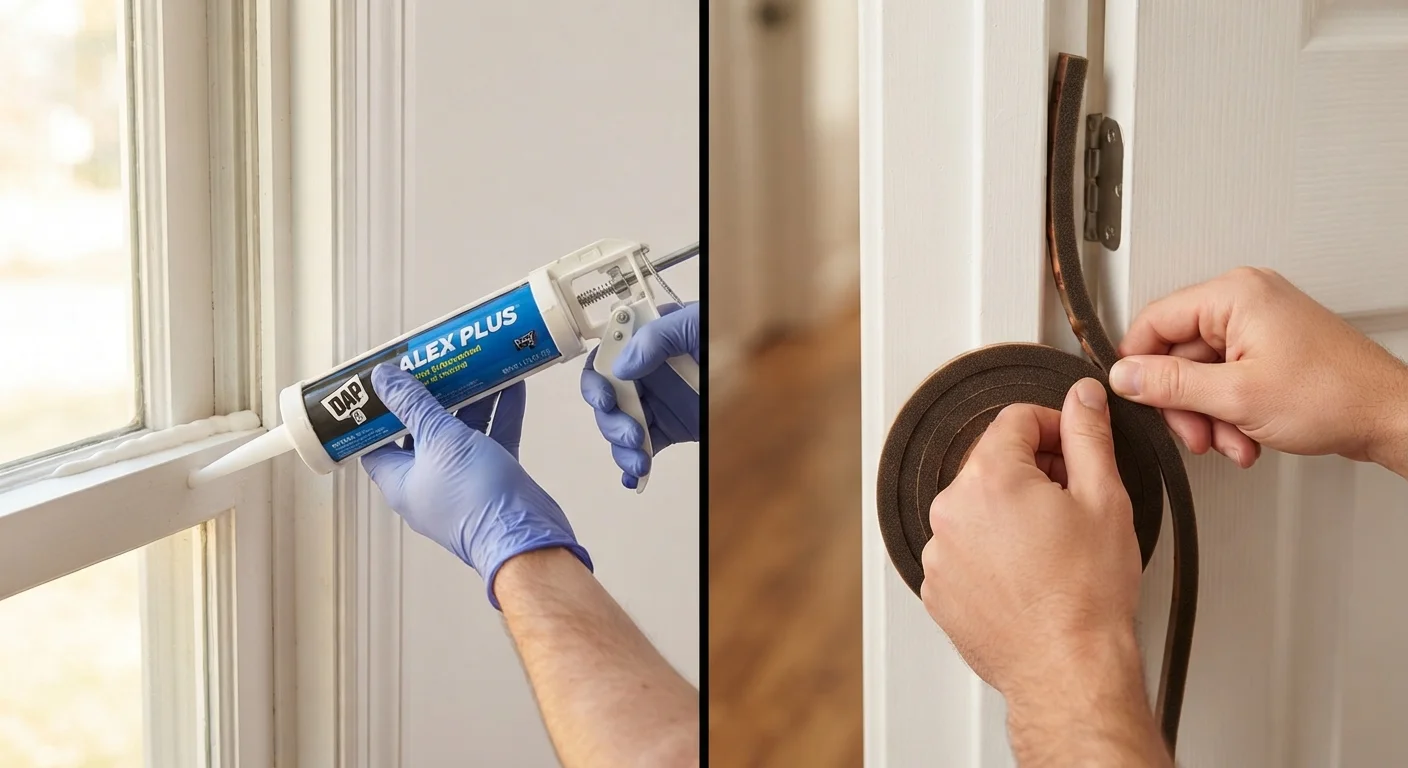
Key Takeaways
Option A
Caulk
The permanent, flexible filler for stationary gaps.
Best for: Sealing fixed joints between surfaces that don't move, such as window frames meeting siding or trim meeting drywall.
Option B
Weatherstripping
The compressible seal designed for moving parts.
Best for: Creating an air-tight seal around doors and operable windows that open and close repeatedly.
If you're sealing gaps around window frames, baseboards, or exterior trim
Caulk
These joints are stationary and need a permanent, paintable fill that won't compress or shift.
If you're stopping drafts around an exterior door that opens daily
Weatherstripping
Weatherstripping is built to compress and recover through thousands of open-and-close cycles without cracking.
If you're finishing a full window replacement or new door installation
Both
Caulk seals the fixed frame to the rough opening, while weatherstripping seals the operable sash or door panel itself.
If you're tackling a quick seasonal draft fix on a tight budget
Weatherstripping
Adhesive-backed foam or V-strip weatherstripping installs in minutes with no drying time and is easy to replace.
What Each Product Actually Does
Both caulk and weatherstripping block air, water, and sometimes noise - but they accomplish that through fundamentally different mechanisms, and confusing the two is one of the most common and costly sealing mistakes homeowners make.
Caulk is a pliable compound applied as a bead that cures into a semi-flexible or rigid seal. It's designed to fill and permanently bond across a gap where neither surface moves. Silicone, latex, and polyurethane are the main formulas, each with different flexibility levels, paintability, and resistance to moisture. The key word is permanent: once cured, caulk is not designed to tolerate repeated compression or stretching.
Weatherstripping is a physical barrier - foam, rubber, vinyl, or felt - installed along the edges of doors and operable windows. Unlike caulk, it works by being compressed each time the door or window closes, then springing back when it opens. That repeated compression cycle is exactly what caulk cannot handle.
The Movement Test
Before reaching for either product, run a simple test: does the surface you're sealing open, close, or flex in any way during normal use? If it moves, weatherstripping is the appropriate tool. If it stays put, caulk is the right choice. Applying caulk to a moving joint almost guarantees premature failure - typically within one season.
Think of it this way: if the joint moves when you open or close something, weatherstripping is the answer. If the joint is fixed, caulk is the tool for the job.
Where to Use Caulk
Caulk belongs anywhere two stationary building materials meet with a small, fixed gap. Common locations include:
- The perimeter where window and door frames meet exterior siding or interior drywall
- Baseboards and crown molding meeting walls
- Penetrations through exterior walls, such as pipe or conduit entry points
- The joint between a bathtub and tile surround (using a mold-resistant formula)
- Gaps in exterior trim or fascia boards
Silicone caulk handles moisture-heavy areas and exterior exposure well, but it won't accept paint. Latex or siliconized-latex formulas are easier to paint over and clean up with water, making them preferable for interior trim work. Polyurethane caulk is extremely durable for exterior gaps but requires mineral spirits to clean and must be painted over to protect it from UV degradation.
If your existing caulk is cracking, peeling, or pulling away from the surface, the sealant isn't just failing cosmetically - it's creating a pathway for moisture and heat loss. The most common causes of premature caulk failure come down to poor surface prep, applying over existing caulk, or choosing the wrong formula for the location.
| Criterion | Caulk | Weatherstripping |
|---|---|---|
| Best surface type | Stationary, fixed joints | Moving parts - doors, operable windows |
| Common materials | Silicone, latex, polyurethane | Foam, rubber, vinyl, felt, metal |
| Tolerates repeated movement | No - cracks and separates | Yes - designed for it |
| Typical lifespan | 5-10 years (varies by formula) | 2-5 years (varies by material) |
| DIY difficulty | Low to moderate | Low |
| Paintable | Depends on formula (latex: yes; silicone: no) | Generally no |
| Drying or cure time | Hours to 24+ hours | None - immediate use |
Where to Use Weatherstripping
Weatherstripping belongs on any surface that opens, closes, or slides. The four main types each suit different applications:
- Foam tape: Adhesive-backed closed-cell foam works well for casement windows and infrequently used doors. It compresses easily but wears out faster under heavy use.
- V-strip (tension seal): A folded strip of plastic or metal that fits into the channel along a door or window edge. Very durable and nearly invisible when installed correctly.
- Door sweeps: Mounted to the bottom of exterior doors to seal the gap at the threshold. Available in brush, rubber, and fin styles.
- Bulb or tubular rubber/vinyl: Compresses firmly against a door stop and handles high-traffic doors well without deteriorating quickly.
For a comprehensive approach to reducing heat loss, sealing entry points with weatherstripping works in tandem with wall and attic insulation. Our insulation type comparison explains how the two layers of protection complement each other in a complete building envelope.
Replacing worn weatherstripping is a straightforward weekend task: remove the old material, clean the surface with rubbing alcohol, and press or nail the new strip into place. No drying time, no fumes, and the improvement is immediate.
Making the Right Call Before You Start
Before buying either product, ask yourself two diagnostic questions:
- Does this joint move? If yes, weatherstripping. If no, caulk.
- How large is the gap? Caulk handles gaps up to about half an inch reasonably well. Larger gaps may need a backer rod inserted first, or a different solution entirely such as expanding foam sealant for deep wall penetrations.
Many homeowners discover during a seasonal energy audit that they need both products working together. A new exterior door, for example, requires caulk around the fixed frame where it meets the house, and weatherstripping along the door panel itself. Applying only one or the other leaves part of the gap unsealed.
Check your doors and windows each fall by holding a lit incense stick or a thin piece of tissue near the edges on a windy day. Movement indicates air infiltration - and a clear signal about which seal is missing or has failed.
30%
Heat loss through gaps and cracks
The U.S. Department of Energy estimates that air leaks through gaps, cracks, and openings can account for up to 30% of a home's heating and cooling costs.
$0.25-$1.50
Cost per linear foot of weatherstripping
Foam and felt weatherstripping is among the most affordable home sealing options, with more durable rubber and vinyl strips running slightly higher per foot.