
Why 'Eating Healthy' Feels Confusing - and How Nutrition Science Actually Works

Key Takeaways
Nutrition Science
Nutrition science is the study of how food and its components affect the human body, health, and disease. It draws on biology, chemistry, epidemiology, and clinical medicine to understand what people eat, why it matters, and how dietary patterns influence long-term health outcomes. Like all sciences, it advances through ongoing research - meaning recommendations can evolve as evidence accumulates.
Much of population-level nutrition research relies on observational epidemiology, which can identify associations between diet and health outcomes but generally cannot establish direct causation on its own.
The Headlines Aren't Wrong - They're Just Incomplete
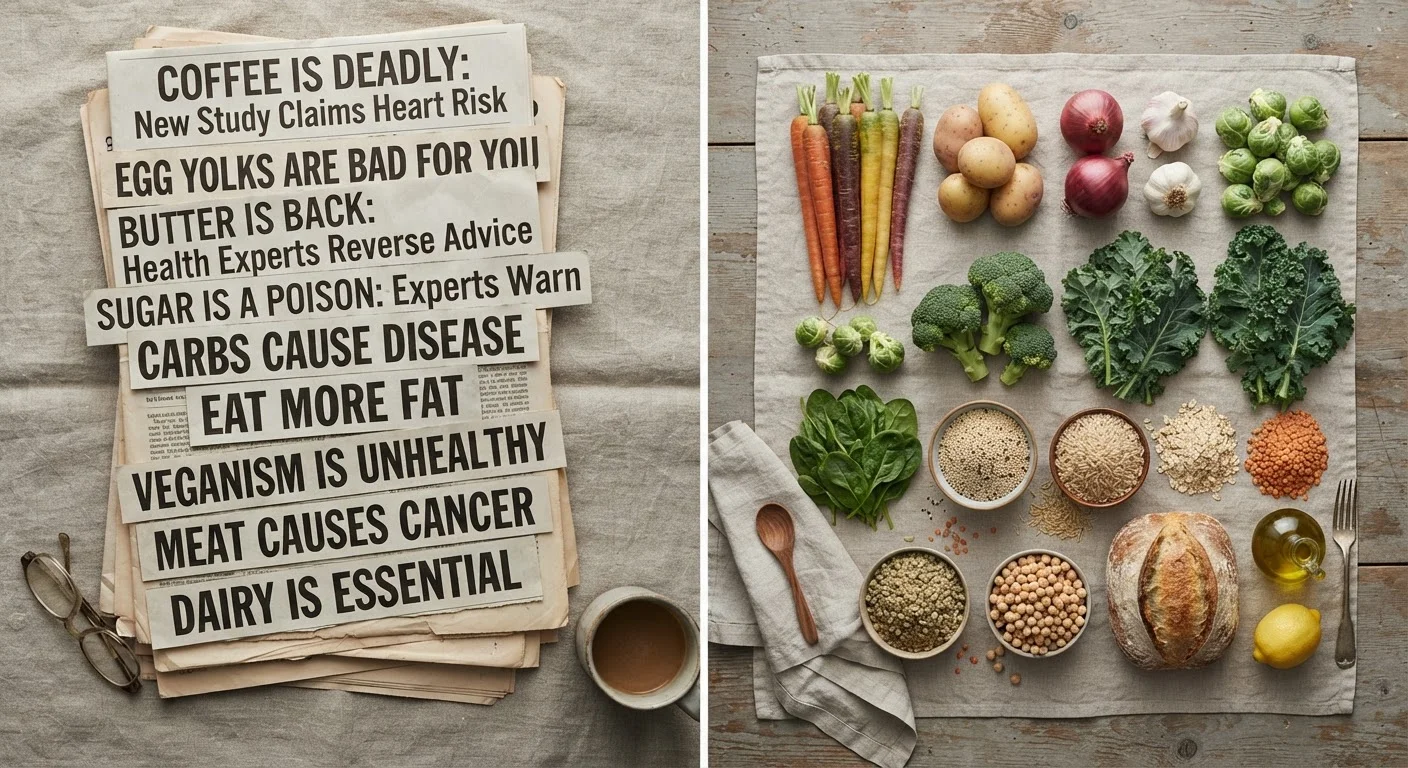
One week, eggs are dangerous. The next, they're a health food. Coffee causes cancer; coffee prevents it. Fat is the enemy; no, sugar is. If you've ever felt whiplash from nutrition news, you're not misreading it - you're noticing something real about how nutrition research gets communicated.
The confusion rarely comes from scientists disagreeing randomly. More often, it comes from how individual studies get translated into headlines, stripped of the caveats that make them meaningful. Understanding a few basics about how nutrition studies are designed goes a long way toward filtering signal from noise.
For a practical complement to this foundation, see our guide to whole foods vs. processed foods, which applies these principles to one of the most common areas of dietary confusion.
How Nutrition Studies Are Actually Designed
Nutrition research uses several different study designs, each with strengths and limitations.
- Observational studies track what large groups of people eat over time and correlate those patterns with health outcomes. They can identify associations - like the link between heavily processed food intake and cardiovascular risk - but can't fully isolate cause and effect. People who eat more vegetables may also exercise more, sleep better, and smoke less; separating these influences is genuinely difficult.
- Randomized controlled trials (RCTs) assign participants to different dietary interventions and measure outcomes. These can more directly test causation, but long-term dietary RCTs are logistically challenging and expensive to conduct. You can't blind someone to what they're eating the way you can blind them to a pill.
- Systematic reviews and meta-analyses pool data from multiple studies to identify consistent patterns. These are generally considered the strongest form of evidence because they reduce the influence of any single study's quirks.
When a single observational study produces a headline, it's a data point - not a verdict. Scientific consensus forms when diverse study types converge on the same conclusion over time.
~90%
Nutrition studies that are observational in design
Estimates from nutrition research methodology reviews suggest the large majority of published diet-health studies rely on observational rather than experimental methods, underscoring why replication and design type matter when interpreting findings.
3-5x
Times more likely a headline overstates a single study
Science communication researchers have documented that media coverage of nutrition studies frequently omits key methodological caveats, amplifying findings beyond what the study design supports.
30+ years
Duration of some long-running dietary cohort studies
Landmark studies like the Nurses' Health Study have followed participants for decades, providing some of the most robust long-term data on diet and chronic disease risk available in the field.
Why Dietary Patterns Matter More Than Individual Foods
One of the most durable findings in nutrition science is that overall dietary patterns predict health outcomes more reliably than any single food or nutrient. The Mediterranean diet, for example, has been associated with reduced cardiovascular risk across decades of research and multiple study types - not because olive oil is magic, but because the pattern as a whole - abundant vegetables, legumes, fish, and whole grains with limited ultra-processed foods - appears to be protective.
Focusing on individual nutrients in isolation - the "fat is bad" era of the 1980s and 1990s is a prime example - can produce well-intentioned but misleading guidance. When dietary fat was villainized, many food manufacturers replaced fat with refined sugar, which contributed to its own set of metabolic concerns. The lesson wasn't that fat is good and sugar is bad; it's that reductive thinking about single nutrients tends to oversimplify a complex system.
“The science of nutrition is more consistent than it appears in popular media. The basic principles - eat more plants, limit ultra-processed foods, favor whole grains - have held up remarkably well over decades of research.”
— Walter Willett, Professor of Epidemiology and Nutrition, Harvard T.H. Chan School of Public Health
If you're trying to apply this practically, our article on nutrition myths that refuse to die examines how some of these oversimplifications became entrenched cultural beliefs.
How to Read a Nutrition Claim More Critically
A few questions help separate strong evidence from noise when you encounter a nutrition claim:
- What kind of study is this? An observational study in 500 people over two years carries less weight than a meta-analysis of dozens of trials.
- Is the finding replicated? A single study - even a well-designed one - is a starting point, not a conclusion.
- What's the effect size? A 2% increased risk sounds alarming in a headline but may be clinically trivial. Context matters enormously.
- Who funded the study? Industry-funded research isn't automatically invalid, but funding source is a legitimate factor in evaluating potential bias.
- Does it contradict established consensus? When a single new study seems to overturn decades of evidence, scrutiny is warranted before updating your beliefs.
Learning to read a nutrition label with this same critical eye is also valuable. Our guide to reading nutrition labels breaks down what the numbers actually mean.
This article is for general informational and educational purposes only and is not a substitute for professional medical or dietary advice. Consult a qualified healthcare provider or registered dietitian for guidance specific to your health needs.