

Key Takeaways
Option A
Whole Foods
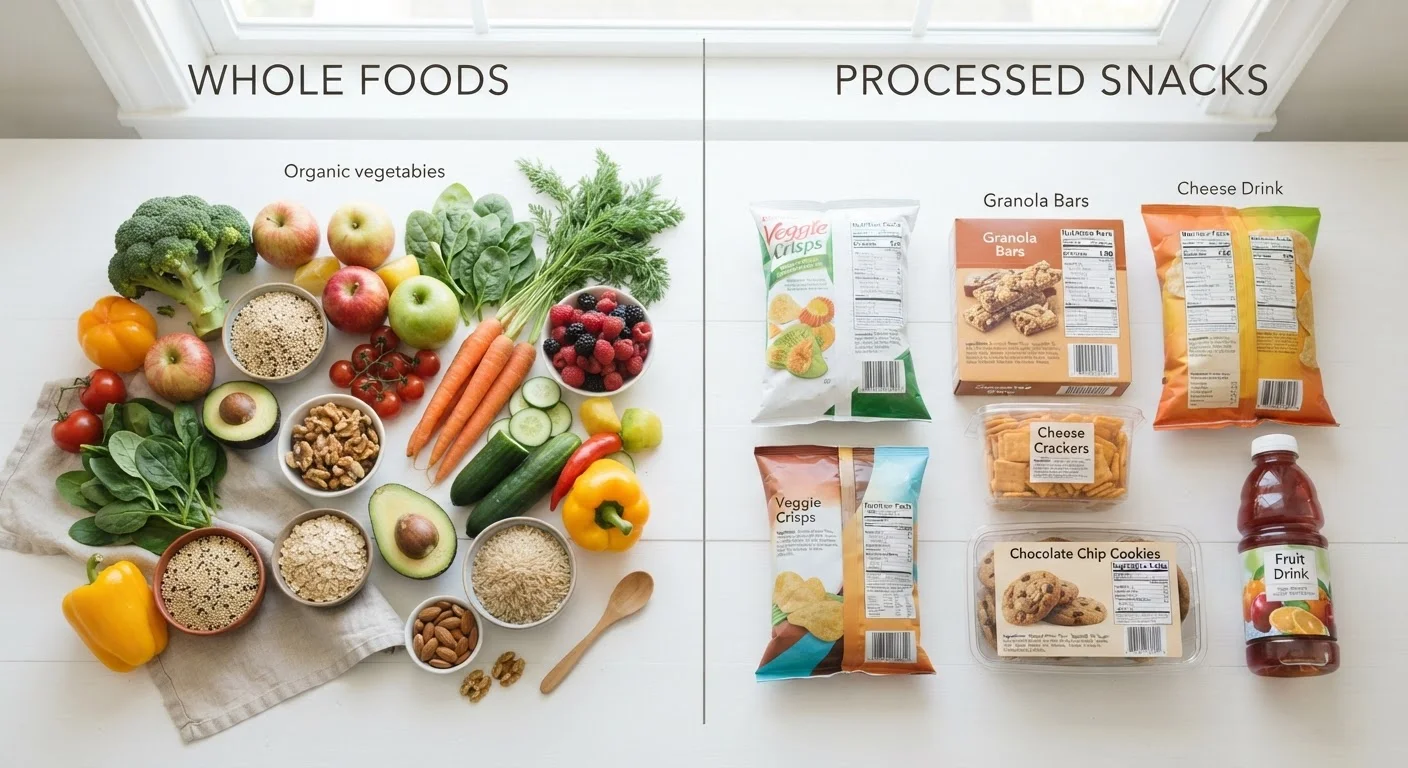
Foods in their natural or minimally altered state.
Best for: Readers seeking nutrient-dense dietary foundations with minimal additives or ingredient manipulation.
Option B
Processed Foods
A broad category spanning minimally to heavily modified food products.
Best for: Understanding where convenience foods fall on the spectrum - and which processing levels genuinely matter for health.
If you want to build a nutrient-dense dietary foundation
Whole Foods
Whole foods provide fiber, micronutrients, and phytonutrients in their most intact forms, supporting overall dietary quality with minimal nutritional trade-offs.
If you need practical, affordable convenience without abandoning nutrition
Processed Foods
Minimally processed options like canned legumes, frozen vegetables, and plain yogurt offer real nutritional value and are widely accessible for everyday meal planning.
If you are trying to reduce chronic disease risk through diet
Whole Foods
Large observational studies consistently associate diets higher in whole foods and lower in ultra-processed foods with reduced risk of cardiovascular disease, obesity, and type 2 diabetes.
If you are evaluating a specific packaged product
Processed Foods
Not all packaged foods are nutritionally poor. Learning to read ingredient lists and nutrition labels helps you distinguish lightly processed items from ultra-processed ones.
What 'Processed' Actually Means
The word processed gets used as shorthand for unhealthy, but technically it describes any food that has been altered from its raw state. That definition covers an enormous range - from washed and bagged spinach to shelf-stable cheese-flavored crackers packed with additives. Treating them as equivalent misrepresents the real nutritional picture.
A widely used framework developed by Brazilian nutrition researchers - the NOVA classification - groups foods into four categories based on the degree and purpose of processing: unprocessed or minimally processed foods, processed culinary ingredients (like oils and flours), processed foods (canned, fermented, or salted products), and ultra-processed foods. The last category - which includes items formulated with industrial additives, flavor enhancers, and emulsifiers largely absent from home cooking - is the one most examined in chronic disease research.
Understanding where a food falls on this spectrum is far more useful than applying a simple whole-vs-processed binary. Reading a nutrition label carefully can help you identify where a packaged product sits on that spectrum.
| Criterion | Whole Foods | Processed Foods |
|---|---|---|
| Definition | Unaltered or minimally altered from natural state | Any food changed from raw form - a wide spectrum |
| Fiber content | Generally high and intact | Often reduced; varies by processing level |
| Micronutrient retention | Typically well-preserved | Variable; some fortified, others depleted |
| Added sugars & sodium | Naturally low or absent | Can be high in ultra-processed products |
| Shelf stability | Generally lower | Often extended via preservation methods |
| Cost & accessibility | Varies; fresh produce can be costly | Often affordable; widely available |
| Health research association | Linked to better long-term outcomes | Ultra-processed linked to chronic disease risk |
The Nutritional Case for Whole Foods
Whole foods - fresh vegetables, fruits, legumes, whole grains, nuts, seeds, and unprocessed meats - tend to retain their full complement of fiber, vitamins, minerals, and phytonutrients. These compounds often work synergistically; the benefit of eating an apple, for instance, likely comes from the combination of fiber, antioxidants, and water content together - not from any single nutrient in isolation.
Research consistently associates higher whole food intake with better cardiovascular, metabolic, and gut health outcomes. Dietary fiber, found abundantly in whole plant foods, supports healthy blood sugar regulation and gut microbiome diversity. Many vitamins and polyphenols found in whole foods degrade or are removed during heavy processing.
That said, not every whole food is nutritionally complete on its own, and no single food category determines overall health. Research on dietary patterns shows that the overall composition of the diet - not individual foods eaten in isolation - is what most strongly predicts health outcomes over time.
57%
Share of American calories from ultra-processed foods
Research published in the BMJ estimated that ultra-processed foods account for more than half of daily caloric intake for U.S. adults.
10%+
Greater all-cause mortality risk with ultra-processed diets
A large prospective cohort study in JAMA Internal Medicine found significantly higher mortality risk associated with higher ultra-processed food consumption.
25g / 38g
Daily fiber targets for adult women and men
The Dietary Guidelines for Americans recommend these daily fiber targets, which most Americans fall well short of - a gap whole foods can help close.
When Processing Is Neutral - or Even Beneficial
Some forms of food processing exist to protect health, not undermine it. Pasteurization eliminates harmful pathogens in dairy and juice. Fortification adds nutrients back to foods - iodized salt virtually eliminated iodine deficiency in the United States, and folic acid fortification of grain products has significantly reduced neural tube defect rates. Fermentation transforms raw ingredients into yogurt, kefir, and sauerkraut - foods that may actively support gut health.
Frozen vegetables are another useful example: they are typically blanched and frozen shortly after harvest, which preserves many nutrients at levels comparable to - and sometimes exceeding - those in fresh produce that has traveled long distances. Canned beans, rinsed before use to reduce sodium, are a convenient, affordable, nutritionally solid option.
The practical takeaway is that processing level alone does not determine nutritional value. Ingredient quality, sodium content, added sugars, and the presence of artificial additives are more meaningful indicators than whether a food comes in a package. For a deeper look at how ultra-processed foods specifically fit into American eating patterns, see where ultra-processed foods fit in the modern American diet.
This article is for general informational and educational purposes only and is not a substitute for personalized dietary or medical advice. Consult a registered dietitian or qualified healthcare professional before making significant changes to your diet.
Confused by Conflicting Nutrition Headlines?
Nutrition science can seem contradictory because individual studies often make headlines before the full body of evidence is established. Understanding how dietary research is designed - and its inherent limitations - helps put any single finding in context. Learn why nutrition guidance can feel contradictory and how to evaluate what you read.