

Key Takeaways
Our Verdict
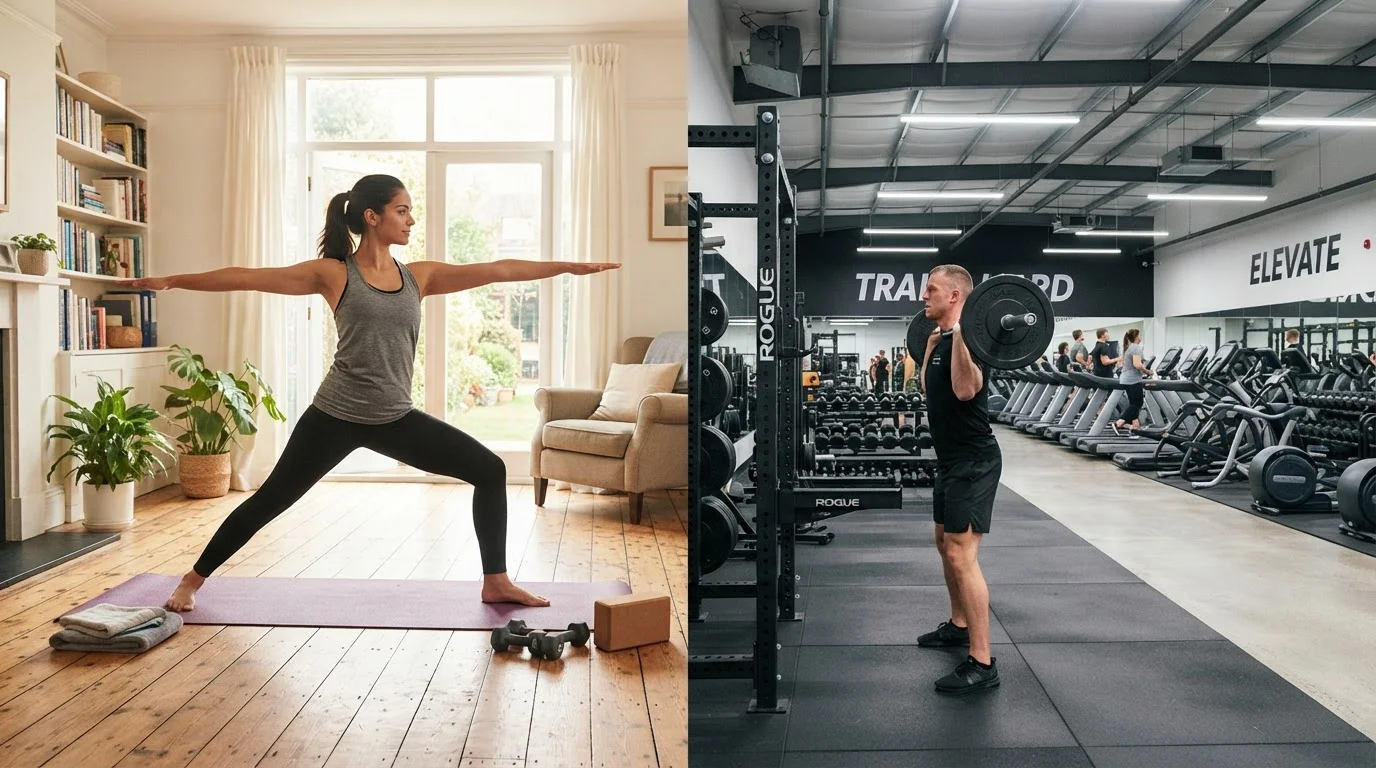
Both home and gym workouts are legitimate, effective approaches to fitness. Home training wins on convenience, cost, and privacy, while gyms provide equipment variety, expert access, and a socially motivating atmosphere. Most people will find that their ideal setup reflects their lifestyle, not a single correct answer.
| Best for | Recommended |
|---|---|
| Those working within tight budgets or unpredictable schedules | Home Workouts |
| Those pursuing strength training with progressive overload or specialized equipment | Gym Workouts |
| Beginners who want low-pressure entry into exercise | Home Workouts |
| Those who thrive on community, classes, or coached instruction | Gym Workouts |
The Core Trade-offs at a Glance
Choosing between a home workout and a gym isn't just about equipment - it's about understanding which environment actually supports your habits. Both can produce real fitness results. The difference lies in how each setting aligns with your lifestyle, goals, and motivation style.
| Home Workouts | Gym Workouts | |
|---|---|---|
| Upfront Cost | Low to none (bodyweight) or modest equipment investment | Membership fees plus possible initiation costs |
| Equipment Variety | Limited unless you invest significantly | Extensive - barbells, machines, cables, cardio equipment |
| Convenience | Very high - no commute, flexible hours | Moderate - requires travel and operating hours |
| Progression Options | Requires creativity or equipment purchases | Straightforward with adjustable weights |
| Motivation Environment | Self-directed, more distractions | Structured, social, purpose-built space |
| Professional Guidance | Online resources only | Trainers, classes, and staff on-site |
| Privacy | Completely private | Shared public space |
For a deeper understanding of how different training variables affect your progress, see our guide to fitness metrics like reps, sets, and intensity.
Cost and Accessibility
Home workouts carry a low barrier to entry. Bodyweight exercises - push-ups, squats, lunges - require no equipment at all, and a modest investment in resistance bands or a set of adjustable dumbbells can expand options significantly. There are no membership fees, no commute, and no operating hours to work around.
Gym memberships vary widely in cost depending on location and facility type. Basic memberships at large chain facilities can be affordable, but premium gyms, personal training sessions, and specialty studios add up. However, gyms provide access to equipment - barbells, cable machines, squat racks - that would cost thousands to replicate at home.
If cardio without a gym setting interests you, our article on cardio that doesn't require a gym membership covers practical options from brisk walking to jump rope.
Start With What You'll Actually Do
The most effective workout environment is the one you'll use consistently. If a gym membership goes unused after the first month, the equipment variety it offers provides no real benefit. Honest self-assessment about your habits - not aspirational thinking - should guide your initial choice. You can always adjust your approach as your routine becomes more established.
Equipment, Variety, and Progression
One of the gym's clearest advantages is equipment range. Progressive overload - gradually increasing resistance or volume over time - is a foundational principle of strength development. Gyms make this straightforward: you simply add weight to the bar. At home, progressing past bodyweight resistance requires creative programming or additional equipment purchases over time.
That said, bodyweight training is more capable than many people assume. Movements like single-leg squats, archer push-ups, and ring rows can challenge even experienced exercisers. For a direct comparison of these approaches, our article on bodyweight training vs. free weights breaks down the practical trade-offs in detail.
Gyms also typically offer group fitness classes, swimming pools, saunas, and other amenities that home setups simply cannot match.
Accountability, Motivation, and Environment
Environment shapes behavior more than most people recognize. A gym visit creates a clear psychological boundary - you're there to train, and the cues around you (other exercisers, equipment, staff) reinforce that purpose. Research in behavioral science consistently shows that environmental design influences habit formation.
Home workouts, on the other hand, compete with distractions: household responsibilities, family members, screens, and comfort. This doesn't make them less effective, but it does require stronger self-direction. Some people find that removing the commute removes a key friction point; others find the commute is the psychological transition that primes them to train.
It's also worth examining whether beliefs about what a "proper" workout requires are shaping your choices. Our article on exercise myths that may be influencing your training addresses some widely held assumptions about gym-based fitness that the evidence doesn't fully support.
Safety, Guidance, and Getting Started
Gyms often provide access to certified personal trainers who can assess form, suggest programming, and reduce injury risk - a real advantage for beginners or anyone returning after a long break. Many also offer onboarding orientations to familiarize new members with equipment.
Home exercisers aren't without resources: reputable online programs, video instruction, and apps can provide structured guidance. However, form feedback is harder to obtain without an in-person professional, and some movements - particularly barbell lifts - carry higher injury risk when performed without proper coaching.
Before starting any new exercise routine, regardless of location, it's worth reviewing our readiness checklist for new exercisers to confirm you're prepared to train safely.
This article is for general informational purposes only and does not constitute medical or professional fitness advice. Consult a qualified healthcare provider before beginning a new exercise program, especially if you have existing health conditions.