

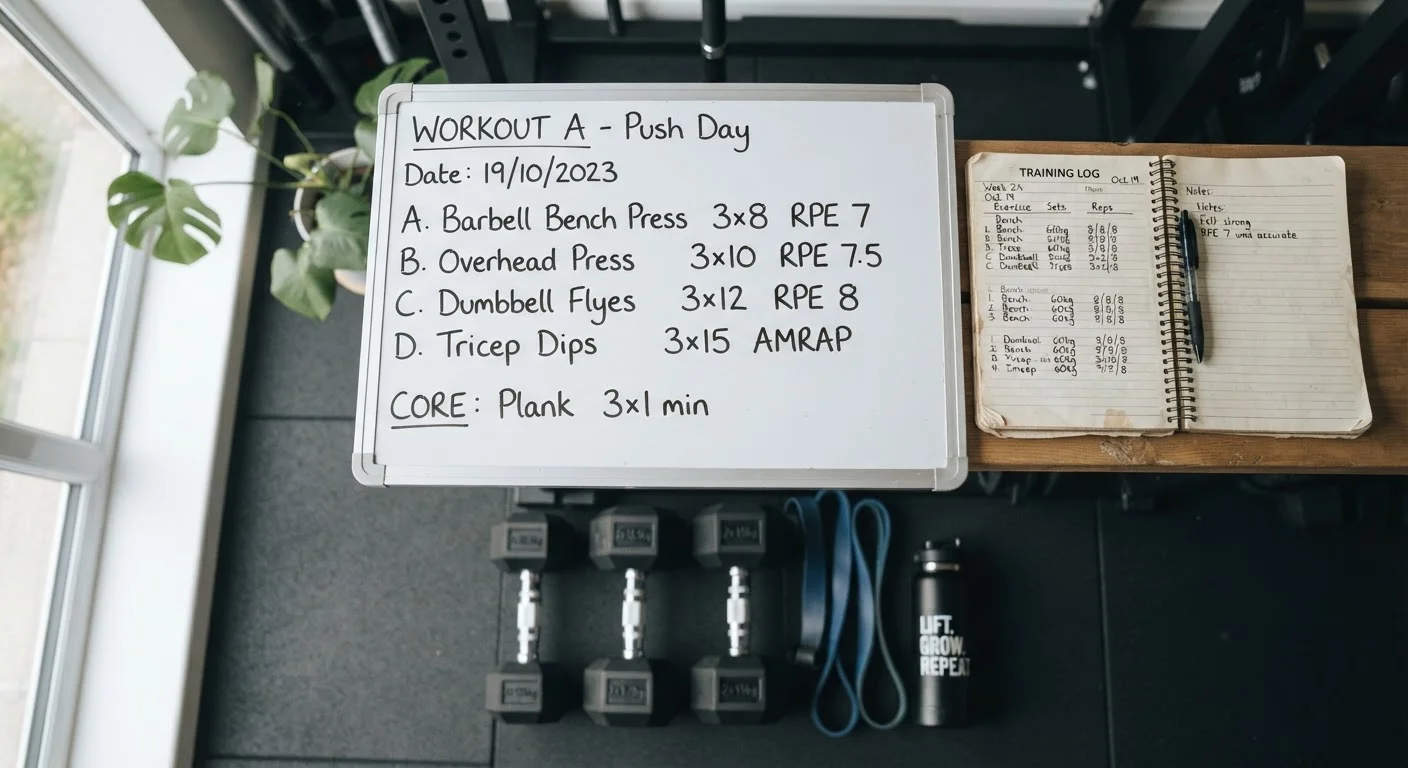
| Notation for 3 sets of 10 reps | Written as "3×10" |
| Rep range typically linked to strength | 1-5 reps per set (General exercise science consensus) |
| Rep range commonly used for muscle building | 6-12 reps per set (General exercise science consensus) |
| Rep range associated with muscular endurance | 15+ reps per set (General exercise science consensus) |
| Volume formula | Sets × Reps × Load |
| RPE scale range | 1 (minimal effort) to 10 (maximum effort) |
The Building Blocks: Reps and Sets
Most workout programs are written in a shorthand that can look cryptic at first - "3x10" or "4 sets of 8 reps" - but the logic behind it is straightforward once you know the vocabulary.
A rep (repetition) is one complete movement of an exercise. One push-up from the floor back to the starting position is one rep. One squat down and back up is one rep. Reps are the smallest unit of measurement in a training plan.
A set is a group of consecutive reps performed without stopping to rest. If you do 10 push-ups, rest, then do 10 more, you have completed two sets of 10 reps - written as 2x10. The rest period between sets is intentional; it allows muscles to partially recover before the next effort.
The number of reps per set is not arbitrary. Research in exercise science suggests that different rep ranges tend to emphasize different training outcomes. Lower rep ranges (roughly 1-5) with heavier loads are commonly associated with developing maximal strength. Moderate ranges (roughly 6-12) are frequently used for muscle building, a goal called hypertrophy. Higher rep ranges (15 or more) with lighter loads tend to build muscular endurance. These are general patterns, not rigid rules, and individual responses vary.
If you are building a fitness routine from scratch, a simple starting structure - such as 2-3 sets of 10-15 reps of basic movements - gives your body time to adapt before increasing demands.
Rep (Repetition)
One complete execution of an exercise movement from start position back to start position. Reps are the smallest unit tracked in a training program.
Set
A group of consecutive reps performed without a rest break. Sets are separated by intentional rest periods to allow partial muscle recovery.
Training Volume
The total amount of work done, calculated as sets × reps × load. In bodyweight training, it is often measured simply as total sets and reps completed.
Intensity
A measure of how demanding an exercise effort is. Can refer to absolute load (e.g., percentage of 1RM) or perceived exertion on a subjective scale (RPE).
Progressive Overload
The training principle of gradually increasing the demands placed on the body over time - through more reps, more sets, or more load - to continue driving adaptation.
Hypertrophy
The increase in muscle size as an adaptation to resistance training. It is typically associated with moderate rep ranges and consistent progressive overload.
One-Rep Maximum (1RM)
The maximum weight a person can lift for exactly one complete repetition of an exercise with proper form. Used as a baseline for calculating training load percentages.
RPE (Rate of Perceived Exertion)
A self-reported scale - usually 1 to 10 - that rates how hard an exercise effort feels. An RPE of 10 means maximum effort; an RPE of 6 or 7 means several reps remain in reserve.
Volume, Intensity, and How They Interact
Training volume refers to the total amount of work performed in a session or over a week. It is most precisely expressed as: sets × reps × load. A session of 3 sets of 10 squats at 100 lbs equals 3,000 lbs of total volume. In bodyweight training where load is fixed, volume is often tracked simply as total sets and reps.
Volume is a primary driver of fitness adaptation over time. Gradually increasing volume - adding a set, adding reps, or incrementally increasing load - is the mechanism behind the principle of progressive overload, which underpins virtually all effective training programs.
Intensity has two common meanings in fitness contexts, and it is worth distinguishing them:
- Absolute intensity: the actual weight or resistance used, often expressed as a percentage of a person's one-rep maximum (1RM) - the most weight they can lift for a single rep.
- Relative intensity (RPE): how hard an effort feels on a scale, typically 1-10. An RPE of 7 means the set felt moderately challenging with a few reps left in reserve. RPE is especially useful when you do not have a measured 1RM or are training with bodyweight.
Volume and intensity exist in a trade-off relationship. As load increases, the number of reps that can be performed with good form decreases. This is why heavy strength programs use fewer reps per set while endurance-focused programs use many more.
| Notation for 3 sets of 10 reps | Written as "3×10" |
| Rep range typically linked to strength | 1-5 reps per set (General exercise science consensus) |
| Rep range commonly used for muscle building | 6-12 reps per set (General exercise science consensus) |
| Rep range associated with muscular endurance | 15+ reps per set (General exercise science consensus) |
| Volume formula | Sets × Reps × Load |
| RPE scale range | 1 (minimal effort) to 10 (maximum effort) |
Whether you prefer training at home or at a gym, these principles apply equally. Our practical comparison of home and gym workouts explores how to apply structured training in both environments. Pairing good training with sound nutrition also matters - the basics of macronutrients are a useful companion read.
This article is for general informational and educational purposes only and is not a substitute for personalized advice from a qualified fitness or healthcare professional. Consult a licensed professional before beginning any new exercise program, especially if you have a medical condition or injury.