
Bodyweight Training vs. Free Weights: Choosing the Right Resistance for Your Goals

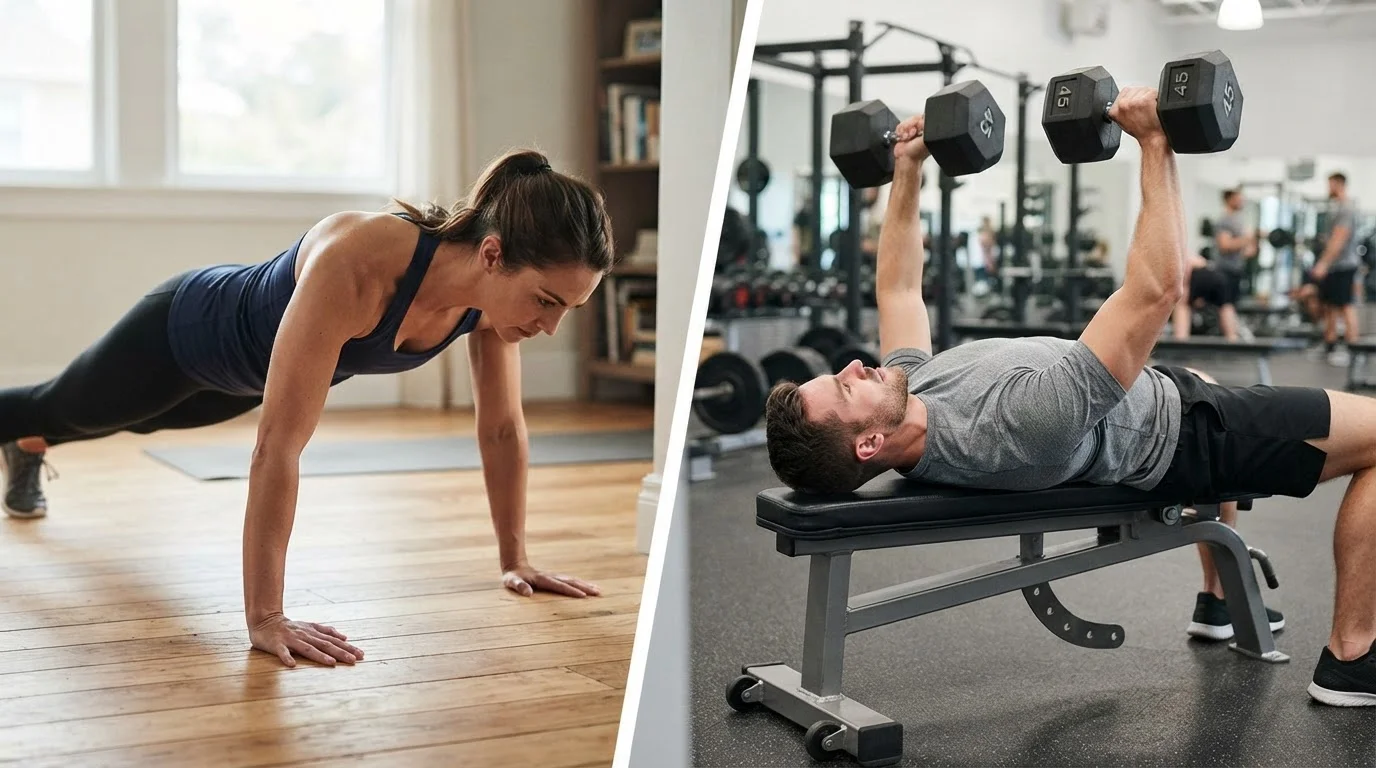
Key Takeaways
Option A
Bodyweight Training
The accessible, equipment-free foundation of movement.
Best for: Beginners, travelers, home exercisers, and anyone building functional movement patterns without equipment.
Option B
Free Weights
The scalable, measurable tool for progressive strength development.
Best for: Intermediate to advanced trainees aiming to maximize measurable strength and muscle gains over time.
If you're just starting out and have no equipment
Bodyweight Training
Learning foundational movement patterns through push-ups, squats, and hinges is low-risk and builds a strong base before adding external load.
If your primary goal is maximizing long-term strength and muscle mass
Free Weights
The ability to incrementally increase resistance makes it easier to apply progressive overload systematically over months and years.
If you travel frequently or workout space is limited
Bodyweight Training
No equipment is needed, making consistent training possible anywhere without cost or logistics.
If you want measurable, trackable progress milestones
Free Weights
Adding 5 lbs to a lift is a clear, objective marker of progress that bodyweight progressions can't always replicate as cleanly.
If you want a sustainable, combined long-term routine
Bodyweight Training
Integrating bodyweight movements alongside free weights reduces injury risk, improves movement quality, and keeps training varied and adaptable.
How Each Approach Builds Strength
Both bodyweight training and free weights challenge your muscles against resistance - the core mechanism behind building strength and muscle. The distinction lies in how that resistance is delivered and scaled.
With free weights - dumbbells, barbells, and kettlebells - resistance is external and precisely quantifiable. You can add 5 lbs to a squat or bench press and track that progression week over week. This maps directly onto the principle of progressive overload, which is the gradual increase of training stimulus over time. For strength-focused training, that measurability is a significant practical advantage.
Bodyweight training uses your own mass as the load. Movements like push-ups, pull-ups, dips, and pistol squats can be genuinely demanding, but increasing difficulty requires changing leverage, angle, or movement complexity rather than simply adding weight. A standard push-up becomes an archer push-up or a single-arm variation - effective, but harder to quantify in the same linear way.
| Criterion | Bodyweight Training | Free Weights |
|---|---|---|
| Equipment needed | None | Dumbbells, barbells, or gym access |
| Upfront cost | Free | Low to high depending on setup |
| Load progression | Leverage and movement complexity | Incremental weight increases |
| Beginner accessibility | High | Moderate (technique required) |
| Strength ceiling | Moderate (limited by body weight) | High (load scales indefinitely) |
| Portability | Excellent - no equipment to carry | Low without gym access |
| Injury risk (beginner) | Generally lower | Higher without coaching |
| Muscle building potential | Good with progressive programming | Strong with measurable overload |
Cost, Access, and Convenience
One of bodyweight training's most practical advantages is that it costs nothing and can be done almost anywhere. There are no gym memberships, no equipment purchases, and no space requirements beyond a small floor area. For anyone weighing the tradeoffs between home and gym environments, bodyweight routines represent the lowest barrier to entry.
Free weights require either a gym membership or a meaningful upfront investment in home equipment. A quality set of adjustable dumbbells and a bench involves real cost. That said, gym access provides a wide range of loads and equipment that can support a training program for years without the need to keep purchasing new gear.
~80%
Adults who don't meet strength training guidelines
According to the CDC, approximately 80% of U.S. adults do not meet the recommended muscle-strengthening activity guidelines - highlighting that consistency matters more than method.
2x/week
Minimum frequency for strength adaptation
The American College of Sports Medicine recommends resistance training each major muscle group at least twice per week for general health and strength development.
Neither approach is inherently superior - the more sustainable choice is often the one that fits your actual lifestyle. If a gym membership sits unused, bodyweight training done consistently will produce far better results.
Skill Level and Learning Curve
Bodyweight exercises appear simple on the surface, but performing them with proper technique requires genuine body awareness. A correct push-up demands a rigid core, aligned shoulders, and controlled descent - things that take practice. Novices often find early wins accessible, but plateaus can arrive faster without a clear load-progression path.
Free weight training has its own learning curve, particularly with compound barbell movements like deadlifts and overhead presses. Technique errors under load carry a higher injury risk than most bodyweight errors. Understanding how reps, sets, volume, and intensity interact is useful regardless of which tool you choose, but becomes especially important when programming free weight sessions.
It's also worth examining whether common assumptions about either method hold up. For example, the notion that free weights are inherently more effective than bodyweight for muscle building isn't straightforwardly supported - programming quality and consistency matter more than the tool itself. For a broader look at fitness assumptions worth questioning, see our piece on exercise myths that may be shaping how you train.
This article is for general informational purposes only and does not constitute medical or fitness advice. Speak with a qualified health or fitness professional before beginning any new resistance training program, particularly if you have pre-existing health conditions or injuries.