

Key Takeaways
Tailgating
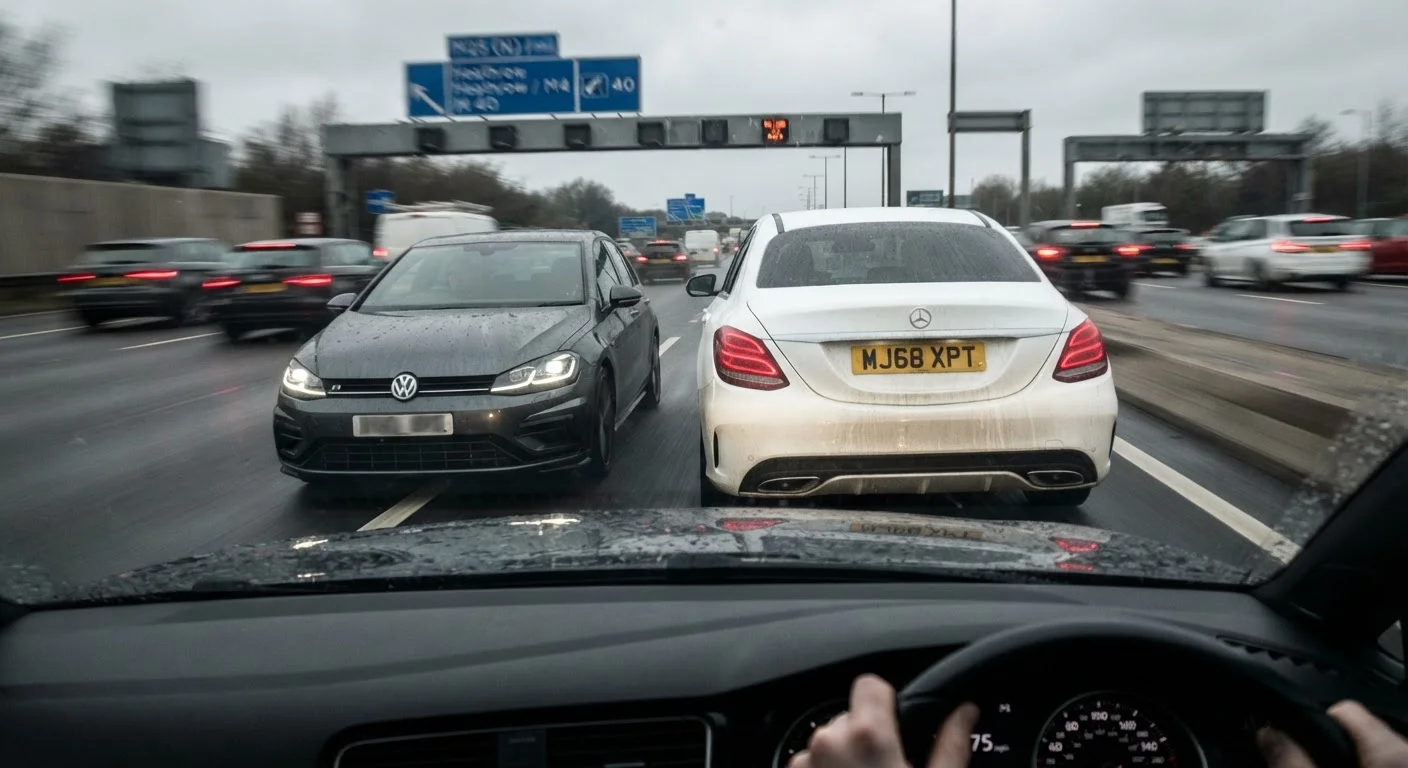
Tailgating means following another vehicle too closely - leaving less space between your car and the one ahead than you would need to stop safely in an emergency. It is a form of aggressive or inattentive driving that dramatically increases the risk of a rear-end collision. Most drivers underestimate how much distance is required to stop at highway speeds.
Stopping distance is the combined total of reaction distance (the space traveled while the driver perceives and responds to a hazard) and braking distance (the space needed for the vehicle to physically stop). Both increase significantly with speed.
The Physics That Make Tailgating So Risky
Stopping a vehicle is not instantaneous. Two distinct phases occur from the moment a driver perceives a hazard to the moment the car finally halts. The first is reaction distance - the ground covered between recognizing a problem and pressing the brake pedal. At highway speeds, even an alert driver with an average reaction time of 1.5 seconds will travel roughly 130 feet before braking begins. The second phase, braking distance, depends on vehicle weight, tire condition, road surface, and speed.
The compounding effect is severe. At 60 mph, total stopping distance under normal conditions typically falls in the range of 240 to 300 feet - nearly the length of a football field. A driver following just one car length behind at that speed has almost no viable stopping distance at all. This is why tailgating transforms a manageable situation into a collision whenever the lead vehicle brakes even moderately.
Speed makes the math worse in a nonlinear way. Braking distance increases with the square of speed - so doubling your speed quadruples the stopping distance needed. Drivers who feel comfortable following close at 35 mph are often applying the same intuition at 65 mph, where the physics are fundamentally different.
~29%
Of all U.S. crashes that are rear-end collisions
According to the National Highway Traffic Safety Administration (NHTSA), rear-end crashes are consistently among the most common crash types on American roads.
1.5 sec
Average driver perception-reaction time
Transportation safety researchers commonly cite 1.5 seconds as a standard average, though this varies by driver age, alertness, and distraction level.
~300 ft
Total stopping distance at 60 mph
Under typical dry-road conditions, this estimate includes both reaction distance and braking distance for an average passenger vehicle.
The Three-Second Rule and How to Apply It
Traffic safety educators and most state driver's manuals endorse the three-second rule as a practical, speed-independent method of gauging following distance. The approach is straightforward: when the vehicle ahead passes a fixed reference point - a sign, shadow, or line on the road - count "one thousand one, one thousand two, one thousand three." If your vehicle reaches that same point before you finish counting, you are too close.
The value of this method is that it automatically adjusts for speed. At 30 mph, three seconds equals about 132 feet. At 65 mph, the same three seconds translates to roughly 286 feet. No calculation is required - the rule scales naturally.
Conditions that warrant extending the gap include:
- Rain or wet roads - Wet pavement significantly increases braking distance, and hydroplaning risk rises. See our guide on driving in adverse weather for more.
- Night driving - Reduced visibility shortens the time available to react. Night driving habits that reduce risk covers this in more detail.
- Towing or heavy loads - Added vehicle weight increases braking distance substantially.
- Older vehicles or worn tires - Degraded braking systems extend stopping time. Tire condition matters - even a slow leak can compromise traction.
Adjust Your Gap for Conditions
Three seconds is a baseline, not a ceiling. In rain, fog, night conditions, or when driving a heavier vehicle, extend your following distance to four or five seconds. The extra space costs you almost nothing in travel time but provides significantly more stopping room when it matters most.
Legal Consequences and Crash Liability
Following too closely is a codified traffic violation across all 50 U.S. states, though the specific statutory language varies. Most statutes require a driver to maintain a distance that is "reasonable and prudent" given the speed, traffic, and road conditions. Unlike fixed speed limits, there is no single universally mandated number of feet - which means officers and courts apply judgment based on circumstances.
In crash scenarios, a driver who rear-ends another vehicle is almost always presumed to have been following too closely. This presumption has direct consequences for insurance claims and civil liability. The tailgating driver typically bears responsibility for damages regardless of why the lead vehicle braked. As part of a broader understanding of road safety obligations, it helps to know how defensive driving works in practice - including how anticipating hazards reduces crash risk before it materializes.
Traffic citations for following too closely may carry fines, points on a driver's license, and in some states, mandatory driving school. Repeated violations can affect insurance premiums, though outcomes vary by insurer and state.
State Laws Vary in Specifics
While all U.S. states prohibit following too closely, the exact wording and enforcement standards differ. Some states have statutes specific to trucks, buses, or convoys of vehicles. Drivers should familiarize themselves with the traffic laws in their home state and any state they drive through frequently.
What to Do If You're Being Tailgated
Being on the receiving end of tailgating places you in an uncomfortable position - you have limited control over another driver's behavior. The safest response is to avoid retaliatory or reactive braking, which can immediately trigger the collision you're trying to prevent. Instead, consider these measured responses:
- Change lanes when safe to do so. If you are in a left lane and traffic allows, moving right removes you from the situation without escalating it.
- Gradually reduce speed. Slowing slightly - without brake-checking - can create additional buffer space and may prompt the tailgater to pass.
- Increase your own following distance from the car ahead. More room in front gives you more time to brake gently, reducing the chance of a chain-reaction impact.
- Do not engage. Eye contact, gestures, or sudden speed changes in response to a tailgater can escalate to road rage. These encounters can become dangerous independently of the tailgating itself.
Understanding the full picture of road safety - including speed laws and driver obligations - supports better decision-making behind the wheel. Our overview of how speed limits work is a useful companion to this topic.