

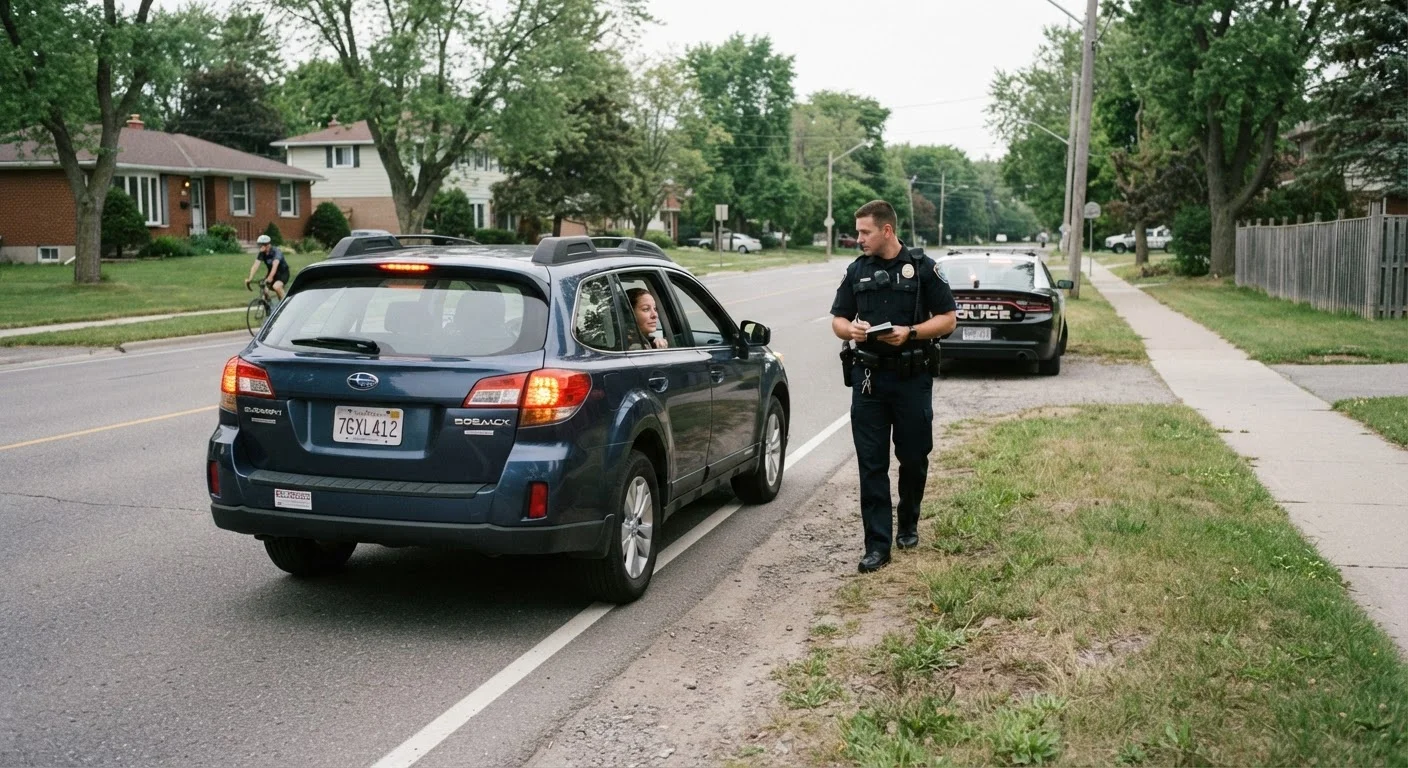
Your First Obligation: Pull Over Safely and Promptly
The moment you see flashing lights or hear a siren directed at your vehicle, the law in every U.S. state requires you to yield to the officer. That means signaling, moving to the right side of the road, and stopping as soon as it is reasonably safe to do so. Failing to pull over - or continuing to drive for an extended distance - can elevate a routine traffic stop into a criminal matter, sometimes charged as eluding or fleeing.
Where you stop matters. Aim for a well-lit, flat stretch of road away from active traffic lanes. On a highway or expressway, a wide shoulder or an exit ramp is preferred. Once stopped, turn off your engine, activate your hazard lights, and remain in the vehicle unless the officer instructs otherwise. These steps signal cooperation and reduce risk for everyone involved.
Required Documents: What You Must Provide
All 50 states require drivers to present three documents upon an officer's request:
- Driver's license - proof that you are legally permitted to operate a vehicle
- Vehicle registration - confirms the vehicle is properly registered with the state
- Proof of insurance - demonstrates financial responsibility coverage required by state law
Most states accept digital insurance cards displayed on a smartphone, but requirements vary. Carrying physical copies remains the safest approach. Retrieve documents calmly and deliberately - ideally announcing your movements to the officer before reaching into a glove box or center console.
Refusing to provide these documents is a separate violation in itself, independent of whatever prompted the stop. Understand too that an officer may run your license and plates through law enforcement databases as a standard part of the stop.
Stop-and-identify statute
A state law requiring a person lawfully detained by police to provide their name or identity upon request. Not all states have these laws, and requirements vary.
Financial responsibility
A legal requirement in all U.S. states that drivers carry minimum insurance coverage or an approved alternative to cover liability in the event of an accident.
Eluding or fleeing
The criminal act of failing to stop for a law enforcement officer's signal to pull over. This is a separate and more serious offense than whatever initially prompted the stop.
Vehicle registration
An official document issued by a state agency confirming that a vehicle has been properly registered and is permitted to be operated on public roads.
Fifth Amendment
The constitutional amendment protecting individuals from being compelled to incriminate themselves. During a traffic stop, it generally allows drivers to decline to answer questions beyond confirming identity and providing required documents.
What the Law Does - and Does Not - Require You to Say
Beyond providing your documents, drivers are generally not legally required to answer substantive questions about their destination, activities, or the reason for the stop. The Fifth Amendment of the U.S. Constitution protects against self-incrimination. You may politely decline to answer questions beyond confirming your identity and providing required documentation.
However, being uncooperative or combative is never advisable from a safety or legal standpoint. If you believe your rights were violated during a stop, the appropriate remedy is through the legal system afterward - not by escalating the encounter at the scene.
Some states have stop-and-identify statutes that may require you to provide your name when lawfully detained, even outside a vehicle stop. Requirements differ by state, so it is worth knowing your state's specific rules. For a broader look at how road laws vary across the country, see our article on what hands-free driving laws actually cover in each state.
This article provides general legal information for educational purposes only and is not legal advice. Laws vary by state and jurisdiction. Consult a licensed attorney for guidance specific to your situation.
Behavior and Safety During the Stop
Officers are trained to assess risk from the moment they approach a vehicle. Actions that help reduce tension and keep the stop moving efficiently include:
- Keeping your hands visible on the steering wheel until asked to retrieve documents
- Lowering your window fully before the officer reaches the door
- Speaking calmly and clearly
- Avoiding sudden movements
- Not exiting the vehicle unless directed to do so
Passengers in the vehicle are subject to similar courtesies, and in some states, officers may lawfully ask passengers to provide identification as well - though passenger rights during stops vary more significantly by state than driver requirements do.
Understanding traffic law more broadly is part of responsible driving. Our guide to right-of-way rules that confuse even experienced drivers covers another area where driver knowledge directly affects road safety for everyone. Likewise, school zone and work zone laws outline situations where heightened compliance is both legally and practically critical.