

Key Takeaways
Our Verdict
Rotation, balancing, and alignment each address a distinct problem. Rotation evens out wear over time, balancing eliminates vibration caused by uneven weight distribution, and alignment corrects steering and handling issues caused by wheel angle drift. Staying current on all three - rather than treating them as interchangeable - is the most reliable way to protect your tires and keep your vehicle handling safely.
| Best for | Recommended |
|---|---|
| Drivers who want to maximize tire lifespan | Regular rotation on a consistent schedule |
| Anyone experiencing steering wheel vibration or shimmy | Wheel balancing |
| Vehicles pulling to one side or showing uneven tread wear patterns | Four-wheel alignment |
| Drivers who hit a significant pothole or curb | Both balancing and alignment check |
Why These Three Services Get Confused
Tire rotation, balancing, and alignment are often lumped together in conversations about tire care - and sometimes bundled at the shop - but they address completely different mechanical issues. Confusing them can lead drivers to skip a service they actually need, or to misread a symptom and request the wrong fix.
All three services contribute to tire health and ride quality, which is likely why they're frequently grouped. But understanding what each one actually does makes it far easier to recognize when your vehicle is telling you it needs one specifically. For a broader look at how these services fit into your vehicle's overall upkeep, see scheduled maintenance intervals.
Tire Rotation: Evening Out the Wear
Rotation is the simplest concept of the three. It means moving your tires from one position on the vehicle to another - typically front to rear, side to side, or in a cross pattern - according to a defined schedule.
The reason this matters: tires wear unevenly depending on where they're mounted. Front tires on a front-wheel-drive vehicle, for example, handle both steering and power delivery, so they wear down faster than the rears. By periodically swapping positions, you allow each tire to experience different stress patterns, which helps all four wear at a more similar rate over time.
Most vehicle manufacturers and tire industry guidelines suggest rotating tires every 5,000 to 7,500 miles, though your owner's manual is the authoritative source for your specific vehicle. Skipping rotations doesn't cause immediate problems, but over time it leads to premature and uneven tread wear that can shorten tire life significantly.
| Tire Rotation | Wheel Balancing | Wheel Alignment | |
|---|---|---|---|
| What it fixes | Uneven tread wear across positions | Weight imbalance causing vibration | Wheel angle deviation affecting handling |
| Common symptom | Two tires wearing faster than others | Vibration through wheel or seat | Vehicle pulls left or right |
| Typical interval | Every 5,000-7,500 miles | With each rotation or tire mount | Annually or after suspension impact |
| Equipment required | Jack stands and basic tools | Electronic balancing machine | Specialized alignment rack with sensors |
| DIY feasible? | Possible with proper equipment | No - requires machine | No - requires machine |
| Effect on tire life | Directly extends tire lifespan | Prevents cupping and vibration wear | Prevents edge and feathered wear |
Wheel Balancing: Smoothing Out the Ride
Balancing addresses a different problem entirely: uneven weight distribution in the tire-and-wheel assembly. Even a new tire mounted on a new wheel will have slight variations in weight around its circumference. When that assembly spins at highway speeds, those imbalances create vibrations that travel through the suspension and into the steering wheel or floorboard.
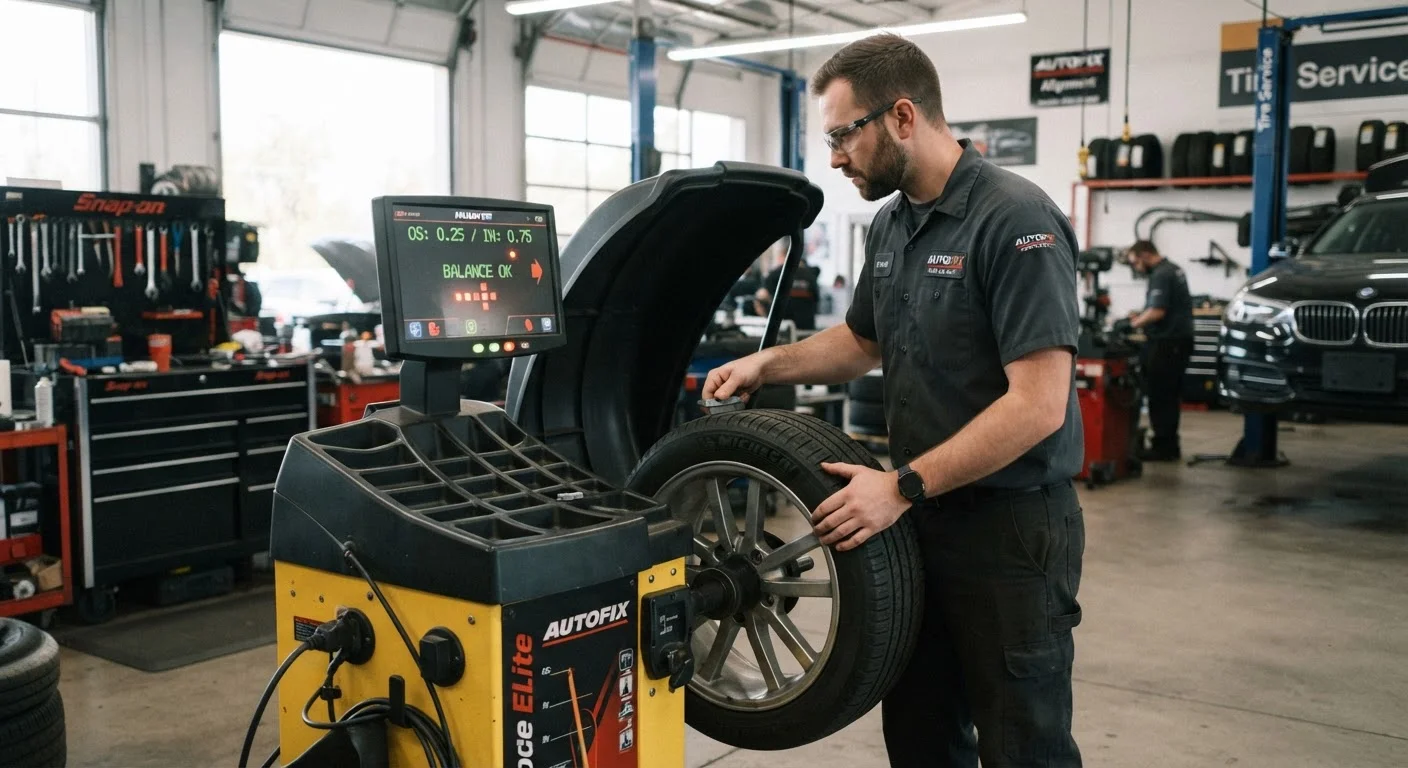
To correct this, a technician mounts the wheel on a balancing machine that spins it and identifies where weight is uneven. Small metal weights are then attached to the rim to counteract the imbalance. The result is a smoother, vibration-free ride.
Common signs that balancing is needed include a steering wheel that vibrates at certain speeds, a shimmy felt through the seat, or scalloped (cupped) wear patterns on the tread. Balancing is typically recommended when tires are mounted or rotated, and after hitting a significant road hazard. It's not the same issue as alignment, even though both can cause handling complaints.
Bundle Services Strategically
Many shops offer balancing as part of a rotation service, which makes sense since the tires are already off the vehicle. Ask your mechanic upfront whether balancing is included or priced separately. Getting both done at the same visit saves labor time and ensures you're not leaving with newly rotated tires that haven't been balanced.
Wheel Alignment: Correcting the Angles
Alignment has nothing to do with the tires themselves - it refers to the geometric angles at which your wheels contact the road. Three key angles are typically measured and adjusted: camber (the inward or outward tilt of the wheel when viewed from the front), toe (whether the fronts of the tires point inward or outward), and caster (the angle of the steering axis when viewed from the side).
Over time, these angles drift out of specification due to normal driving, road impacts, and suspension wear. When they're off, the result can be a vehicle that pulls to one side, a steering wheel that sits crooked on a straight road, or accelerated and uneven tread wear - particularly feathering or wear concentrated on one edge of the tire.
An alignment check involves placing the vehicle on a specialized rack with sensors attached to each wheel. A technician then adjusts the suspension components to bring all angles back within the manufacturer's specifications. Unlike rotation and balancing, alignment has no standard mileage interval - most mechanics recommend checking it annually or after any significant suspension impact. Understanding what's stamped on your tires can also help you spot wear-related clues; reading your tire sidewall explains what those markings mean.
How the Three Services Work Together
None of these services replaces the others. A vehicle can have perfectly balanced wheels that are misaligned. It can have correct alignment but uneven wear from skipped rotations. And even tires worn evenly can develop balance issues after a pothole strike.
The practical approach is to treat each service as targeting a specific symptom or maintenance window - not as alternatives to choose between. If you're not sure which service your vehicle needs, describe the symptoms to a qualified mechanic rather than requesting a service by name. Vibration at highway speeds points toward balancing; pulling or uneven edge wear points toward alignment; faster wear on two tires than the other two suggests rotation was overdue.
For tasks you're considering handling yourself, DIY vs. shop guidance can help clarify where home mechanics can safely step in and where professional equipment is genuinely necessary. Balancing and alignment both require specialized machines and are firmly in the professional category.