

| Law Governing the Label | Automobile Information Disclosure Act (1958) |
| Who Must Display It | All new vehicle manufacturers and dealers in the U.S. |
| Who Can Remove It | Only the purchaser - dealers are prohibited from removing it before sale |
| Fuel Economy Data Source | U.S. Environmental Protection Agency (EPA) standardized testing |
| Safety Rating Bodies | NHTSA (stars) and IIHS (descriptive grades) |
| MSRP Includes | Base price + installed options + destination charge |
What Is a Monroney Label - and Why Is It Required?
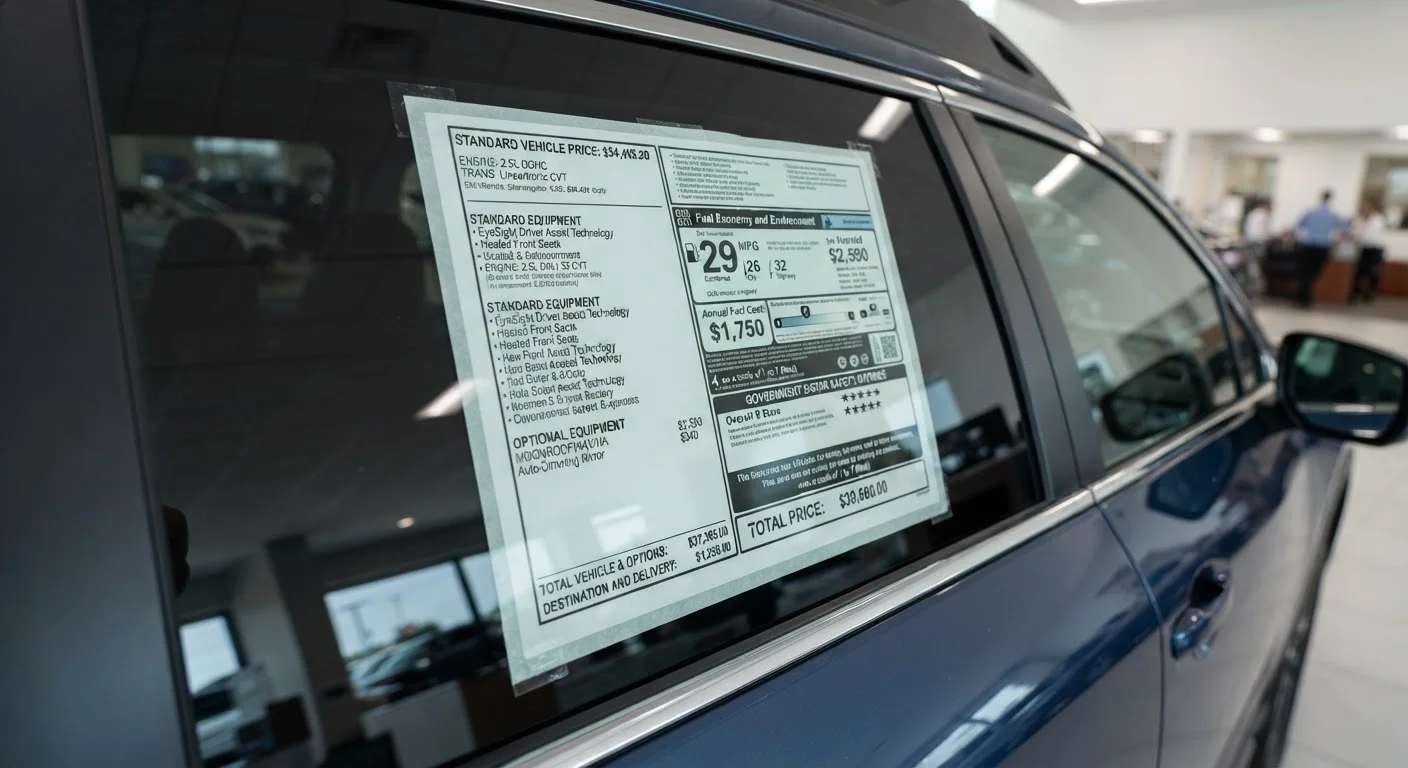
The sticker affixed to every new car's window is formally called the Monroney label, named after Senator Mike Monroney, who sponsored the Automobile Information Disclosure Act of 1958. That law made it a federal requirement for manufacturers to disclose pricing, equipment, and fuel economy data on every new vehicle before it's sold. Dealers are prohibited from removing it before the sale - only the buyer can legally take it down.
The label isn't marketing copy. It's a standardized, government-regulated document designed to help you compare vehicles honestly and make an informed purchase decision. Understanding each section turns what looks like a dense printout into genuinely useful information.
| Law Governing the Label | Automobile Information Disclosure Act (1958) |
| Who Must Display It | All new vehicle manufacturers and dealers in the U.S. |
| Who Can Remove It | Only the purchaser - dealers are prohibited from removing it before sale |
| Fuel Economy Data Source | U.S. Environmental Protection Agency (EPA) standardized testing |
| Safety Rating Bodies | NHTSA (stars) and IIHS (descriptive grades) |
| MSRP Includes | Base price + installed options + destination charge |
The Five Major Sections, Line by Line
1. Vehicle Identification
At the top of the label you'll find the make, model, model year, trim level, and body style. Below that is the Vehicle Identification Number (VIN) - a 17-character code unique to that specific vehicle. The VIN is your most reliable reference for recall lookups, title history checks, and registration. Jot it down before you leave the lot.
2. Standard and Optional Equipment
This section lists every feature the vehicle comes with as configured: standard equipment included in the base price, and any installed options added by the manufacturer or dealer. Each optional package or individual add-on is listed with its individual price. Read this carefully - it's where you verify that the features you negotiated are actually on the vehicle.
3. Fuel Economy Estimates
The EPA fuel economy section is one of the most-consulted parts of the label. It shows city, highway, and combined MPG estimates derived from standardized EPA testing - not real-world driving. Actual efficiency will vary based on driving habits, load, and conditions. The label also displays an annual fuel cost estimate and a comparison bar showing how this vehicle ranks against others in its class. For electric and plug-in hybrid vehicles, this section instead shows MPGe and estimated driving range. See our guide to reading tire sidewall codes for another example of decoding manufacturer data you'll encounter on the vehicle itself.
4. Safety Ratings
If the vehicle has been tested, this section shows crash test and rollover ratings from the National Highway Traffic Safety Administration (NHTSA) and may reference results from the Insurance Institute for Highway Safety (IIHS). Ratings appear as stars (NHTSA) or descriptive grades (IIHS). Not all vehicles are tested before sale, so a blank safety section doesn't mean the car is unsafe - it means testing results weren't available at the time of printing.
5. Pricing
The bottom of the label details the Manufacturer's Suggested Retail Price (MSRP), broken into three figures: the base vehicle price, the total price of all installed options, and the destination and delivery charge - a federally mandated flat fee covering transport from the assembly plant to the dealer. These three figures are added together to produce the Total MSRP. This is the suggested price, not a fixed one. Dealers may sell above or below this figure depending on supply, demand, and negotiation.
Monroney Label
The federally required window sticker on every new vehicle, disclosing pricing, equipment, fuel economy, and safety data. It is named after the senator who authored the 1958 law mandating it.
MSRP
Manufacturer's Suggested Retail Price - the price the automaker recommends the vehicle be sold for. Dealers can sell above or below this figure.
VIN
Vehicle Identification Number - a unique 17-character alphanumeric code assigned to every motor vehicle. It is used for recalls, title checks, registration, and insurance.
MPGe
Miles Per Gallon Equivalent - the EPA metric used for electric and plug-in hybrid vehicles to allow fuel economy comparisons with conventional gasoline cars.
Destination Charge
A fixed fee set by the manufacturer covering the cost of transporting the vehicle from the assembly plant to the dealership. It is non-negotiable and must be disclosed on the Monroney label.
Addendum Sticker
A dealer-placed document separate from the Monroney label that may list dealer-installed options or additional markup. Unlike the Monroney, it is not federally regulated and its charges are negotiable.
What the Label Doesn't Tell You
The Monroney label reflects manufacturer data and EPA testing conducted under controlled conditions. It does not disclose dealer-added accessories or markups (sometimes listed on a separate sticker), financing terms, tax, title, or registration fees, or the vehicle's actual transaction price. When comparing vehicles across dealerships, always reference the Monroney - not the dealer's own promotional pricing - as your consistent baseline. Just as the U.S. traffic sign system uses standardized shapes and colors so every driver reads the same message, the Monroney uses a regulated format so every buyer sees the same categories in the same order.
If you see a second sticker - often called an addendum sticker - placed next to the Monroney, that's a dealer document, not a federal one. It may list dealer-installed extras or additional markup. You are not legally obligated to pay those amounts, and they are subject to negotiation.
This article provides general informational guidance about vehicle documentation and is not a substitute for legal or financial advice. Always review actual vehicle documents and consult a qualified professional for decisions specific to your situation.