

Key Takeaways
Our Verdict
Digital tools win on flexibility, collaboration, and information density - especially for complex, multi-stop trips. Paper planning earns its place for focus, reliability, and the joy of a tangible record. Most experienced travelers land somewhere in the middle, using apps for bookings and a notebook for day-to-day flow. The best planning system is the one you'll actually stick with from first research to final day.
| Best for | Recommended |
|---|---|
| Complex, multi-destination trips with shared itineraries | Digital Tools |
| Travelers who want a distraction-free, battery-free backup | Paper Planning |
| First-time international travelers managing many moving parts | Digital Tools |
| Solo or weekend travelers who prefer a simple, tactile system | Paper Planning |
Why Your Planning System Actually Matters
Most travel stress doesn't start at the airport - it starts weeks earlier, when a confirmation email gets buried, a hotel address is scribbled on a napkin that's now missing, or three people in your group are working from three different versions of the same itinerary. A consistent planning system eliminates that friction before it starts.
Whether you lean toward apps or prefer a trusty spiral notebook, the goal is the same: get the right information in front of you at the right moment, without scrambling. Check out our guide to building a well-structured itinerary to understand what information actually belongs in your plan, regardless of the format you choose.
The choice between digital and paper is rarely about one being objectively superior - it's about which approach matches your habits, your trip's complexity, and how your brain processes information under the low-level stress of travel.
The Case for Digital Planning Tools
Apps and cloud-based documents genuinely shine when a trip has many moving parts. Flight numbers, hotel confirmation codes, restaurant reservations, museum timed-entry tickets - digital tools let you store all of it in one searchable place and pull it up in seconds at a check-in desk or border crossing.
Collaboration is another clear advantage. Shared documents and travel-specific apps allow every member of a group to view and edit the same plan in real time, which cuts down on the endless group-chat thread trying to pin down who has the Airbnb address. If your group includes travelers with differing preferences, a shared digital doc also makes it easier to track compromises - something worth thinking through using the strategies in our article on planning trips with different comfort levels.
Digital tools also adapt quickly. Flight delayed by four hours? Reschedule dinner in the app, update the shared doc, and everyone knows instantly. That kind of real-time flexibility is hard to replicate with a printed sheet.
| Digital Tools | Paper Planning | |
|---|---|---|
| Accessibility without connectivity | Requires signal or downloaded content | Works anywhere, no power needed |
| Real-time updates | Instant edits synced across devices | Manual updates only |
| Group collaboration | Easy shared access and editing | Requires physical copies or photos |
| Search and retrieval | Instant keyword search | Manual page-flipping |
| Distraction risk | High - notifications, apps compete | None - single-purpose medium |
| Memory retention of plan | Lower - passive reading | Higher - active writing reinforces recall |
| Recovery if lost or damaged | Cloud backup available | Typically unrecoverable |
| Ease for complex, multi-stop trips | Excellent - handles volume well | Can become unwieldy quickly |
The main watch-outs: digital planning rewards people who actually maintain their system. An app full of half-entered data or a folder of unorganized screenshots creates its own chaos. Battery life and connectivity matter too - a phone at 4% with no charger in sight is a terrible time to discover your hotel's address is only stored online.
The Case for Paper Planning
Paper has one unbeatable quality: it works everywhere, always, no exceptions. No signal needed, no battery required, no account to log in to. For destinations with spotty connectivity - rural areas, international roaming gaps, long flights - a printed or handwritten itinerary is an anchor when everything digital fails you.
There's also a cognitive argument. Writing by hand forces you to slow down and synthesize information rather than just copy-paste it. Many travelers find that the act of writing an itinerary by hand helps them actually absorb the plan - so they spend less time staring at their phone on the trip itself and more time looking around.
The One-Page Paper Rule
If you do carry a paper itinerary, keep each travel day to a single page. Include your accommodation address, one or two key confirmation numbers, and a loose timeline. Anything that doesn't fit on one page probably belongs in your digital archive rather than your pocket. This keeps your paper plan scannable under pressure - exactly when you need it most.
Paper also carries no distractions. Opening a planning app sometimes means ending up scrolling through social media 20 minutes later. A notebook stays focused on the task.
The trade-offs are real, though. Paper doesn't update itself, can't be searched, and if you lose it, it's gone. It's also harder to share - photographing each page and sending it to travel companions is workable but clunky. For first-time international travelers managing visas, connections, and unfamiliar transit systems, paper alone can quickly feel limiting. Our guide for first-time international travelers walks through the full planning picture if you're tackling that milestone.
Building a Hybrid System That Works
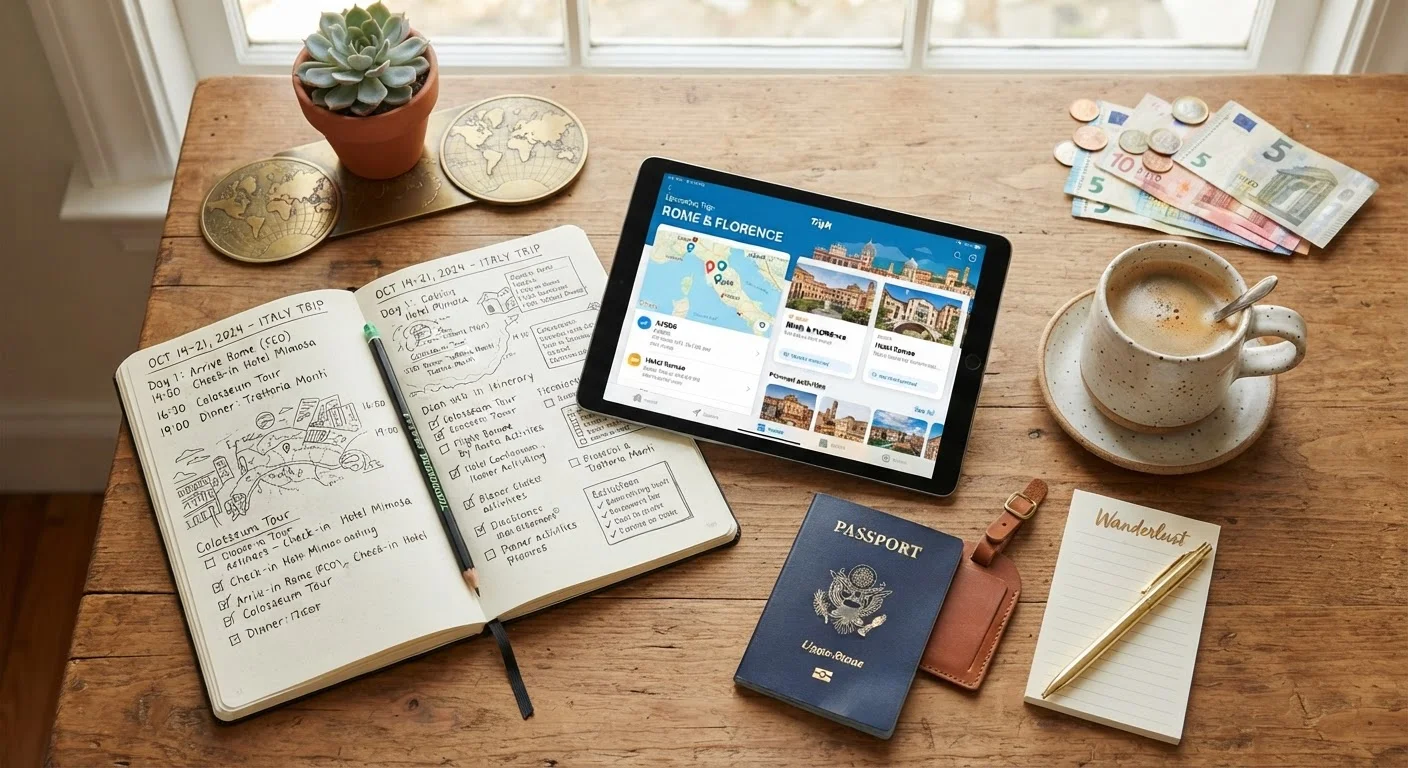
The most practical approach for most travelers is a deliberate hybrid: use digital tools for the heavy lifting of research, booking management, and group coordination, then distill the essential daily information onto paper for on-the-ground use.
Think of it this way - your phone or laptop is the command center before departure; your notebook or printed one-pager is the field guide you actually carry. Print the day's key addresses, confirmation numbers, and a rough schedule. Keep the deep archive digital. This setup means a dead battery or lost notebook is an inconvenience, not a crisis.
Before you settle on any system, our pre-trip planning checklist is worth running through - it surfaces the logistics you need to have captured somewhere, in whatever format suits you. The Travel Tips hub also has practical advice on making smarter decisions at every stage of the journey.
Ultimately, complexity is your best guide. A weekend road trip may need nothing more than a few notes on your phone. A three-week multi-country itinerary almost always benefits from the organizational muscle of digital tools, backed up by a paper summary for each day. Match the system to the trip, not the other way around.