

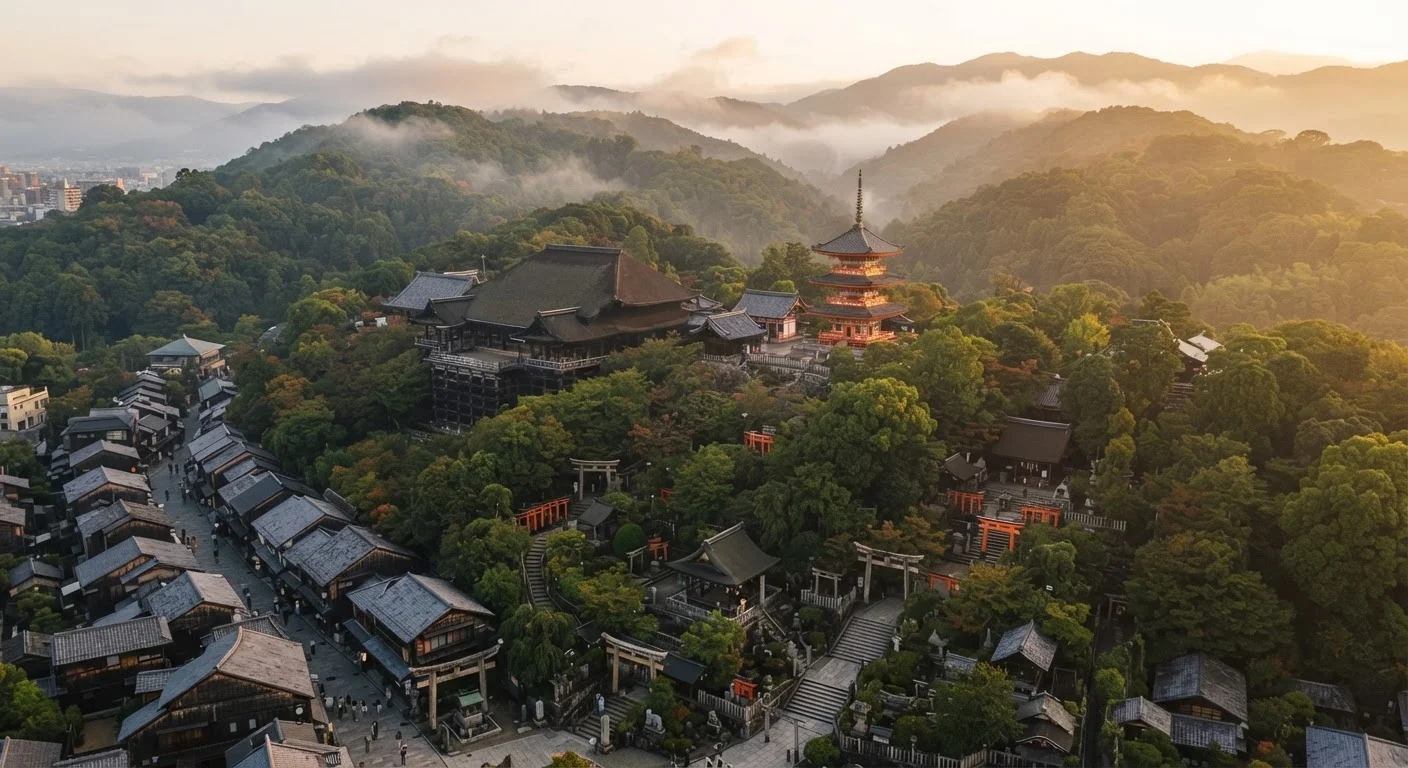
How Kyoto's Districts Are Organized
Kyoto was Japan's imperial capital for more than a thousand years, and that history is written into its geography. Rather than clustering all its temples and shrines into a single tourist corridor, the city spreads them across distinct neighborhoods - each shaped by a different era, patron, or Buddhist school. Understanding this layout before you arrive helps you plan realistically and avoid spending half your day on transit.
The city sits in a basin surrounded by mountains on three sides. Most of the major temple districts hug the eastern and northern hills (known collectively as Higashiyama and Rakuhoku), while the western district of Arashiyama marks its own cultural zone. Downtown Kyoto - the Kawaramachi and Gion area - acts as a commercial and transport hub connecting them.
If you're planning a broader Japan itinerary, it helps to understand how Kyoto differs from the capital. Our Tokyo first-timer's guide breaks down how to navigate that city's very different neighborhood structure.
Higashiyama: The Eastern Temple Corridor
Higashiyama (literally "Eastern Mountain") is the district most first-time visitors encounter first. It runs along the lower slopes of the Higashiyama mountain range and is home to some of Kyoto's most recognized sites, including Kiyomizudera, a wooden-stage temple that dates to the 8th century. The approach streets - Ninenzaka and Sannenzaka - are preserved pedestrian lanes lined with machiya townhouses converted into shops and tea rooms.
The district rewards slow walking. Chion-in, a massive Jodo sect complex with one of Japan's largest temple gates, sits at the northern end. Kodaiji temple, built in the early 17th century, is known for its Zen garden and autumn illuminations. Note that much of Higashiyama is steep - comfortable footwear is a practical necessity, not a suggestion.
Arashiyama: Western Temples and Bamboo
Arashiyama occupies Kyoto's western edge where the Oi River bends beneath forested mountains. The area is anchored by Tenryuji, a UNESCO World Heritage Zen temple with a garden designed in the 14th century to frame the mountain scenery behind it. The famous bamboo grove sits immediately north of the temple grounds - it is genuinely impressive, though it draws substantial crowds and is best visited early morning on weekdays.
Smaller temples worth seeking out include Jojakukoji, a moss-covered hillside complex that tends to be quieter than its neighbors, and Nonomiya Shrine, a small Shinto shrine associated with the Tale of Genji. Arashiyama is roughly 30 minutes from central Kyoto by train or bus, making it a natural half-day trip rather than a quick stop.
Rakuhoku: Kyoto's Quieter Northern District
Rakuhoku - the area north of the Imperial Palace - encompasses some of Kyoto's most atmospheric but less-visited sites. Kinkakuji (the Golden Pavilion) is the notable exception: it draws enormous crowds year-round. But the surrounding Kinugasa and Kita neighborhoods also contain Ryoanji, famous for its rock garden, and Ninnaji, a complex that served as a princely temple and retains a distinct imperial character.
Farther north, Kamigamo Shrine and Shimogamo Shrine - both UNESCO sites - sit in quieter residential settings along the Kamo River. These offer a different atmosphere from the polished tourist infrastructure of Higashiyama. Getting around Rakuhoku typically requires buses; the area is less walkable than the eastern corridor.
Travel conditions, entry hours, and site access can change. Verify current details with official tourism sources or individual temple websites before visiting.