

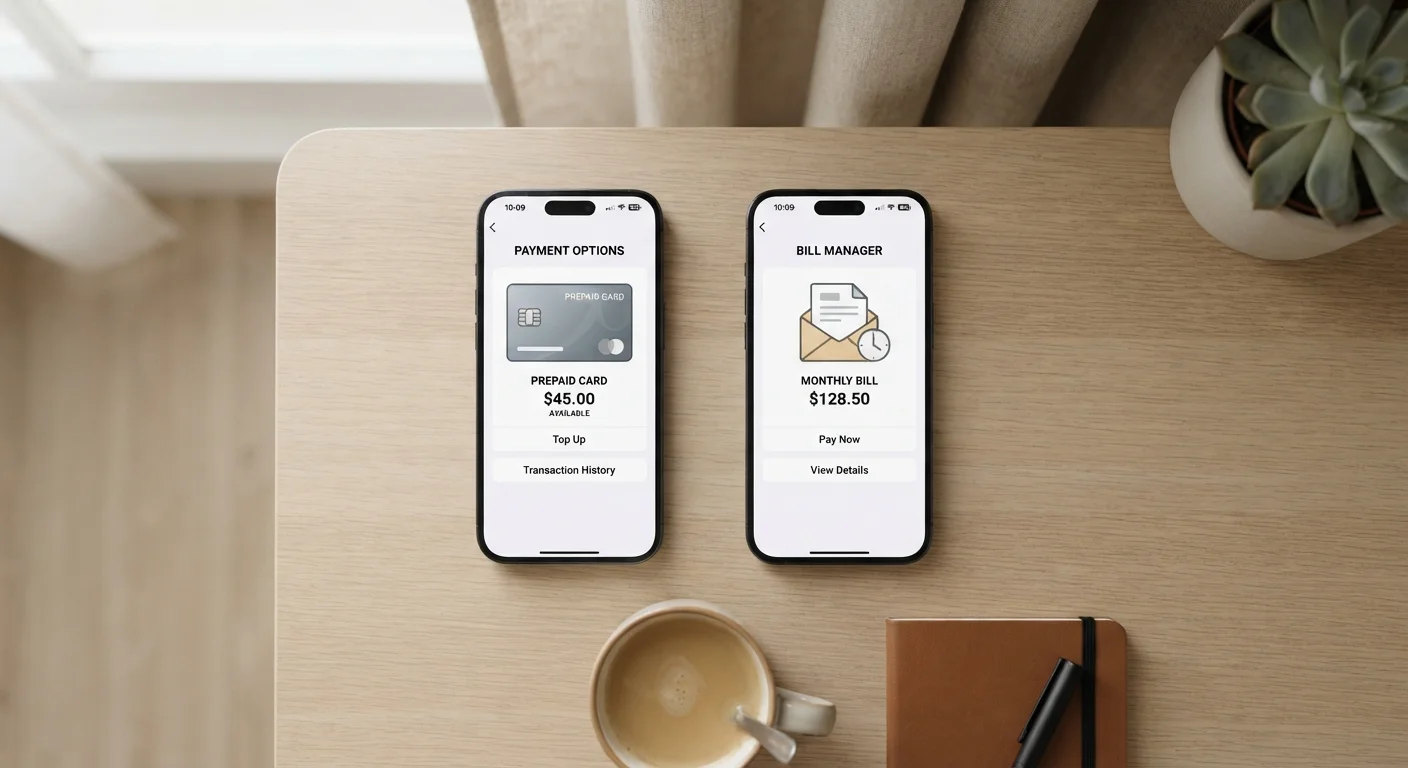
Key Takeaways
Option A
Prepaid Phone Plans
Pay upfront, use what you buy.
Best for: Shoppers who want predictable spending and no credit check requirements.
Option B
Postpaid Phone Plans
Use now, pay later - with more flexibility built in.
Best for: Households that want device financing options and consistent service guarantees.
If you want no credit check and full spending control
Prepaid Phone Plans
Prepaid plans require no credit inquiry and no monthly bill surprise. You load exactly what you need and stop there.
If you want to finance a new phone through your carrier
Postpaid Phone Plans
Device installment programs are almost exclusively tied to postpaid accounts, which require the billing relationship that supports multi-month financing.
If you use moderate data and want the lowest possible monthly outlay
Prepaid Phone Plans
Prepaid plans at lower data tiers are frequently priced below equivalent postpaid options, particularly on smaller carriers running on major networks.
If you need hotspot data, international roaming, or family account management
Postpaid Phone Plans
Postpaid tiers typically offer more robust hotspot allowances, international add-ons, and multi-line account tools that prepaid plans handle inconsistently.
If you travel internationally or switch countries frequently
Postpaid Phone Plans
Most international roaming partnerships and travel passes are structured for postpaid accounts with ongoing billing relationships.
The Core Difference: When Money Changes Hands
The names say it plainly. Prepaid means you fund the account before using service. Postpaid means you use service first and receive a bill afterward. That timing gap is the foundation of every other difference between the two models.
With a prepaid plan, you purchase a set amount of data, talk, and text - either as a one-time allocation or a monthly renewal - and service continues only as long as that balance or subscription is active. When data runs out, service either stops or slows to a minimal speed, depending on the plan's terms. There's no invoice, no autopay requirement, and typically no contract.
With a postpaid plan, a carrier extends you a form of credit. You use service throughout the month, and at the billing cycle's close, the carrier charges a card or bank account on file. That credit extension is why carriers run a credit check when you open a postpaid account - they're taking on a short-term risk that you'll pay. For readers who are new to wireless, this plain-English walkthrough covers how both structures work in a broader plan context.
Network Access: Same Towers, Different Priority
A common misconception is that prepaid service runs on inferior infrastructure. In most cases, that's not accurate. Major carriers sell prepaid plans under their own brand or through subsidiary and MVNO labels, and those plans use the same physical towers as postpaid lines.
The real distinction is data prioritization. When a tower is congested - meaning many users are competing for bandwidth simultaneously - carriers typically serve postpaid customers first. Prepaid subscribers on the same network may experience slower speeds during peak hours in dense areas. This isn't hidden; it's disclosed in plan terms, though the language can be easy to overlook.
MVNOs - companies that lease network capacity from major carriers and resell it under their own brand - are almost always prepaid or month-to-month. They tend to sit at a lower priority tier than the host carrier's own customers, postpaid or prepaid. Understanding how "unlimited" is applied across these tiers matters: unlimited plans vary widely in what they actually deliver, regardless of which payment model they use.
| Criterion | Prepaid | Postpaid |
|---|---|---|
| Payment timing | Pay before use | Pay after monthly use |
| Credit check required | No | Yes, typically |
| Contract or commitment | None | Often month-to-month or device term |
| Device installment plans | Not typically available | Widely available |
| Network priority during congestion | Lower priority | Higher priority |
| International roaming options | Limited | More broadly available |
| Hotspot data | Available on some plans | Broadly available, more generous |
| Overage charges | Rare; service slows or stops | Possible on some plans |
Device Financing and Plan Commitment
One of the most significant practical differences involves phones themselves. Postpaid accounts are designed to support device installment plans - spreading the cost of a new phone over 24 or 36 months. Because the carrier is essentially lending you money for the hardware, a postpaid billing relationship and credit approval are prerequisites. The full cost of carrier financing isn't always obvious from the monthly installment figure alone.
Prepaid plans don't typically offer installment financing. You either bring your own unlocked device or buy one outright. That's a constraint for some users, but a structural simplicity for others - there's no multi-year device commitment tying you to a carrier.
Before signing any postpaid agreement, it's worth checking device lock status, autopay conditions, and early termination terms. A pre-signup checklist can help you avoid commitments you didn't fully see coming.
~40%
U.S. wireless lines on prepaid
Industry analysts have estimated that roughly 40% of U.S. wireless connections are on prepaid or MVNO plans, reflecting widespread adoption beyond the budget segment.
24-36 months
Typical postpaid device financing term
Most major carrier installment plans spread device costs over 24 to 36 months, tying customers to postpaid billing for the duration.
What Happens When You Hit Your Data Limit
Both plan types have data limits - even those marketed as unlimited. What differs is the consequence.
On most prepaid plans, once you exhaust your high-speed data, service either cuts off entirely or drops to a very slow speed (often 128 Kbps or 256 Kbps) until you add more data or the plan renews. There's no overage charge; the cap is absolute.
On postpaid plans, data behavior after the threshold depends on the tier. Lower-cost postpaid tiers may throttle speed similarly to prepaid. Higher-cost tiers may allow continued full-speed use - or charge overage fees for exceeding a hard cap. Some postpaid plans deprioritize rather than throttle, meaning speed drops only when the network is busy, not all the time.
The word "unlimited" doesn't resolve this ambiguity. Assumptions about what unlimited actually means are a common source of avoidable overspending on both plan types.
eSIMs Change the Switching Equation
If your phone supports an eSIM - a digital SIM embedded in the device - switching between prepaid and postpaid plans, or between carriers, doesn't require a physical SIM swap. You can activate a new plan digitally in minutes. However, some carrier-locked devices restrict eSIM use to their own network until an unlock is processed. Understanding eSIM vs. physical SIM differences is useful before making any plan change.