

Key Takeaways
MERV Rating
MERV stands for Minimum Efficiency Reporting Value - a standardized scale from 1 to 16 that measures how effectively a furnace or HVAC filter captures airborne particles. The higher the MERV number, the smaller the particles a filter can trap. It helps homeowners compare filters across brands and types on a level playing field.
MERV ratings are established by ASHRAE (American Society of Heating, Refrigerating and Air-Conditioning Engineers) Standard 52.2. Filters rated above MERV 16 fall into HEPA territory and are typically used in medical or industrial settings rather than residential HVAC systems.
Why the Filter Is the First Line of Defense
Your furnace filter does two jobs that most homeowners underestimate: it keeps your HVAC equipment clean, and it removes airborne particles from the air circulating through your home. When it works properly, it's invisible. When it fails - usually from neglect - the consequences show up on your energy bill, in your air quality, and eventually in a repair estimate.
The filter sits between your return air duct and the air handler, intercepting dust, pet hair, pollen, and other debris before they coat your blower motor, coils, and heat exchanger. A clean filter means your system moves air efficiently. A dirty one creates resistance that makes your furnace work much harder to push the same volume of air through.
Filter maintenance is one of the simplest tasks in the seasonal home maintenance calendar, but it's also one of the most frequently skipped. Unlike a leaky faucet or a sticking door, a clogged filter gives no obvious warning signs until something more serious develops.
MERV vs. MPR vs. FPR: What's the Difference?
You may encounter other rating systems at the hardware store: MPR (Microparticle Performance Rating) and FPR (Filter Performance Rating) are proprietary scales used by specific filter manufacturers. They measure similar things to MERV but use different numerical ranges and aren't directly interchangeable. When in doubt, look for the MERV rating, as it's the industry-standard, independent measure recognized by ASHRAE and HVAC professionals.
Decoding the MERV Scale
MERV ratings give you an objective way to compare filter performance without relying on marketing language. Here's how the scale breaks down in practical terms for residential use:
- MERV 1-4: Fiberglass panel filters. These catch large particles like carpet fibers and dust bunnies. They protect equipment but do very little for air quality.
- MERV 5-8: Pleated filters. These capture mold spores, dust mite debris, and some pollen. A solid choice for most households without specific air quality concerns.
- MERV 9-12: Higher-efficiency pleated filters. These trap finer particles including auto emissions and legionella bacteria. Good for homes with mild allergy sufferers.
- MERV 13-16: Near-HEPA performance. These capture very small particles including smoke and some viruses. Useful in homes with serious respiratory conditions, but only if the HVAC system is rated to handle them.
The sweet spot for most American homes falls between MERV 8 and MERV 13. Going higher sounds appealing, but a filter your system can't handle does more harm than good.
5-15%
Energy savings from a clean vs. clogged filter
The U.S. Department of Energy estimates that replacing a dirty, clogged filter can reduce an HVAC system's energy consumption by 5 to 15 percent.
MERV 8-13
Recommended range for most residential homes
ASHRAE and most HVAC manufacturers suggest this range as the practical balance between filtration effectiveness and safe airflow for typical home systems.
1-3 months
Standard filter replacement interval
Industry guidance from HVAC professionals consistently places the general replacement window at one to three months for standard 1-inch pleated filters in occupied homes.
How Often You Actually Need to Change It
Filter manufacturers and HVAC professionals generally recommend replacing standard 1-inch filters every 30 to 90 days. That wide window exists because household conditions vary considerably. Use these benchmarks to find your interval:
- Monthly: Homes with multiple pets, high dust levels, ongoing renovation work, or residents with asthma or severe allergies.
- Every 60 days: Average households with one pet or a resident with mild allergies.
- Every 90 days: Single-occupant homes with no pets and no notable air quality concerns.
- Every 6 months: Thicker 4- to 5-inch media filters, which have significantly more surface area and last longer between changes.
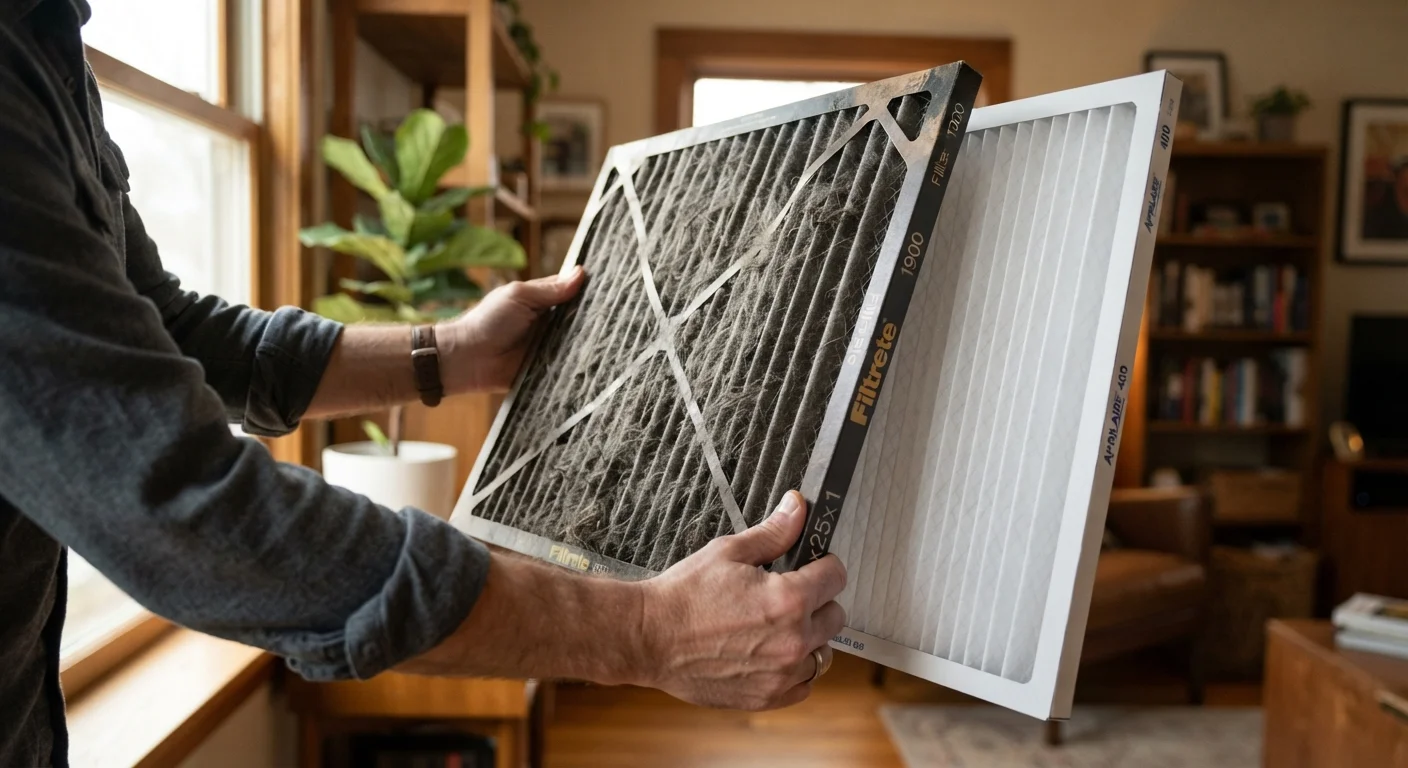
A simple visual check takes seconds: pull the filter out and hold it up to a light source. If you can no longer see light passing through clearly, it's time to replace it regardless of how long it's been installed. During heavy-use seasons - peak winter heating and summer cooling - check more frequently.
Mark the Date on the Filter Frame
When you install a new filter, write the date on the cardboard frame with a permanent marker. Next time you check it, you'll know exactly how long it's been running without having to guess or search for a purchase receipt. This habit takes five seconds and removes one common reason filter changes get delayed.
The Real Cost of Skipping Filter Changes
Delayed filter changes create a chain of consequences that grows more expensive the longer they go uncorrected. A clogged filter forces your blower motor to work against increased resistance. That translates directly into higher electricity use - your system runs longer cycles to reach the same thermostat setting.
Beyond energy costs, restricted airflow causes the heat exchanger to overheat and can trigger the furnace's safety shutoff. Repeated overheating stresses components that aren't cheap to replace. On the cooling side, restricted airflow across an evaporator coil can cause it to freeze, shutting down your air conditioning entirely.
Routine filter maintenance is the kind of low-effort, high-impact upkeep that prevents the larger failures. It's comparable to following a vehicle's scheduled maintenance intervals - skipping the oil change to save time creates a much bigger problem down the road.
Similarly, don't overlook other overlooked home maintenance tasks. Dryer vent cleaning is another simple task that, when ignored, leads to consequences far costlier than the task itself.
Set a recurring reminder on your phone or mark your filter-change dates on the filter's cardboard frame with a marker. Consistency costs almost nothing; neglect eventually costs a great deal.