

| FDA-recognized added sugar aliases | Over 60 names (U.S. Food and Drug Administration guidance on added sugars) |
| Grams of sugar per teaspoon | ~4 grams (Standard conversion used in nutrition education) |
| Daily Value for added sugars (adults) | 50 grams (based on a 2,000-calorie diet) (FDA Nutrition Facts label regulations) |
| Ingredient list order | Listed by descending weight (FDA food labeling requirements) |
| Naturally occurring vs. added sugar | Only added sugars appear on the Added Sugars line (FDA Nutrition Facts panel requirements) |
Why Sugar Has So Many Names
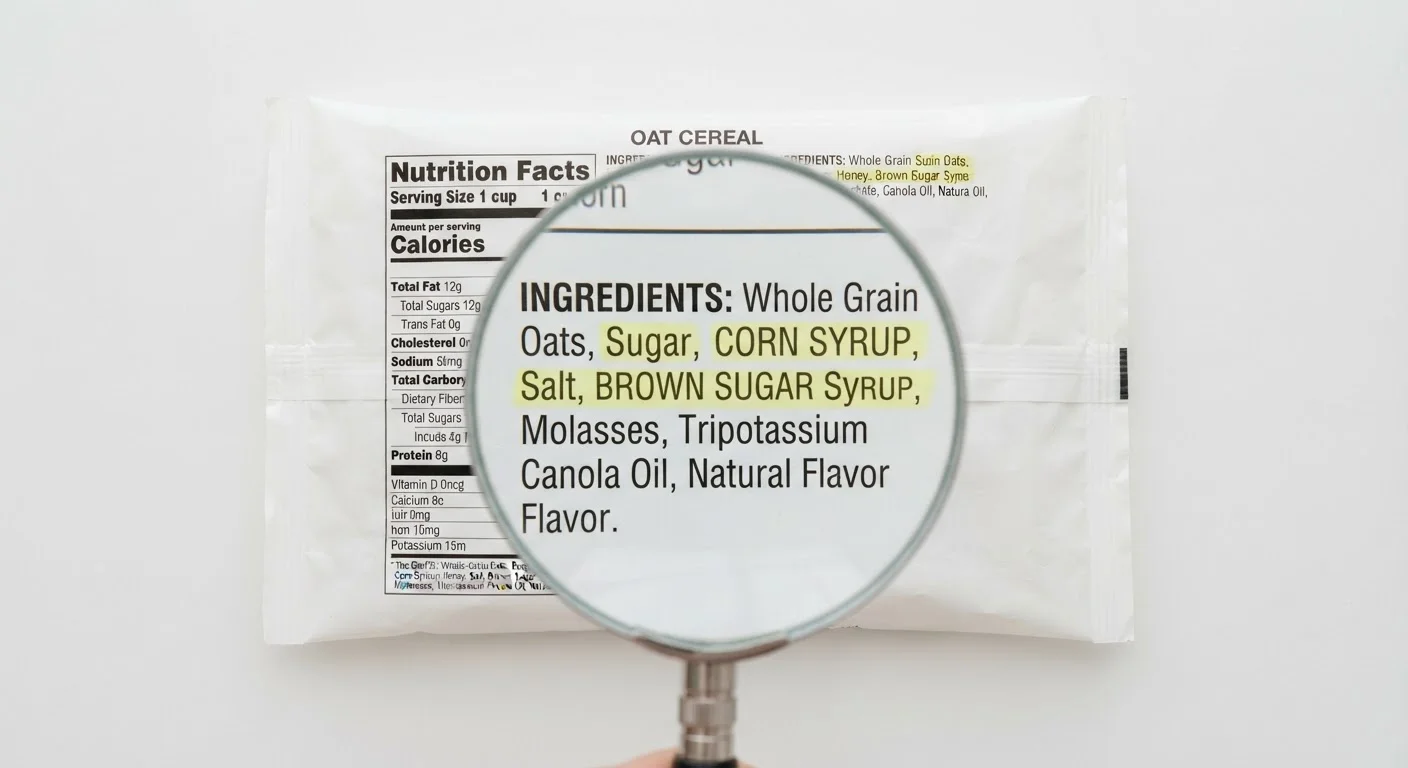
A product labeled "no added sugar" on the front may still list cane juice, rice syrup, and maltodextrin on the back. That is not a coincidence - food manufacturers use a wide variety of sweetening ingredients, and each one appears under its own chemical or trade name. The result is that added sugars can be dispersed across an ingredient list, making it harder for any single item to appear high on the list (which is ordered by weight).
The U.S. Food and Drug Administration (FDA) requires that the Nutrition Facts panel disclose a single line for "Added Sugars" in grams and as a percentage of the Daily Value. However, the ingredient list itself does not group them together. Understanding both sections of a label gives you a clearer picture. For a broader walkthrough of the full label, see our guide to reading nutrition labels.
Added sugars
Sugars and syrups that are added to foods or beverages during processing or preparation, as opposed to sugars that occur naturally in whole foods like fruit or plain dairy. The FDA requires these to be listed separately on the Nutrition Facts panel.
Sucrose
Common table sugar, composed of one glucose molecule and one fructose molecule bonded together. It is extracted from sugar cane or sugar beets and is one of the most widely used added sugars globally.
High-fructose corn syrup (HFCS)
A liquid sweetener made from corn starch in which some glucose has been converted to fructose. It is commonly used in soft drinks, condiments, and processed foods.
Maltodextrin
A starch-derived carbohydrate that is highly processed and can act as a sweetener or thickener. It has a high glycemic index and is classified as an added sugar when used for sweetening purposes.
Glycemic index
A scale that ranks how quickly a carbohydrate-containing food raises blood glucose levels compared to pure glucose. Foods with a higher glycemic index cause faster blood sugar spikes.
Fruit juice concentrate
Fruit juice from which most water has been removed, leaving a dense, sweet liquid. When added to foods for sweetness, it is classified as an added sugar despite its fruit origin.
A Field Guide to Common Added Sugar Names
The list below organizes the most frequently encountered added sugars into recognizable categories. None of these categories is inherently "healthier" than another - all added sugars contribute calories and affect blood glucose. The distinctions are chemical, not nutritional.
| FDA-recognized added sugar aliases | Over 60 names (U.S. Food and Drug Administration guidance on added sugars) |
| Grams of sugar per teaspoon | ~4 grams (Standard conversion used in nutrition education) |
| Daily Value for added sugars (adults) | 50 grams (based on a 2,000-calorie diet) (FDA Nutrition Facts label regulations) |
| Ingredient list order | Listed by descending weight (FDA food labeling requirements) |
| Naturally occurring vs. added sugar | Only added sugars appear on the Added Sugars line (FDA Nutrition Facts panel requirements) |
Sugars Ending in "-ose"
Many simple sugars carry the suffix -ose. Recognizing this pattern is one of the fastest ways to identify sugar on a label: sucrose (table sugar), fructose (fruit sugar, often added as a concentrate), glucose, dextrose (a form of glucose derived from starch), maltose (from malted grains), and lactose (milk sugar, naturally occurring in dairy but sometimes added to other products).
Syrups
Liquid sweeteners are commonly derived from corn, rice, or plants: high-fructose corn syrup (HFCS), corn syrup, brown rice syrup, maple syrup, agave nectar/syrup, molasses, and malt syrup. Despite their varied origins, all of these are sources of added sugar.
"Natural" and Minimally Processed Names
Ingredients like cane sugar, cane juice, evaporated cane juice, coconut sugar, date sugar, raw sugar, turbinado sugar, honey, and fruit juice concentrate are still counted as added sugars by the FDA. Their minimal processing does not change how the body metabolizes them in meaningful ways.
Starch-Derived Sweeteners
Maltodextrin, dextrin, and modified food starch are processed from starches and can function as sweeteners or thickeners. Maltodextrin in particular has a high glycemic index and is classified as an added sugar when used for sweetening.
How to Use This Information Practically
Knowing the names is only useful if you can act on them. A few practical habits help:
- Check the Nutrition Facts panel first. The "Added Sugars" line gives you the total regardless of how many names appear in the ingredient list.
- Scan the first five ingredients. Ingredients are listed in descending order by weight. If any form of added sugar appears in the first three to five spots, the product contains a significant amount.
- Count aliases. If three or four different sugar names appear separately in the list, their combined contribution may be higher than any single ingredient suggests.
- Use grams as your reference. Four grams of sugar equals approximately one teaspoon. This conversion can make abstract numbers more concrete when evaluating a product.
Dietary guidelines from major health organizations generally recommend limiting added sugar intake, though individual needs vary. Anyone managing a health condition that affects blood sugar - such as diabetes or prediabetes - should discuss specific targets with a registered dietitian or physician rather than relying on general guidance.
This article is for general informational and educational purposes only. It is not a substitute for professional medical or nutritional advice. Consult a qualified healthcare provider before making significant changes to your diet, especially if you have an existing health condition.