

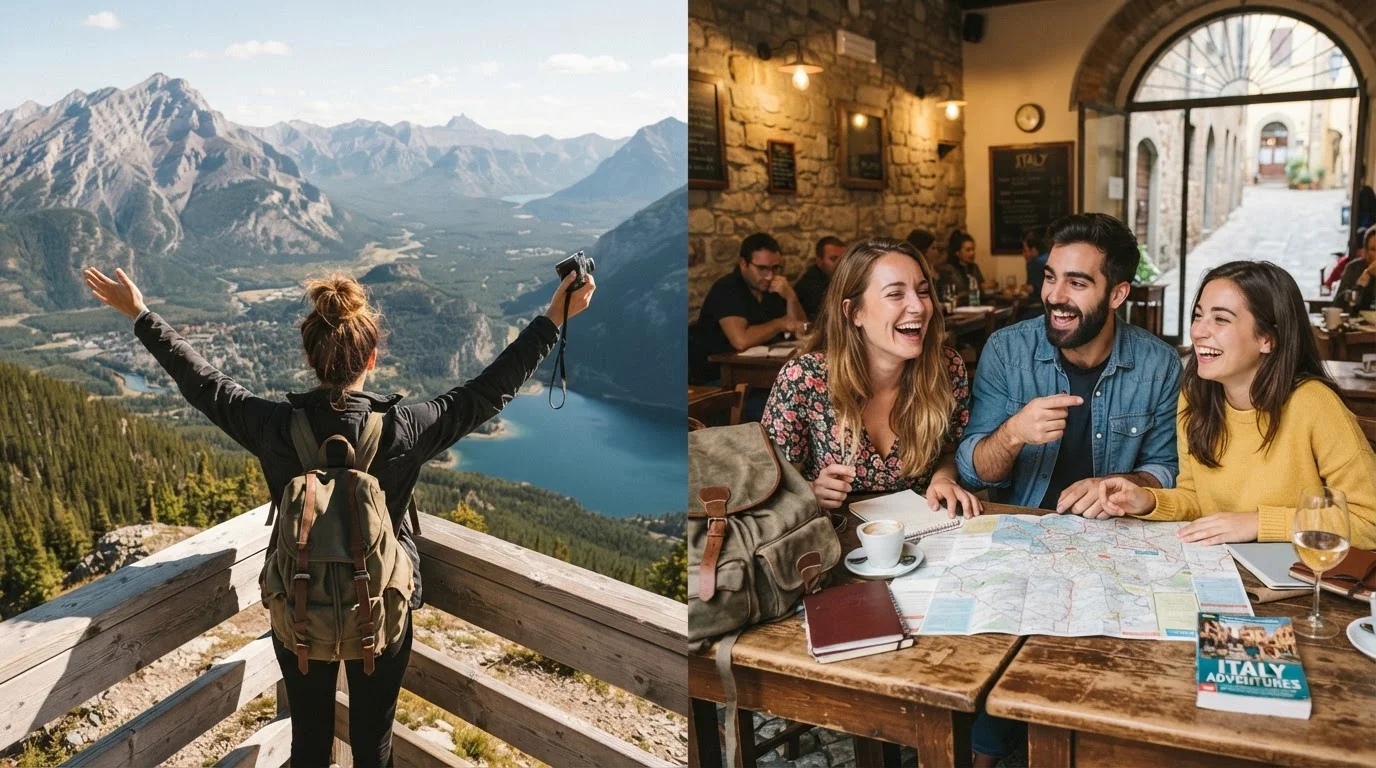
Key Takeaways
Complete autonomy over every decision
Solo travelers set their own schedule, choose activities based purely on personal interest, and can change plans without negotiating with anyone. This freedom is especially valuable in destinations that reward spontaneous exploration.
Deeper engagement with local culture
Without a built-in social buffer, solo travelers often interact more readily with locals and fellow travelers. Many report that going alone pushed them into conversations and connections they would have skipped in a group.
Easier last-minute and flexible booking
A single traveler can snap up one remaining seat on a tour, one open hostel bed, or a standby flight far more easily than a group trying to coordinate multiple spots simultaneously.
Personal pace and rhythm
You can linger where you want and move quickly through what doesn't interest you - no guilt, no waiting, no rushing. For travelers who find compromise exhausting, this alone justifies going solo.
Higher per-person accommodation costs
Single-occupancy rooms and single supplements on tours add up quickly. A solo traveler often pays 60-100% more per night for the same room than each person in a pair would pay when splitting the cost.
Greater personal safety responsibility
Without a travel companion to notice if something goes wrong, solo travelers carry the full burden of situational awareness, emergency planning, and decision-making under pressure - especially in unfamiliar destinations.
Coordination overhead grows with group size
Even a small group of three or four people requires significant logistics management: aligning schedules, agreeing on meals, managing pace differences, and resolving disagreements diplomatically.
Compromise can dilute individual experience
When group members have different interests or energy levels, everyone may end up doing activities that are no one's first choice. The result can feel like a lowest-common-denominator itinerary.
Group dynamics can create lasting friction
Travel has a way of magnifying personality differences and minor irritants. Even close friendships can feel strained after a week of spending every hour together - something few travelers anticipate in advance.
Our Verdict
Solo travel rewards those who prize autonomy, can handle unpredictability, and are comfortable making decisions on the fly - but it comes at a financial and logistical premium. Group travel softens costs, adds built-in companionship, and provides a practical safety net, though it demands patience and flexibility from everyone involved. Most experienced travelers end up doing both, matching the style to the trip rather than picking a permanent side.
Solo travel suits independent, adaptable travelers; group travel is ideal for those who value shared experiences, cost-splitting, or simply prefer company on the road.
The Real Difference Between Going Alone and Going Together
Choosing between solo and group travel isn't just a matter of who's available to join you - it's a fundamental decision about how you want to experience a place. Every aspect of a trip, from what you eat for breakfast to how late you stay out, gets shaped by this choice. Understanding the actual trade-offs - not the romanticized versions - helps you plan a trip that suits both your personality and your goals.
For a look at how travel style intersects with other major planning decisions, see our breakdown of slow travel vs. fast itineraries, which covers how pace choices affect the overall experience.
Complete autonomy over every decision
Solo travelers set their own schedule, choose activities based purely on personal interest, and can change plans without negotiating with anyone. This freedom is especially valuable in destinations that reward spontaneous exploration.
Deeper engagement with local culture
Without a built-in social buffer, solo travelers often interact more readily with locals and fellow travelers. Many report that going alone pushed them into conversations and connections they would have skipped in a group.
Easier last-minute and flexible booking
A single traveler can snap up one remaining seat on a tour, one open hostel bed, or a standby flight far more easily than a group trying to coordinate multiple spots simultaneously.
Personal pace and rhythm
You can linger where you want and move quickly through what doesn't interest you - no guilt, no waiting, no rushing. For travelers who find compromise exhausting, this alone justifies going solo.
The Case for Traveling Solo
Solo travel's biggest draw is control. You decide the destination, the pace, the budget allocation, and the daily agenda - full stop. If you want to spend an entire afternoon in one museum or pivot your plans because a local mentioned a better village down the road, nothing stops you. That kind of spontaneity is genuinely hard to replicate in a group setting.
Solo travelers also tend to engage more deeply with destinations. Without the social comfort of traveling companions, you're more likely to strike up conversations with locals, join a shared table at a restaurant, or sign up for a small-group tour where you'll meet fellow travelers organically. Ironically, going alone can be one of the more social ways to travel.
That said, solo travel carries real financial penalties. Single-occupancy hotel rooms typically cost more per night than a room split between two people. Many tour operators charge a single supplement - an added fee that essentially makes you pay for the spot that a second traveler would have filled. Stretching your travel budget as a solo traveler takes deliberate strategy. For practical safety considerations specific to traveling alone, our guide to solo travel safety habits covers the fundamentals.
~17%
Americans who traveled solo in past year
Survey data from travel industry research consistently shows solo travel is a growing segment, with a meaningful share of American adults having taken at least one solo trip.
50-100%
Typical single supplement range on tours
Tour operators commonly charge single travelers a supplement equal to 50-100% of the per-person double-occupancy rate, according to general industry pricing practices.
The Case for Traveling with a Group
Group travel's most immediate advantage is cost-sharing. Splitting a vacation rental, a hired car, or a private guide between four people instead of one changes the math dramatically. Meals, taxis, and day trips all become easier to justify when the bill is divided. This alone makes certain types of travel - a villa in the Italian countryside, say, or a multi-day safari - far more accessible.
There's also an emotional dimension that's easy to underestimate. Shared experiences tend to feel more memorable when they're witnessed together. The running jokes, the collective problem-solving when something goes sideways, and the simple pleasure of having someone to talk with over dinner are genuinely valuable - and not things you can manufacture after the fact.
The friction, though, is real. Group dynamics require compromise at almost every turn. When travelers in the same party have different energy levels, budgets, or interests, tension follows. Our article on planning trips with different comfort levels in the same group offers practical guidance for navigating exactly these situations.
Higher per-person accommodation costs
Single-occupancy rooms and single supplements on tours add up quickly. A solo traveler often pays 60-100% more per night for the same room than each person in a pair would pay when splitting the cost.
Greater personal safety responsibility
Without a travel companion to notice if something goes wrong, solo travelers carry the full burden of situational awareness, emergency planning, and decision-making under pressure - especially in unfamiliar destinations.
Coordination overhead grows with group size
Even a small group of three or four people requires significant logistics management: aligning schedules, agreeing on meals, managing pace differences, and resolving disagreements diplomatically.
Compromise can dilute individual experience
When group members have different interests or energy levels, everyone may end up doing activities that are no one's first choice. The result can feel like a lowest-common-denominator itinerary.
Group dynamics can create lasting friction
Travel has a way of magnifying personality differences and minor irritants. Even close friendships can feel strained after a week of spending every hour together - something few travelers anticipate in advance.
How to Choose the Style That Fits the Trip
The most useful reframe here is this: neither style is a permanent identity. Many travelers who describe themselves as devoted solo adventurers book group trips for specific destinations, and self-described group travelers frequently find that one trip alone changes their perspective entirely.
A few practical questions worth asking before you book:
- How familiar are you with the destination? Less-familiar places often benefit from the built-in safety net of a group.
- What's your budget flexibility? Solo travel at equivalent comfort levels typically costs more. If budget is a constraint, sharing expenses makes a meaningful difference.
- How firm is your itinerary? If you want maximum flexibility, group travel will require real compromise. If you're planning a structured itinerary anyway, the coordination cost of a group is lower.
- What do you actually want from this trip? Reflection and independence, or connection and shared memories?
Group travel also intersects with how you get there. For decisions about transportation itself, our road trip vs. flying comparison is worth reading alongside this one - group road trips, in particular, have their own distinct dynamics.
Organized Group Tours: A Middle Ground
Joining a structured tour - whether through a travel company or a loosely organized meetup group - lets you capture some benefits of both styles. You get built-in company and group pricing without having to coordinate logistics yourself, while still meeting new people rather than relying on an existing social circle. The trade-off is less flexibility on itinerary and pace, since the group follows a set program.