

Key Takeaways
Option A
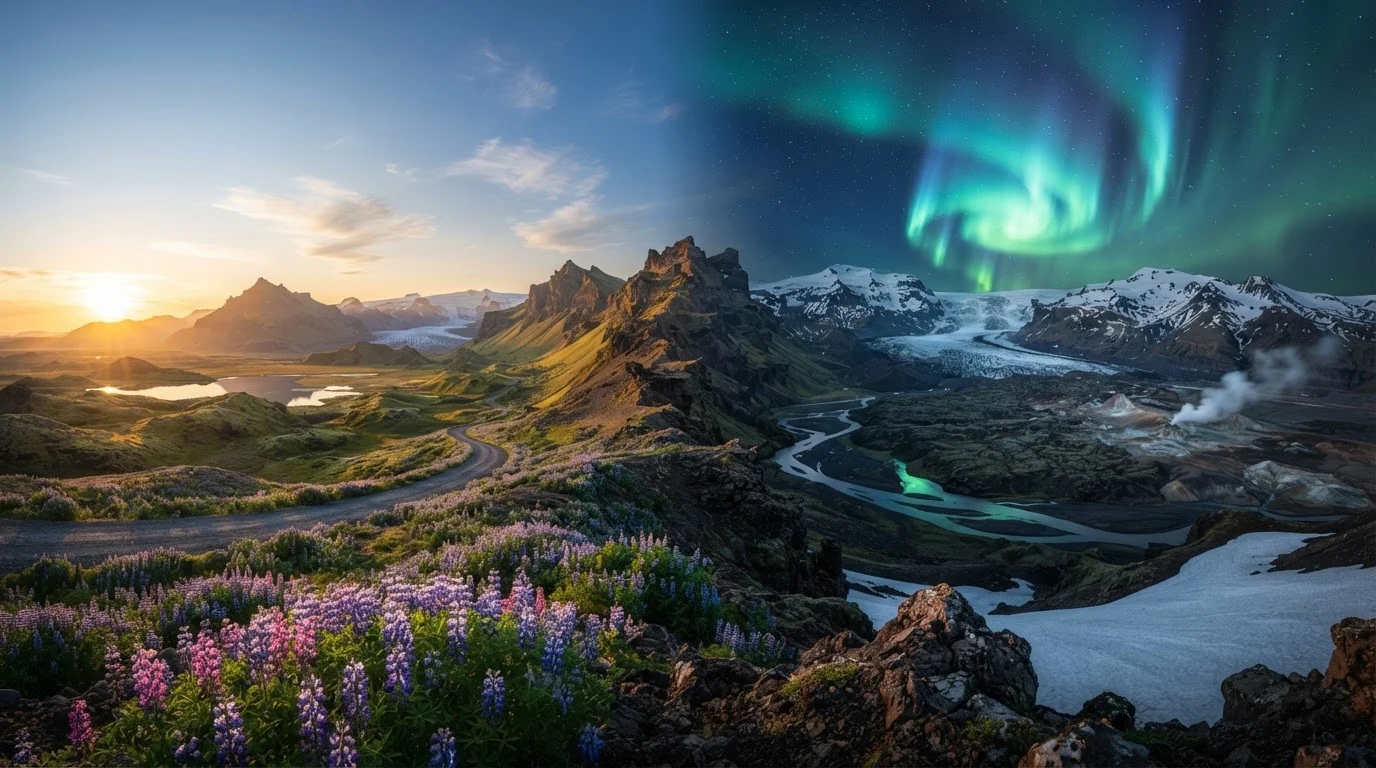
Iceland in Summer
The land of endless daylight and open roads.
Best for: Travelers who want maximum accessibility, hiking, and wildlife without battling the cold.
Option B
Iceland in Winter
A raw, moody frontier lit by the northern lights.
Best for: Adventurers chasing the aurora, ice caves, and an Iceland few others see.
If you want to hike, explore the Highlands, and maximize daylight sightseeing
Iceland in Summer
Highland F-roads open only from late June to September, unlocking destinations like Landmannalaugar and Þórsmörk that are completely inaccessible in winter.
If seeing the northern lights is your primary goal
Iceland in Winter
The aurora borealis requires darkness - summer's midnight sun makes it impossible to witness. November through February offers the longest dark windows for viewing.
If you're a first-time visitor who wants fewer logistical challenges
Iceland in Summer
More daylight, milder temperatures, and fully open roads make navigation far more forgiving for travelers unfamiliar with Iceland's unpredictable conditions.
If you want a more intimate, less crowded experience
Iceland in Winter
Tourism drops significantly outside peak summer months, meaning popular sites like the Blue Lagoon area and Geysir feel far less overwhelmed with visitors.
If glacier and ice cave exploration is on your bucket list
Iceland in Winter
Crystal ice caves inside Vatnajökull are only accessible from November through March, when freezing temperatures keep internal structures safe for guided tours.
Daylight, Darkness, and What That Actually Means for Your Trip
Iceland's relationship with light is unlike anywhere most Americans have experienced. In June, Reykjavík sees roughly 22 hours of daylight - the sun dips briefly below the horizon but never fully disappears. In January, the reverse is true: the city gets around five hours of usable daylight, with sunrise around 11 a.m. and sunset before 4 p.m.
This isn't just a novelty - it fundamentally reshapes what you can do. Summer's extended light means you can hike until midnight, photograph waterfalls in golden-hour glow at 10 p.m., and feel no urgency to rush through a site list. Winter's abbreviated daylight demands disciplined planning: you'll want to be at outdoor landmarks before early afternoon and shift to indoor or evening experiences after dark.
For families or travelers who find nighttime disorienting, summer's brightness is reassuring. For photographers and aurora-chasers, winter's darkness is the entire point.
| Criterion | Iceland in Summer | Iceland in Winter |
|---|---|---|
| Daylight | Up to 22+ hours | 4-6 hours |
| Northern Lights | Not visible | Prime viewing season |
| Ice Cave Access | Closed - unsafe | Open Nov-Mar (guided) |
| Highland F-Roads | Open late June-September | Closed entirely |
| Puffin Watching | Available May-August | Not available |
| Crowd Levels | Peak - very busy in July | Significantly quieter |
| Driving Conditions | Generally straightforward | Ice, storms, closures possible |
| Average Reykjavík Temp | ~50-55°F (10-13°C) | ~28-35°F (-2-2°C) |
Access, Roads, and What You Can Actually Reach
Iceland's interior Highlands - home to some of the country's most spectacular scenery - are completely off-limits in winter. The F-roads that lead to destinations like Landmannalaugar, the lava fields of Lakagígar, and the remote Kjölur route require high-clearance 4WD vehicles and only open when snow melts, typically late June, closing again by September or October.
The famous Ring Road (Route 1) circles the entire island and remains open year-round, though winter storms can cause temporary closures. Drivers should check road conditions at road.is before any winter journey and be comfortable with ice, limited visibility, and sudden weather changes.
Summer, by contrast, opens the country wide. All major waterfalls, black sand beaches, and national parks are accessible, and you can drive the Golden Circle or South Coast at any time of day. The tradeoff? You'll be sharing those roads with many more fellow travelers.
2.3M+
Annual visitors to Iceland
According to the Icelandic Tourist Board, Iceland welcomed over 2 million tourists annually before the pandemic, with summer accounting for the largest share.
~5 hrs
Daylight hours in January in Reykjavík
The Icelandic Met Office records average daily sunshine in Reykjavík dropping to approximately five hours during midwinter months.
140+
Volcanic mountains in Iceland
Iceland sits on the Mid-Atlantic Ridge with over 130 volcanic mountains, many of which are most dramatically seen under snow in winter or bathed in summer light.
Signature Experiences That Define Each Season
Summer exclusives: Puffin watching (these seabirds nest on Icelandic cliffs from May through August), whale watching from Húsavík in peak conditions, hiking Fimmvörðuháls between Eyjafjallajökull and Katla, and attending the Secret Solstice music festival near Reykjavík.
Winter exclusives: Crystal ice cave tours inside Vatnajökull - guided tours are the only safe option - northern lights viewing across rural Iceland, snowmobile excursions on glaciers, and the unique experience of soaking in a geothermal pool while snow falls around you.
Year-round highlights: The Golden Circle (Þingvellir, Geysir, Gullfoss), the South Coast waterfalls at Seljalandsfoss and Skógafoss, whale watching from Reykjavík, and the Blue Lagoon geothermal area remain accessible in both seasons - though winter visits to outdoor sites require more weather flexibility.
A Word on Weather - In Any Season
Iceland's weather is notoriously changeable year-round. The local saying 'if you don't like the weather, wait five minutes' applies in both summer and winter. Layered, waterproof clothing is essential regardless of when you visit. Summer storms are milder but still common, while winter can bring whiteout conditions with little warning. Always check forecasts from the Icelandic Met Office (vedur.is) before heading out, and build flexibility into your daily plans.
Crowds, Cost, and Realistic Expectations
July is Iceland's busiest and most expensive month. Accommodation in Reykjavík and along the South Coast fills quickly, campsites grow crowded, and popular sites can feel more like theme parks than wilderness. Booking flights and lodging at least four to six months ahead is strongly advisable for summer travel.
Winter - particularly November and February outside of the Christmas and New Year window - is noticeably quieter and sometimes more affordable, though savings vary. The tradeoff is weather unpredictability: blizzards, high winds, and icy roads are real considerations, not minor footnotes. Rental agencies typically recommend 4WD vehicles for winter travel, which affects cost.
One honest note on the aurora: seeing the northern lights is never guaranteed. Clear skies, geomagnetic activity, and darkness all need to align. Most visitors staying five or more nights in winter have reasonable odds of a sighting, but one- or two-night trips carry higher disappointment risk. Check aurora forecast apps (the Icelandic Met Office provides one) to set realistic expectations before your trip.