

Key Takeaways
Rising Interest Rates (Housing Context)
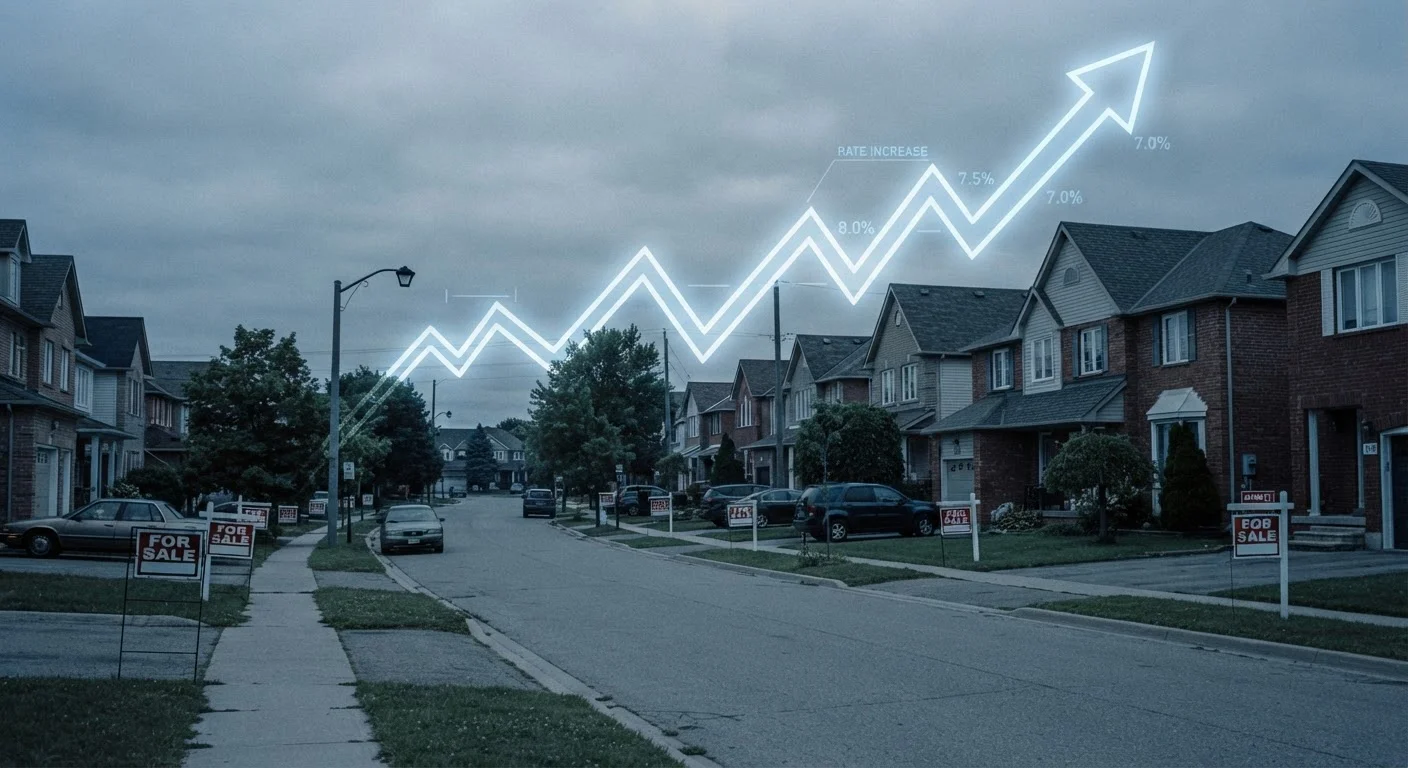
When central banks raise benchmark interest rates, mortgage lenders typically follow by charging borrowers more to finance a home purchase. This means buyers who take out a loan pay more each month for the same home price - which in turn affects how many people can afford to buy, how sellers price their homes, and how much new construction gets built.
Mortgage rates are closely tied to yields on 10-year U.S. Treasury bonds, not directly to the Federal Reserve's federal funds rate - though the two often move in the same direction.
The Most Direct Effect: What Rates Do to Affordability
The most immediate impact of rising interest rates is straightforward: borrowing money to buy a home becomes more expensive. If the mortgage rate on a 30-year fixed loan climbs from 4% to 7%, the monthly payment on a $350,000 loan jumps by several hundred dollars - without the purchase price changing at all.
That payment increase translates directly into reduced purchasing power. A buyer who could comfortably afford a $400,000 home at lower rates may only qualify for $320,000 once rates rise. Lenders assess borrowers based on debt-to-income ratios, so as payments grow, the price range buyers can access shrinks accordingly.
For a deeper look at how these factors connect, see how the housing market works as a starting point, and fixed-rate vs. adjustable-rate mortgages for how loan structure affects exposure to rate changes.
~$250
Approx. monthly payment increase per 1% rate rise
Based on a $400,000, 30-year fixed-rate loan; actual amounts vary by loan balance and terms.
23%
Drop in existing home sales during 2022-2023 rate surge
The National Association of Realtors reported a sharp sales decline as mortgage rates climbed from historic lows to multi-decade highs.
3.5M+
Estimated U.S. housing unit shortage
Research from Freddie Mac and other housing analysts has estimated a multi-million-unit structural supply deficit built up over more than a decade.
How Demand and Home Prices Respond
When affordability drops, fewer buyers enter the market. Fewer buyers competing for the same homes means sellers have less leverage - leading to slower price growth, more days on market, and in some cases, outright price reductions.
This doesn't mean prices always fall. If housing supply is already very low - as it has been in many U.S. metro areas - prices can remain stubborn even as buyer demand softens. The result is often a market that feels frozen: prices haven't crashed, but activity has slowed sharply and homes sit longer before selling.
Why home prices rise and fall covers the broader set of forces at work beyond interest rates alone, including local employment trends and population shifts.
The Inventory Paradox: Why Rising Rates Tighten Supply
One of the less obvious effects of rising rates is their impact on housing supply. During periods of low rates, millions of homeowners refinanced or purchased at historically low mortgage rates - some locking in rates below 3%. When rates climb well above those levels, those homeowners have little financial incentive to sell and take on a new, more expensive mortgage elsewhere.
This dynamic, sometimes called the rate lock-in effect, keeps existing homes off the market. The result is a paradox: rising rates reduce buyer demand and reduce available supply at the same time. That's part of why housing markets can feel stalled during high-rate environments rather than simply correcting downward.
For more on how inventory shapes pricing, see what housing inventory means and why it moves prices.
Rates Don't Act in Isolation
Interest rates are a major market force, but they interact with employment levels, local population growth, zoning laws, and consumer confidence. A region with strong job growth and very limited land for new construction may see prices hold even when rates are high, while a market with weaker fundamentals may correct more sharply. Context always matters when interpreting rate effects.
Effects on New Construction and Long-Term Supply
Rising rates also slow the pipeline of new homes. Developers and homebuilders typically rely on construction loans - and higher rates increase the carrying cost of those loans. If builders expect that the finished homes will be harder to sell at prices that cover their costs, many projects get delayed or canceled.
This matters beyond the current market cycle. A slowdown in construction today means fewer homes available in three to five years. The U.S. has faced an ongoing housing undersupply for well over a decade, and periods of elevated rates have historically deepened that gap rather than correcting it.
The combined effect on buyers, sellers, and builders is explored further in our complete guide to how the housing market works.
This article is for general educational purposes only and does not constitute financial, mortgage, or investment advice. Readers should consult a licensed mortgage professional or financial adviser for guidance specific to their situation.