

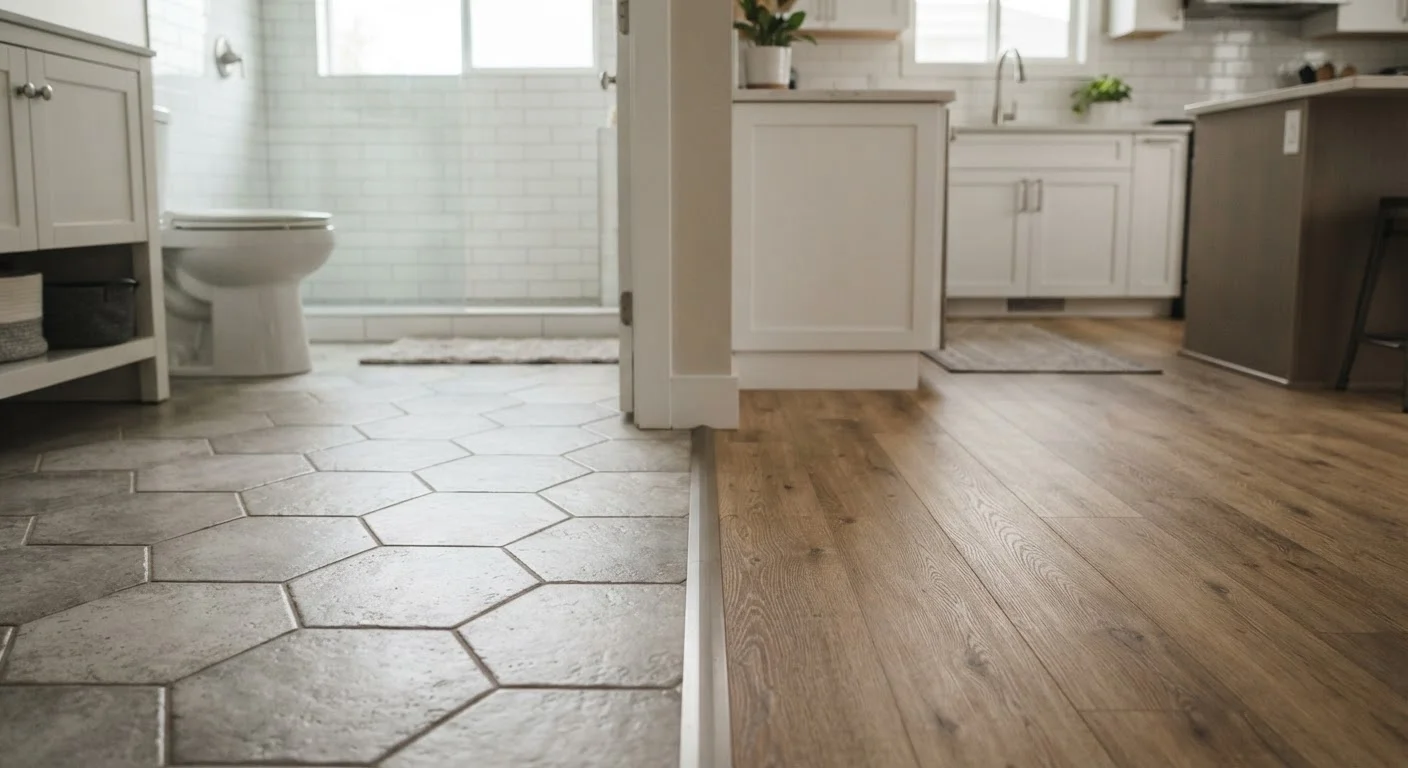
Key Takeaways
Option A
Ceramic or Porcelain Tile
The time-tested, hard-wearing classic for wet spaces.
Best for: Homeowners who want maximum durability, a permanent finish, and don't mind a more involved installation process.
Option B
Luxury Vinyl Plank (LVP)
The flexible, DIY-friendly modern alternative.
Best for: Homeowners who prioritize comfort underfoot, faster installation, and lower upfront cost.
If you want a floor that will last decades with zero replacement
Ceramic or Porcelain Tile
Properly installed tile can outlast the house itself. It handles heat, heavy appliances, and constant moisture better than any other flooring type.
If you're installing the floor yourself over a weekend
Luxury Vinyl Plank (LVP)
LVP's click-lock system requires no mortar, no grout, and far fewer specialty tools, making it genuinely manageable for confident DIYers.
If your household includes young children or elderly family members
Luxury Vinyl Plank (LVP)
LVP has a slight give underfoot that reduces fatigue and is less punishing on knees and hips - a meaningful comfort advantage over hard tile.
If you're renovating a bathroom that already has a mud-set or concrete subfloor
Ceramic or Porcelain Tile
Tile adheres excellently to concrete substrates and handles standing water and steam from showers without any risk of edge lifting or seam separation.
If you're working with a tight renovation budget
Luxury Vinyl Plank (LVP)
Material costs are generally lower and labor savings from DIY installation can significantly reduce total project cost compared to professional tile work.
Moisture Resistance: How Each Floor Holds Up to Water
In bathrooms and kitchens, water resistance isn't optional - it's the starting point. Understanding where each material actually stands helps you choose the right fit for your specific space.
Ceramic and porcelain tile is genuinely waterproof at the tile surface itself. Porcelain, in particular, has a very low water absorption rate (typically under 0.5%), making it nearly impervious to moisture. The vulnerability with tile is the grout. Unsanded or improperly sealed grout can absorb water over time and allow moisture to penetrate the subfloor. Keeping grout sealed - generally recommended every one to three years - is the most important maintenance task for a tiled bathroom or kitchen floor.
Luxury vinyl plank is water-resistant throughout its core, and many products marketed as "100% waterproof" use a rigid WPC (wood-plastic composite) or SPC (stone-plastic composite) core that won't swell or warp when wet. However, standing water that sits at seams or edges for extended periods can still work its way to the subfloor over time. Proper installation with sealed edges and transitions matters.
| Criterion | Ceramic / Porcelain Tile | Luxury Vinyl Plank (LVP) |
|---|---|---|
| Water resistance | Waterproof surface; grout needs sealing | Water-resistant to waterproof core |
| Typical installed cost | Higher (labor-intensive) | Lower, especially DIY |
| DIY difficulty | High - requires specialty tools and skill | Moderate - click-lock, no mortar |
| Comfort underfoot | Hard and cold | Softer, slight give |
| Lifespan | 20-50+ years | 15-25 years |
| Maintenance | Grout sealing required periodically | Sweep and damp mop; no sealing |
| Repair ease | Difficult to match; individual tile swap hard | Individual planks replaceable |
| Subfloor tolerance | Must be very flat and rigid | Tolerates minor imperfections |
Installation Complexity and DIY Feasibility
This is one of the sharpest differences between the two materials - and it directly affects your total cost if you're hiring out the work.
Tile installation is a multi-step process. The subfloor must be flat, solid, and often needs a cement backer board layer before any tile goes down. You'll need thin-set mortar, spacers, a tile saw, and grout - plus the patience to let each phase cure before moving to the next. The entire process from prep to grouted finish typically takes two to four days for a standard bathroom. Most homeowners hire a professional tile setter, and that labor cost is significant.
LVP installation is considerably more approachable. Click-lock planks float over the existing subfloor without adhesive (in most cases), and a standard kitchen or bathroom can be completed in a single day. You'll still need the subfloor to be reasonably level - LVP manufacturers typically specify no more than 3/16 inch variation over a 10-foot span - but minor imperfections are more forgiving than with tile.
Check Your Subfloor Before You Commit
Both tile and LVP installation can be derailed by a subfloor that's too flexible, too uneven, or has existing moisture damage. Before purchasing materials, inspect your subfloor for soft spots, squeaks, or visible water staining. A flooring installer or general contractor can assess whether prep work - such as adding backer board or sistering joists - is needed before any new floor goes down. Skipping this step is the most common cause of premature floor failure in both materials.
Cost, Longevity, and What to Expect Over Time
Neither flooring type is inherently cheap when you account for materials and professional installation, but the cost profiles differ in meaningful ways.
$7-$14
Avg. installed cost per sq. ft. for tile
Cost estimates from remodeling industry sources vary by region, tile type, and labor market conditions.
$4-$9
Avg. installed cost per sq. ft. for LVP
DIY installation can reduce this figure significantly by eliminating professional labor costs.
12 mil+
Recommended minimum wear layer for residential LVP
Flooring industry guidance suggests a thicker wear layer provides meaningfully better scratch and dent resistance in high-traffic areas.
Tile has a higher installed cost on average, driven largely by labor. The payoff is longevity: a well-installed tile floor in a bathroom can remain in excellent condition for 20 to 30 years or more. Cracked individual tiles are the most common repair, and matching an existing tile for a spot repair can be difficult if the product has been discontinued - a practical reason to keep a small stock of extra tiles after installation.
Quality LVP (look for a wear layer of at least 12 mil for residential use) typically carries warranties of 15 to 25 years, though actual lifespan depends heavily on traffic and care. LVP is susceptible to damage from very heavy, sharp point loads - such as appliance legs without floor protectors - and can be gouged or dented in ways tile generally won't be. On the upside, a damaged plank can often be replaced individually without disturbing the rest of the floor.
For maintenance, tile requires periodic grout sealing and prompt attention to cracked grout lines. LVP needs only regular sweeping and damp mopping with a pH-neutral cleaner - no sealing required.