

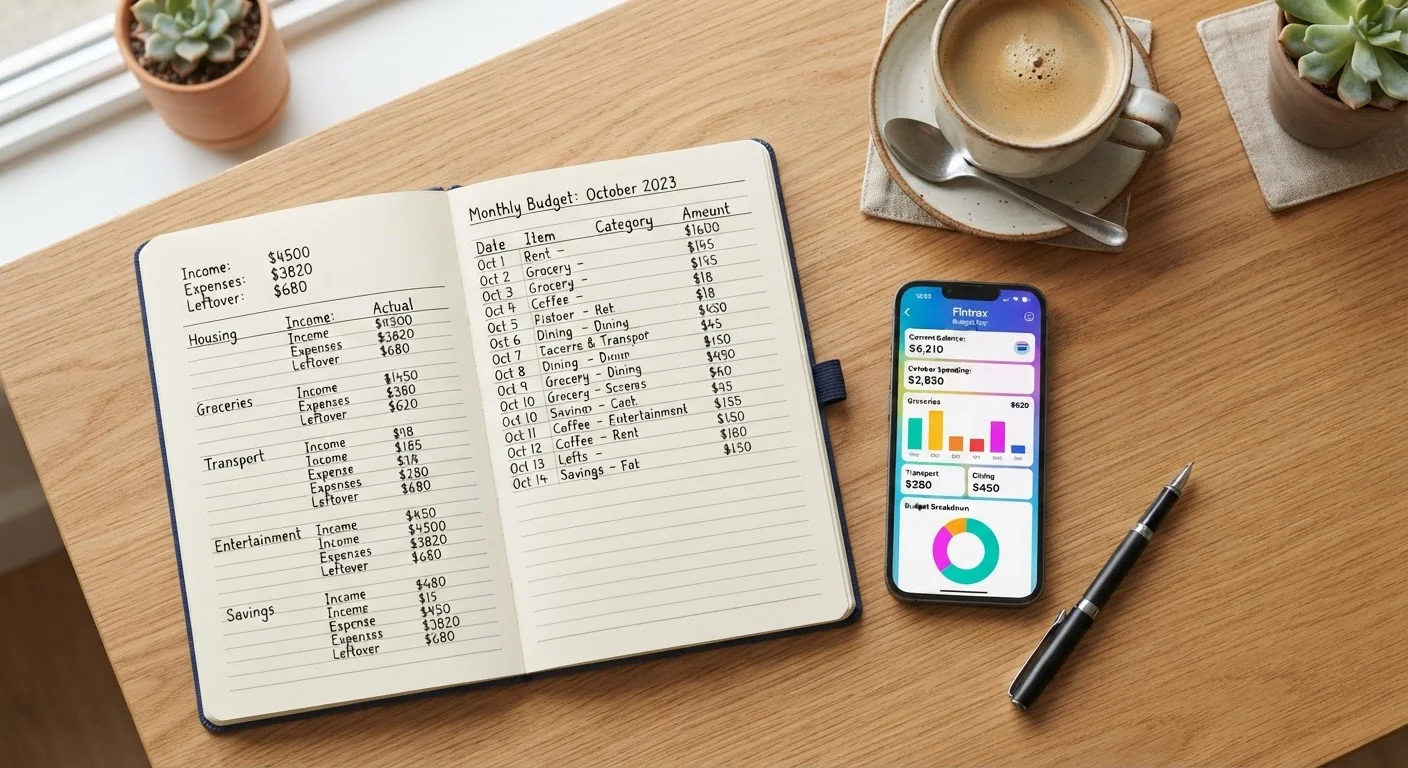
Key Takeaways
Option A
Paper Budgeting
The intentional, tactile approach to tracking money.
Best for: People who retain information better when writing by hand and want zero digital distractions.
Option B
Budgeting Apps
The automated, always-available digital alternative.
Best for: People who want real-time spending visibility and can't dedicate time to manual record-keeping.
If you're building a budget habit from scratch
Paper Budgeting
The friction of writing by hand forces deliberate engagement with every dollar, which helps new budgeters internalize spending patterns more deeply.
If you have a complex financial picture with multiple accounts
Budgeting Apps
Apps can consolidate data from checking, savings, and credit accounts automatically, saving hours of manual reconciliation each month.
If you've abandoned budgets before due to inconsistency
Budgeting Apps
Automated syncing and push notifications lower the barrier to daily check-ins, making it easier to stay engaged between dedicated budget sessions.
If you're concerned about financial data privacy
Paper Budgeting
A notebook shared with no server carries no data-breach risk - a meaningful advantage for those uncomfortable linking bank credentials to third-party platforms.
Why the Method Matters as Much as the Budget Itself
Most budgeting advice focuses on which framework to use - the 50/30/20 rule, zero-based budgeting, the envelope method. But the format you use to actually run that framework may determine whether it lasts past the first month. See our complete personal budgeting guide for a full walk-through of building a budget from the ground up.
The core question here is simpler: does putting pen to paper create more financial clarity than tapping through an app - or is that just nostalgia? The honest answer depends on how your brain processes information and how your daily life is structured.
| Criterion | Paper Budgeting | Budgeting Apps |
|---|---|---|
| Setup effort | Low - pen and paper only | Moderate - account linking required |
| Transaction tracking | 100% manual entry | Largely automated |
| Real-time visibility | Limited to last entry | Near real-time with syncing |
| Privacy risk | None - fully offline | Requires bank credential sharing |
| Cost | Free or minimal | Free tiers or monthly subscription |
| Cognitive engagement | High - reinforced by writing | Variable - passive if not reviewed |
| Best for multiple accounts | Cumbersome to manage | Well-suited - aggregates all accounts |
The Case for Budgeting on Paper
Research in cognitive science consistently finds that handwriting engages deeper processing than typing. When you manually record every income source and expense, you're not just logging a number - you're forcing your brain to confront it. That friction is a feature, not a bug.
Paper budgets also have no learning curve, no subscription fee, no privacy policy, and no risk of a third party accessing your bank credentials. For many people - particularly those who are visually oriented or find apps overwhelming - a simple columnar notebook or printed template is enough.
The envelope method, one of the oldest cash-based budgeting systems, is inherently paper-based: you allocate physical cash to labeled envelopes and stop spending in a category when the envelope is empty. That tactile reality check is difficult to replicate digitally. You can learn more about how this compares to other frameworks in our comparison of the 50/30/20 rule, zero-based budgeting, and the envelope method.
Primary limitations: Paper budgets require consistent manual entry, offer no automatic transaction import, and can become unwieldy if you have many accounts. A missed week of entries can render the whole record unreliable.
~33%
Americans with a formal written budget
Gallup polling has consistently found that fewer than half of U.S. adults maintain a detailed household budget, regardless of income level.
76%
Adults who say budgeting reduces financial stress
The American Psychological Association's Stress in America surveys regularly identify finances as the leading source of stress, with structured planning cited as a key mitigator.
The Case for Budgeting Apps
The most significant advantage of budgeting apps is automation. Most connect directly to bank and credit card accounts, pulling in transactions and categorizing them without manual input. For households juggling multiple income streams or several credit cards, this aggregation alone saves considerable time.
Apps also offer visualizations - pie charts of spending by category, trend lines across months - that make patterns visible in ways a handwritten ledger rarely can. Some send alerts when you approach a spending limit, adding a real-time accountability layer that paper cannot.
Primary limitations: Apps introduce real trade-offs. Connecting a financial app to your bank accounts involves sharing login credentials or read-only access tokens with a third-party company. Understand their data practices before committing. Additionally, automatic categorization is often imperfect - a restaurant charge may appear under "Entertainment" rather than "Dining" - so some manual review is still necessary to keep the data meaningful. If you're weighing apps more broadly, understanding the trade-offs of strict budgeting is a useful companion read.
Making Either Method Stick Long Term
Whichever format you choose, the habits you build around it matter more than the tool itself. A monthly review is essential for both methods - use our monthly budget review checklist to run through key checks at the end of each month. And for the longer arc of consistency, see habits that make budgets work over the long term.
Some people find a hybrid approach most effective: an app for automated transaction tracking paired with a weekly ten-minute paper review where they write down what they notice and adjust the following week's plan. This captures the automation benefit of apps while preserving the intentional engagement that handwriting provides.
The budget that works is the one you return to consistently - not the one with the most features or the most color-coded categories. Start with the format that feels most natural, give it a full 60 days, and evaluate honestly whether it's giving you clearer sight lines into your spending.
This article is for general informational and educational purposes only and does not constitute personalized financial or investment advice. Consult a qualified financial professional for guidance tailored to your specific circumstances.