

Key Takeaways
Start here
What Is Graduated Driver Licensing?
Next
Stage One: The Learner's Permit
Then
Stage Two: The Restricted License
After that
Stage Three: Full Licensure
Finally
Why GDL Laws Exist - and What the Research Shows
What Is Graduated Driver Licensing?
Graduated driver licensing - commonly abbreviated as GDL - is a structured system that introduces new teen drivers to full road privileges in stages rather than all at once. Every U.S. state has adopted some version of GDL, though the specific age thresholds, required practice hours, and restrictions vary from state to state.
The core idea is straightforward: driving skill and hazard recognition develop with experience, and crash risk is highest when that experience is lowest. By separating licensure into distinct phases, GDL gives teens the opportunity to build competence in lower-risk conditions before they face the full range of driving situations on their own.
Graduated Driver Licensing (GDL)
A multi-stage licensing system that gives new teen drivers limited privileges first, expanding them as the driver gains experience and demonstrates safe behavior.
Learner's Permit
An entry-level credential that allows a teen to practice driving only when accompanied by a licensed adult supervisor.
Restricted License
A provisional license that allows unsupervised driving but places limits on nighttime hours and passenger numbers until the driver meets additional requirements.
Nighttime Restriction
A GDL rule that prohibits a restricted-license holder from driving unsupervised during specified late-night and early-morning hours.
Zero-Tolerance Law
A rule that sets the legal blood alcohol concentration for drivers under 21 at or near zero, lower than the standard adult limit of 0.08%.
Stage One: The Learner's Permit
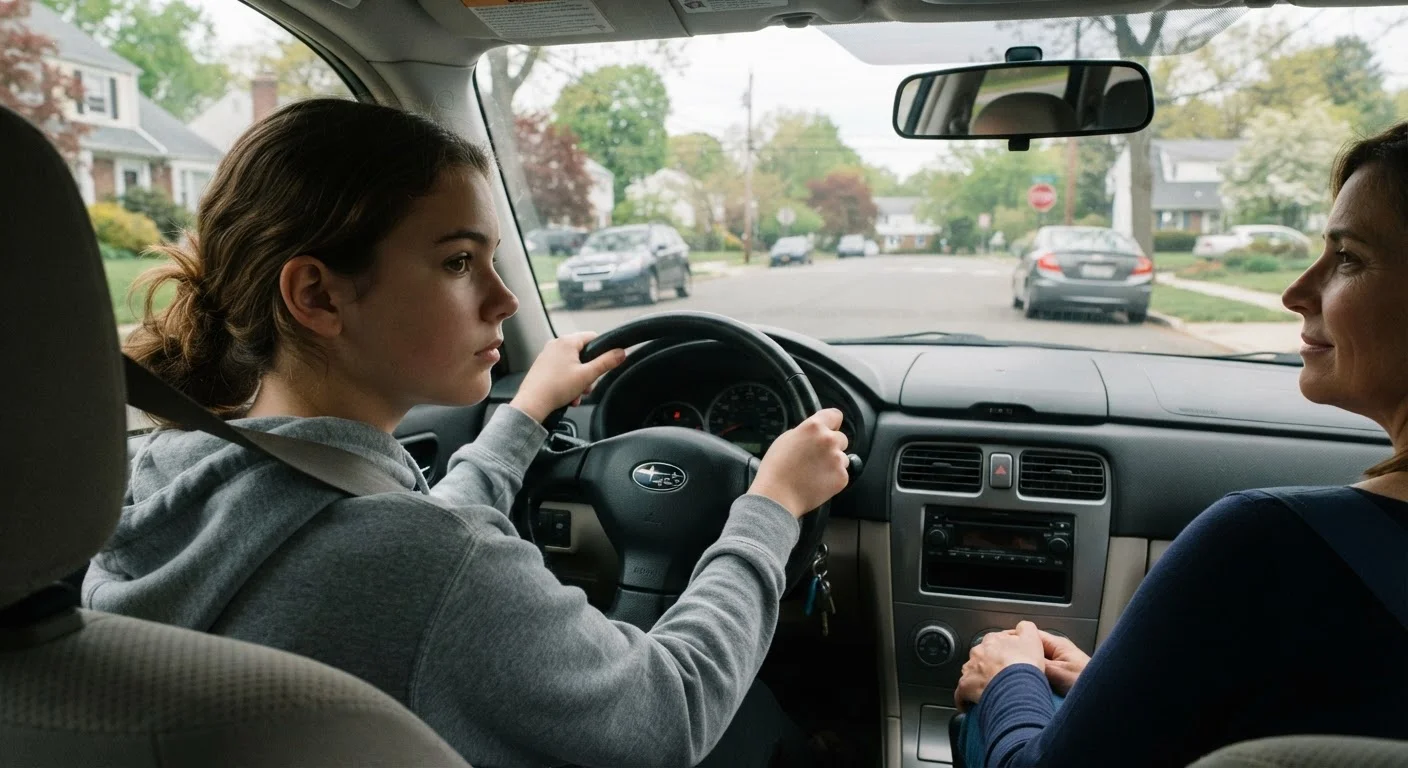
The first stage begins with a learner's permit, issued after a teen passes a written knowledge test covering traffic laws, road signs, and safe driving practices. Permit holders must always drive with a licensed adult supervisor - typically age 21 or older - in the front passenger seat.
During this stage, teens accumulate supervised driving hours. Most states require between 40 and 60 logged hours, with a portion mandated at night. The permit stage typically lasts a minimum of six months, though many states specify longer periods before a teen can advance.
Log Hours Accurately From the Start
Many states require parents or guardians to certify the supervised hours a permit holder has completed. Use a driving log - even a simple paper form - to track dates, conditions, and miles from the very first practice session. Accurate records prevent delays when it's time to apply for the restricted license.
Stage Two: The Restricted License
After passing a road skills test and meeting the supervised-hours requirement, a teen receives a restricted (or provisional) license. This allows unsupervised driving but imposes specific conditions designed to address the two highest-risk scenarios for new drivers: nighttime driving and peer passengers.
- Nighttime restrictions: Most states prohibit unsupervised driving between approximately 11 p.m. and 5 a.m., though exact curfew hours differ by state. Exceptions are usually granted for work, school activities, or emergencies.
- Passenger restrictions: Many states limit the number of non-family teen passengers a restricted driver may carry - often to zero or one during the first several months.
- Zero-tolerance alcohol rules: Every state enforces a zero or near-zero blood alcohol limit for drivers under 21, and violations during the restricted stage carry especially serious consequences.
Violating any restriction can result in fines, an extended restricted period, or suspension. These violations may also generate points on a driving record - a system explained in our guide to how license demerit point systems work.
Stage Three: Full Licensure
A teen advances to a full, unrestricted license after holding the restricted license for a state-specified period - typically six months to one year - without violations, and after reaching the minimum age set by their state (commonly 17 or 18). Some states require an additional road test or completion of a driver education course.
At this point, nighttime and passenger restrictions are lifted. However, general traffic laws, zero-tolerance alcohol policies for drivers under 21, and cell phone restrictions continue to apply just as they do for adult drivers.
Why GDL Laws Exist - and What the Research Shows
Teen drivers are overrepresented in crash statistics relative to their share of miles driven. Factors include limited hazard perception, susceptibility to distraction - particularly from passengers and mobile devices - and difficulty managing higher-speed or nighttime conditions. GDL restrictions directly target the scenarios where crash risk is statistically elevated.
Research published by organizations such as the Insurance Institute for Highway Safety (IIHS) has found that stronger GDL laws are associated with meaningful reductions in teen crash rates. States that extended the learner's permit period, lowered nighttime curfew hours, or tightened passenger limits saw measurable improvements in teen driver safety outcomes.
GDL Violations Can Delay Full Licensure
A single violation during the restricted stage - such as driving past curfew or carrying too many passengers - can reset waiting periods or trigger a license suspension. Teens and their families should review their state's specific GDL rules carefully, since thresholds and penalties differ significantly across states.
GDL is not a guarantee of safety, and full licensure does not mean risk disappears. Developing good driving habits - consistent seatbelt use, phone-free driving, and scanning for hazards - remains a lifelong responsibility. Parents and guardians also play a meaningful role: teens whose families set clear expectations and model safe behavior tend to have better safety records.